
What Are Stainless Steel Bearing Units? SSUC, SSUCP, SSUCF, and SSUCFL Explained
Stainless steel bearing units are mounted bearing assemblies in which the bearing insert and the housing are supplied as a matched unit for shaft support in wet, corrosive or washdown-exposed machinery. The SSUC prefix is the common thread in LDK's stainless mounted-unit codes. The letters that follow it describe the housing family: SSUCP, SSUCF, SSUCFL, SSUCT2, SSUET and SSUEFC. The insert itself is listed separately as the SUC2 stainless steel bearing insert.
For a buyer new to pillow block bearings, the family names can look like a code wall. This guide keeps the question at the discovery stage: what these units are, how they relate to bearing inserts and housings, where they appear, and why a buyer might choose stainless rather than a standard painted cast iron unit.
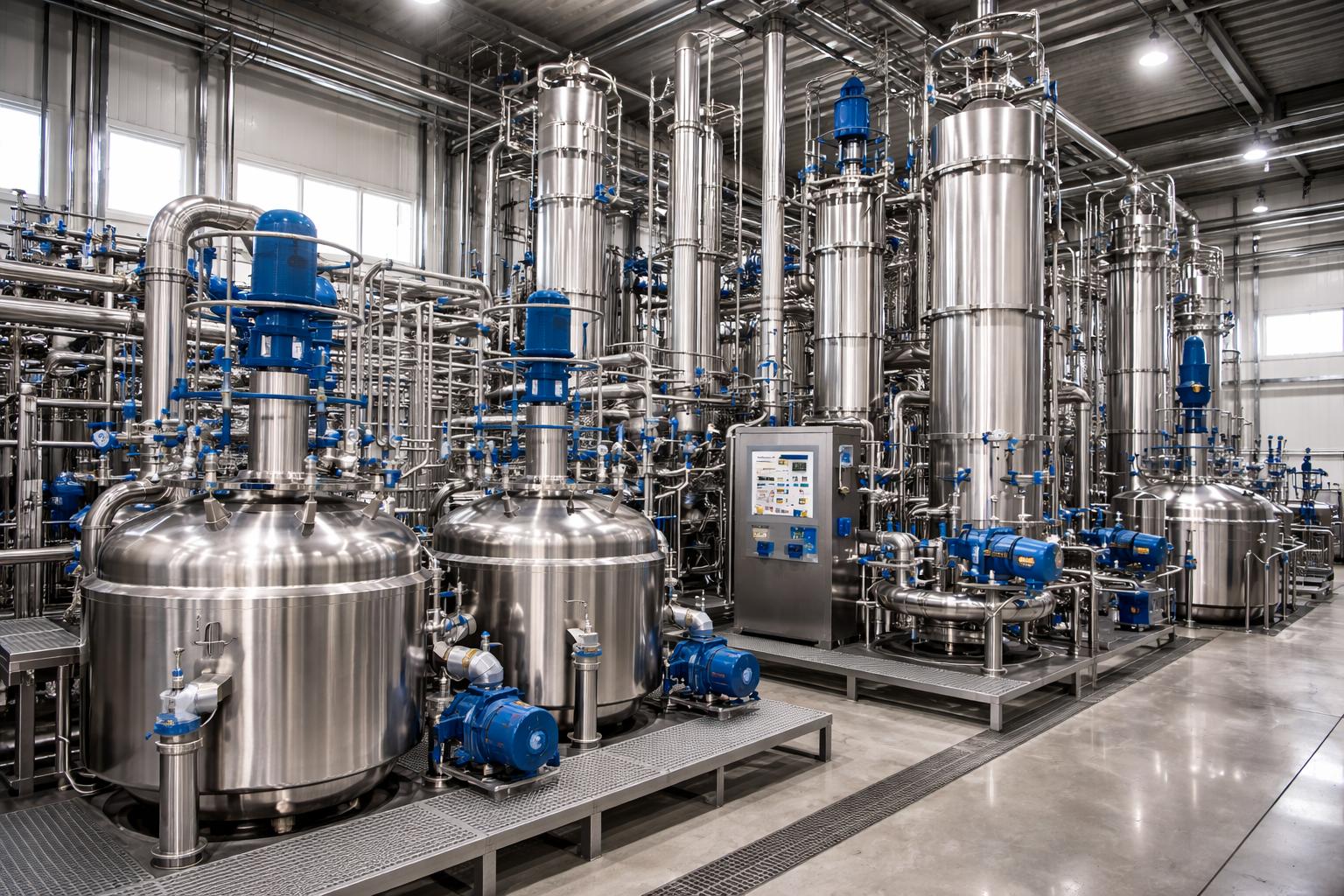
Stainless steel pillow block bearing units in a chemical-process application. Image source: LDK.
What a stainless steel bearing unit actually is
A mounted bearing unit is not a single loose bearing. It is an assembly with three practical parts: the insert bearing, the housing, and the locking device that holds the insert to the shaft. The insert carries the rolling elements and seals. The housing provides the mounting feet, flange or take-up frame interface. The locking device transfers shaft rotation to the insert inner ring.
In a stainless steel bearing unit, the material choice extends beyond the rolling elements. LDK's product portfolio lists all stainless-steel mounted ball bearing units alongside cast iron pillow blocks, thermoplastic housed units and other mounted families. The stainless insert range is listed as the SUC2 family, with models from SUC201 through SUC212-39 in the supplied data. The completed stainless units add a housing code, which is why the same insert logic appears under SSUCP, SSUCF, SSUCFL and related families.
The practical point for a buyer is simple: the unit code tells you the housing family, but it does not replace the shaft bore, housing drawing, locking style and certificate scope. Those items still need to be confirmed model by model.
Why the SSUC prefix matters
SSUC is best read as the shared prefix in LDK's stainless mounted-unit codes, not as one universal housing. The letter after the prefix identifies the mounting form. In common mounted-unit naming, P points to a pillow block, F to a four-bolt flange, FL to a two-bolt flange and T to a take-up frame. That naming logic helps a reader move from a family code to a mounting decision.
The insert is a separate layer. LDK lists the stainless insert as SUC2, with SUC201 to SUC212-39 and inch-size variants in the supplied model list. A buyer replacing a unit should therefore separate two questions: which insert fits the shaft, and which housing fits the machine frame. The SSUC code combines both answers, but it does not make every SSUCP interchangeable with every SSUCF or SSUCFL.
Industry background: where mounted units fit
Mounted ball bearing units are used where a rotating shaft needs support without a split plummer block or a custom bearing housing. They appear on conveyors, fans, food processing lines, packaging machines, agricultural equipment, wastewater equipment, car wash systems and printing or dyeing machinery. The housing bolts to the frame; the insert grips the shaft; the seal and grease retain the rolling element system.
LDK, a bearing manufacturer established in 1986, lists pillow block bearings, rod end bearings and spherical plain bearings among its main products. Its profile states 90,000 m² of factory space, 130 employees, annual output of 15,000,000 units and export coverage across Europe, North America, Latin America and Oceania. Those facts describe the manufacturing base, not a guarantee that every stainless unit suits every wet or chemical environment.
The problem stainless units solve
The problem is rarely just water. In food and beverage plants, the application data lists high humidity, frequent high-pressure washdown, cleaning agents with corrosive chemicals and wash water up to 80°C. In pharmaceutical machinery, the working condition is a GMP cleanroom with frequent cleaning and disinfection. In chemical plants, the risk is strong acid or alkali exposure. In wastewater treatment, the environment combines high humidity, sulfides and continuous operation. Car wash equipment sees spray, detergents and salt. Printing and dyeing equipment adds high temperature, steam, inks, solvents and dyes.
Stainless steel is one way to move the bearing unit away from painted cast iron and chrome steel in those environments. The housing and insert can be made corrosion-resistant by material choice rather than by a paint layer. That does not make stainless a universal answer. The alloy grade, seal, grease, surface finish and cleaning chemistry still determine service life.
LDK's stainless steel bearing unit families
LDK's stainless range is listed under several families. The supplied model lists include SSUCP2..A, SSUCF2..A, SSUCFL2..A, SSUCT2, SSUET and SSUEFC. The same product data also lists ESB and EHB variants, such as SSUCP2..ESB and SSUCF2..EHB, plus SSUCPA and SSUCPA..A. The model coverage in the main stainless series runs from 204 upward to 212 in several families, while SSUCFL2..A in the supplied list runs from SSUCFL204A to SSUCFL210-32A.
That breadth matters at the discovery stage. A buyer should not ask only for a generic stainless pillow block. The better question is which family, which model, which insert locking style and which certificate scope are needed. LDK's profile states insert bearing bore sizes from 10 mm to 140 mm and more than 100 combinations of materials and housing types across the wider portfolio. The stainless family should be selected from the actual model list, not from the family name alone.
| Family | Housing form in common mounted-unit naming | Model examples in the supplied stainless list | Buyer check |
|---|---|---|---|
| SSUCP | Pillow block with a two-bolt base | SSUCP204A through SSUCP212-39A in SSUCP2..A | Base dimensions, bore, locking style and frame height |
| SSUCF | Four-bolt flange | SSUCF204A through SSUCF212-39A in SSUCF2..A | Bolt spacing, flange size and mounting face |
| SSUCFL | Two-bolt flange | SSUCFL204A through SSUCFL210-32A in SSUCFL2..A | Oval flange dimensions, bolt centres and shaft load direction |
| SSUCT2 | Take-up frame unit | SSUCT204 through SSUCT212-39 | Take-up frame width, adjustment travel and shaft bore |
Family roles follow common mounted-unit naming. Final selection must be checked against the LDK model drawing and current catalog.
SSUCP, SSUCF, SSUCFL, SSUCT2, SSUET and SSUEFC in practice
SSUCP is the family most readers will recognise as a stainless pillow block. It supports a shaft above a frame or conveyor rail. SSUCF is the four-bolt flange family for a wall or machine face where the shaft passes through a plate. SSUCFL is the two-bolt flange family for a narrower mounting footprint. SSUCT2 is the take-up family for applications where the shaft position needs adjustment, such as a tensioning station.
SSUET and SSUEFC sit in the same stainless program but should not be guessed from the letters alone. The supplied data lists SSUET models from SSUET204 to SSUET212-39 and SSUEFC models from SSUEFC204 to SSUEFC212-39. A buyer should request the housing drawing, locking style and insert model for those families rather than assuming a direct swap with SSUCP or SSUCF.
The same discipline applies to SSUCPA and SSUCPA..A. They are listed as stainless steel bearing units, but the mounting interface must be read from the model data. This is the difference between a useful family overview and a costly interchange assumption.
Stainless versus standard mounted units
A standard LDK pillow block or flange unit commonly uses an HT200 cast grey iron housing with dark green paint and a chrome steel insert such as GCr15 or AISI52100. A stainless unit moves the housing and insert into the stainless material family. The trade-off is not a simple good-versus-better choice. It is a fit question between environment, mounting form and commercial constraint.
| Consideration | Stainless steel mounted unit | Painted cast iron / chrome steel unit |
|---|---|---|
| Housing material | Stainless steel housing in the SSUC family | HT200 cast grey iron with dark green paint in many standard LDK units |
| Insert material | Stainless steel insert, listed as SUC2 in the supplied data | Chrome steel GCr15 / AISI52100 in many standard units |
| Best fit | Wet, washdown, chemical, cleanroom, coastal or corrosion-exposed areas | Dry indoor frames and general conveying where corrosion is not the main risk |
| Main trade-off | Higher material and machining cost; certificate scope must be checked | Lower material cost; corrosion protection depends on paint and environment |
The comparison is about documented material and fit, not a claim that one unit is better in every duty. A stainless unit can still fail if the seal, grease or cleaning chemistry is wrong. A painted cast iron unit can still be the correct choice in a dry indoor frame where stainless adds cost without solving a real problem.
Where stainless steel bearing units appear
Food and beverage machinery is a common entry point because washdown and cleaning agents attack painted housings. The application data lists food processing, ice making, meat processing, canning, bottling and dairy equipment among the relevant areas, with corrosion resistance and easy-clean requirements.
Pharmaceutical machinery is another. The working condition is a GMP cleanroom with frequent cleaning and disinfection, low-to-medium load and continuous operation. Stainless units fit that cleaning regime when the correct seal and lubricant are selected.
Chemical processing, wastewater treatment, car wash systems and printing or dyeing equipment add different stresses. Chemical plants bring acid and alkali exposure. Wastewater brings high humidity and sulfides. Car wash brings spray, detergents and salt. Printing and dyeing brings heat, steam and process chemicals. In each case, the stainless unit is a material answer to a corrosion or washdown problem, not a substitute for application engineering.
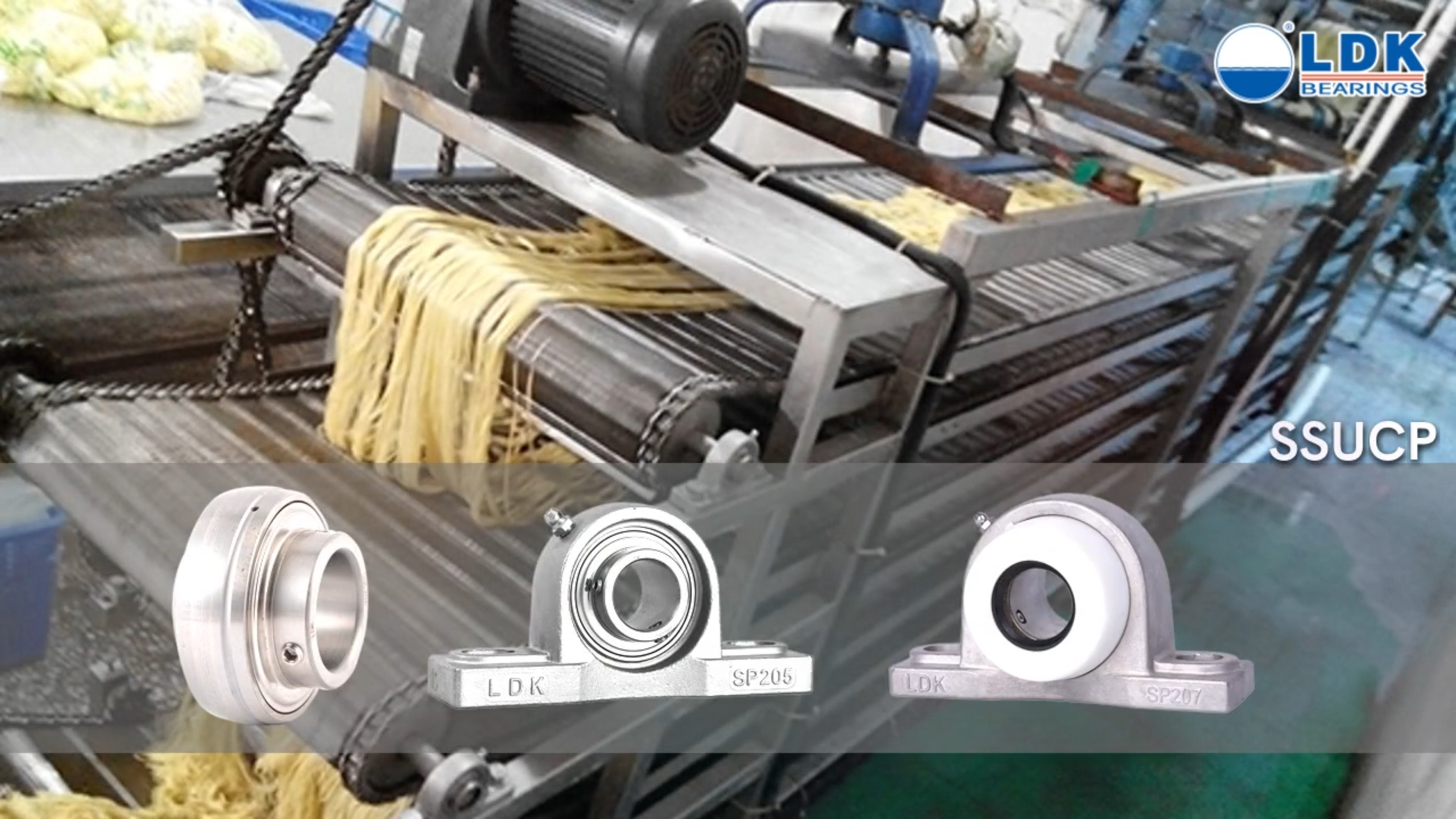
Stainless steel bearing units for food processing and beverage machinery. Image source: LDK.
How to specify a stainless unit: step by step
- Define the environment first. Record moisture, washdown frequency, cleaning chemicals, temperature, dust, load and duty cycle. A stainless unit selected only because the area is wet may miss the chemical or temperature constraint.
- Choose the housing form. Use SSUCP for a pillow block, SSUCF for a four-bolt flange and SSUCFL for a two-bolt flange. Use SSUCT2 only when the frame needs take-up adjustment.
- Select the insert and locking style. Confirm the shaft bore, insert series and locking method. The SUC2 stainless insert list is separate from the housing family list for a reason.
- Confirm the seal and grease. Washdown, food contact, high temperature and chemical exposure are different lubricant and seal questions. Do not treat them as one stainless material decision.
- Check certificate scope. Ask for the document that names the exact model, housing material and insert. A certificate for a related cast iron or thermoplastic product is not automatic coverage.
- Confirm commercial constraints. Check MOQ, lead time, packaging, private label needs and the availability of technical remote support before releasing a purchase order.
Compliance and certificate scope: what to check
Stainless steel is a material statement, not a compliance certificate. LDK's supplied compliance data includes management-system certificates, SGS RoHS verification reports and a TÜV Rheinland food-contact test report. Each document has a defined scope. The buyer's task is to match that scope to the exact stainless unit being ordered.
| Document | Supported scope in the supplied data | What it does not automatically prove |
|---|---|---|
| IATF 16949 certificate, expiry 2027-01-25 | Manufacturing of bearings and bearing housings, including design and development | It is a manufacturing-system certificate, not a product-specific corrosion or food-contact approval |
| ISO 14001:2015 and ISO 45001:2018, expiry 2028-11-06 | Production and relevant management activities of ball bearing units, bearing housings and spherical plain bearings | They do not certify washdown performance or chemical resistance of a stainless grade |
| SGS RoHS reports, including UCFC205, UC206 L3, SB205, PF205, ETC-F-SM208 and UFL002 scopes | Specific model ranges named on each report | They should not be read as blanket RoHS coverage of every SSUCP, SSUCF or SSUCFL model |
| TÜV Rheinland test report 168263398a 001, expiry 2030-05-07 | Food-contact material safety for thermoplastic bearing housing | It does not automatically cover stainless housings or other insert and grease combinations |
This is the constraint that matters for HVQ-type procurement research. A stainless housing can be the right material and still need a model-specific RoHS report or food-contact review. The certificate number should match the product scope, not just the supplier name.

Stainless bearing units in pharmaceutical packaging equipment. Image source: LDK application data.
Commercial constraints: MOQ, lead time and price
LDK's OEM and ODM capability data lists a 5,000-unit MOQ, a 30 to 90 day lead time and 300,000-unit monthly capacity. The same data lists private labelling, custom packaging, FEMA capability, 8D problem solving, self-inspection, second-party audit and third-party audit options. Those are production-program facts, not a promise that every sample request or mixed-model order follows the same terms.
Pricing for stainless steel bearing units is normally quote-based. Housing type, insert size, stainless grade, seal and grease choice, certificate requirements and order quantity all change the commercial answer. A single price band for all stainless units would be inaccurate because SSUCP, SSUCF, SSUCFL, SSUCT2, SSUET and SSUEFC use different housings and model ranges.
For a first evaluation, separate the technical shortlist from the commercial quote. Shortlist two or three models, confirm the certificate scope, then ask for a model-specific quotation and delivery schedule. This avoids comparing a stainless pillow block against a flange unit as if they were the same purchased item.
Limitations and boundaries
Stainless steel is not a guarantee against every corrosion mode. Chloride exposure, stagnant wet areas, dissimilar metal contact and the wrong cleaning chemistry can still damage a stainless assembly. The seal and grease are part of the corrosion boundary, not an accessory.
A stainless housing does not automatically make a unit food-contact compliant. The supplied TÜV Rheinland report covers thermoplastic bearing housing, not stainless housings. A buyer who needs food-contact compliance should request the correct report for the exact housing, insert, grease and seal combination.
Finally, family codes are not interchange drawings. SSUCP, SSUCF and SSUCFL share the SSUC prefix but use different mounting interfaces. SSUET and SSUEFC should be checked against the housing drawing before any replacement decision.
FAQ
Are stainless steel bearing units automatically RoHS or food-contact compliant?
No. A stainless housing does not create compliance by itself. The supplied SGS RoHS reports list specific scopes such as UCFC205, UC206 L3, SB205, PF205, ETC-F-SM208 and UFL002; the TÜV Rheinland food-contact report covers thermoplastic bearing housing. For a stainless SSUCP or SSUCF order, request the current report that names the exact housing, insert, grease and seal.
What is the difference between SSUCP, SSUCF and SSUCFL?
SSUCP is the pillow-block family in the stainless range; SSUCF is the four-bolt flange family; SSUCFL is the two-bolt flange family. The supplied LDK lists show SSUCP2..A, SSUCF2..A and SSUCFL2..A as separate model series, so the housing drawing and bolt pattern should be checked before interchange.
What parameters should I confirm before ordering stainless bearing units?
Confirm shaft bore, housing form, insert locking style, housing material, seal and grease, operating temperature, washdown chemistry, certificate scope, MOQ and lead time. LDK's stainless range is listed alongside insert bore sizes from 10 mm to 140 mm and more than 100 material and housing combinations, so the exact model must be quoted rather than selected by family name alone.
How is pricing for stainless steel bearing units determined?
Pricing is normally quoted per model. It is affected by housing type, insert size, stainless grade, seal and grease choice, certificate requirements and order quantity. A single price band for all stainless units would be inaccurate because SSUCP, SSUCF, SSUCFL, SSUCT2, SSUET and SSUEFC use different housings.
Can I request a sample or test report for a specific stainless unit?
Yes. A sample request should name the family, model, bore, locking style, housing material and the test report needed. LDK lists a 5,000-unit MOQ for OEM/ODM production and technical remote support, so sample quantities and mixed-model trials should be confirmed directly with LDK.
What lead time and MOQ should buyers plan for?
LDK's listed OEM/ODM lead time is 30 to 90 days, with a 5,000-unit MOQ and 300,000-unit monthly capacity. For a stainless SSUCP, SSUCF or SSUCFL order, confirm the exact model, certificate scope and delivery schedule before releasing a purchase order. The LDK catalog can be downloaded from the brochure link at the end of this guide.
Conclusion
Stainless steel bearing units are mounted assemblies built around a stainless insert, a stainless housing and a locking device. The SSUC prefix ties the family together; SSUCP, SSUCF and SSUCFL describe different mounting forms, while SSUCT2, SSUET and SSUEFC extend the range into other housing families. The buyer's decision is not simply stainless versus standard. It is a match between environment, housing form, insert, seal, certificate scope and commercial terms.
For a first shortlist, start with the application condition and the mounting drawing. Then confirm the exact stainless model, request the matching report and check the MOQ and lead time. LDK's catalog is available here: LDK bearing catalog PDF. Company information is available at LDK Bearings.
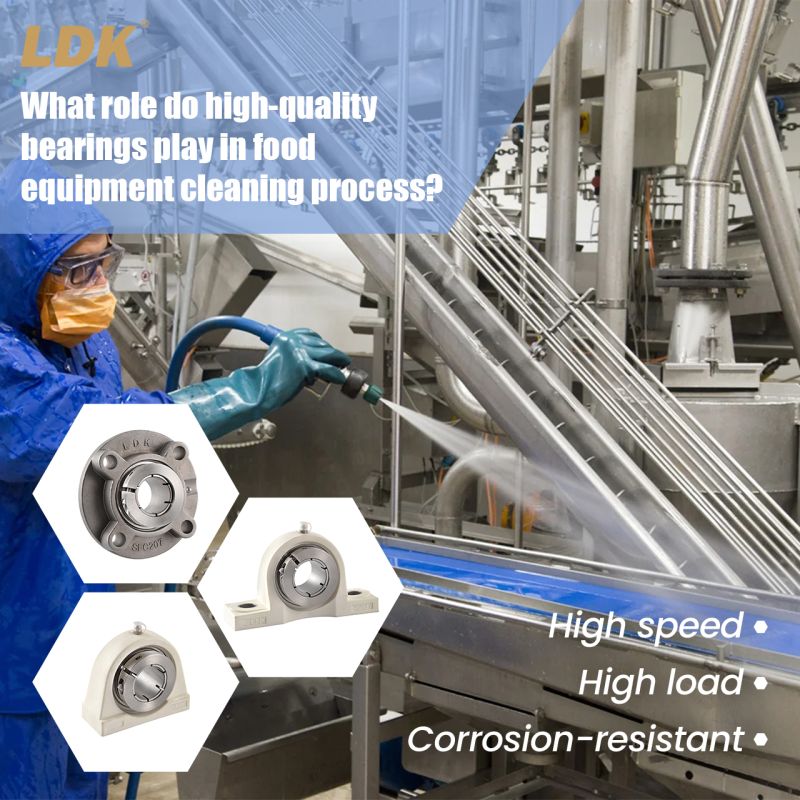
Stainless steel and plastic bearing units for washdown food processing equipment. Image source: LDK.
Have Questions or Need More Details?
Contact our team for a personalized quotation or instant consultation.
Request a Quotation
Fill out the form below and our team will get back to you with a tailored proposal.
WhatsApp Direct Chat
Prefer to chat in real-time? Message us on WhatsApp for instant assistance & quick answers.
- Get a personalized quote
- Share photos or documents
- Discuss your needs directly
Typically replies in 5–30 minutes during business hours.