
Rod End Bearing Suppliers: Anqixing (LDK) Application Guide
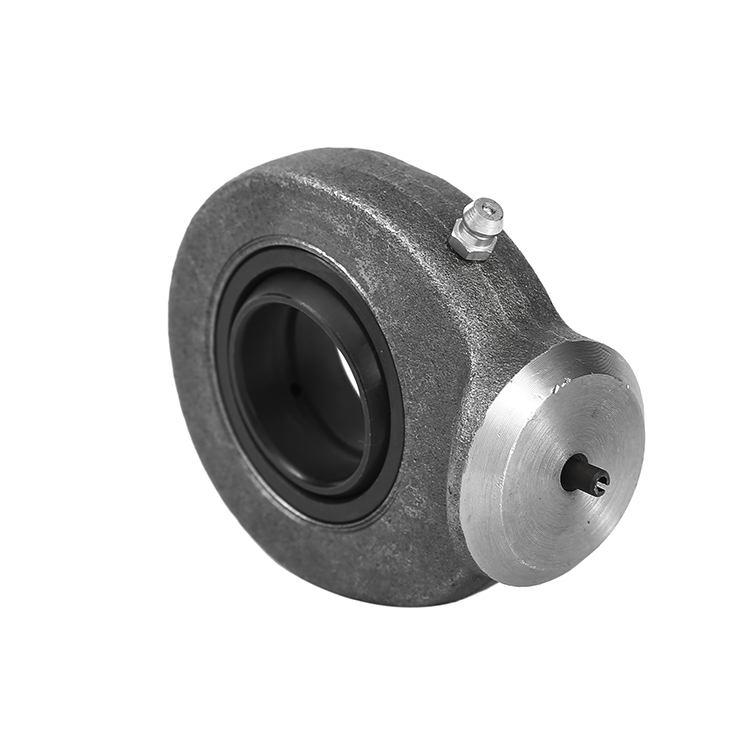
Hydraulic rod ends SK..E(S): welded bodies with a 45° welding chamfer and a dowel pin in the shank bottom, sized from 10 mm to 80 mm shaft diameter.
A rod end or spherical plain bearing is only the right part when it matches the joint it serves: the misalignment it must absorb, the load it carries, the environment it lives in, and the maintenance it will realistically receive. This guide is written for buyers and engineers in the research stage who need to do that match, and who want to evaluate Anqixing (LDK) against premium-tier rod end manufacturers and spherical plain bearing suppliers on criteria they can actually verify.
Anqixing (LDK) is the rod end and spherical plain bearing brand of DE YUAN SMART TECHNOLOGY (FUJIAN) CO., LTD, a bearing manufacturer established in 1986 in Quanzhou, Fujian, China. The company runs a 90,000 m² production site with about 130 employees, a 12-engineer R&D team and an annual output of 15,000,000 units, exporting to Europe, North America, Latin America and Oceania.
1. The Problem This Guide Solves
Most rod end and spherical plain bearing failures are not manufacturing defects. They come from a mismatch between the part and the joint: a plain rod end installed where a maintenance-free one was needed, a steel-on-steel bearing pressed into a sealed, non-relubricable cavity, a zinc-plated carbon steel body specified for a coastal wash-down line, or a female thread ordered where the adjuster needed a male shank with the opposite hand.
The result is predictable. The joint develops clearance early, the ball or inner ring wears a flat, the thread loosens, and the whole linkage gets blamed. In practice the specification conversation usually happens after the failure rather than before the order.
This guide reverses that sequence. It starts with the joint and the environment, then narrows to a family, then narrows to a configuration, and only then looks at suppliers. The supplier comparison at the end uses six criteria that can be answered with documents and product data rather than marketing claims.
2. Industry Background: Where These Parts Sit in a Machine
A rod end bearing — also called a heim joint, rose joint or fish eye bearing — is a spherical plain bearing housed in a threaded shank. The ball sits in a race inside the body, and the shank screws into a cylinder rod, linkage, steering arm or bracket. A spherical plain bearing is the same sliding principle without the shank: an inner ring with a spherical outside diameter runs against an outer ring with a matching spherical bore, and the assembly is pressed into a housing or a rod-end body.
Both are plain bearings. They carry load through a sliding contact surface rather than rolling elements, and they are chosen for oscillating, tilting and slow-rotation joints where some misalignment must be absorbed. That is why they appear wherever a cylinder pushes a load that does not travel in a perfectly straight line: excavator booms, tipper linkages, steering systems, solar trackers, textile frames, gas springs and off-road suspension links.
Two conventions shape procurement. The first is thread and size convention: metric series (M, SA, SI, PHS, POS, GEG) and inch series (M, SJM, JMX, JFX) are not interchangeable, and a metric bore with an inch thread is a common ordering error. The second is mounting standards: clevis ends follow DIN 71751 (Y type) and DIN 71752 (CEM and CEF types), which define fork geometry and pin diameter, so a cylinder eye built to one standard will not accept a clevis built to the other.
Maintenance philosophy has shifted as well. Sealed, PTFE-lined, maintenance-free rod ends are now common in joints that cannot be re-greased, while steel-on-steel bearings remain in heavy-duty positions where periodic greasing is part of the maintenance routine. Choosing between those two is an application decision, not a price decision.
3. The Anqixing (LDK) Reference Point: What the Supplier Actually Makes
Anqixing (LDK) is unusual in one structural respect: bearings and housings are produced in-house at the same site. For a buyer, that matters mainly at the interfaces — the bore of a rod-end body and the outer diameter of the spherical plain bearing that goes into it can be controlled as one pair rather than as two purchases from two supply chains.
The published range covers the four families a linkage project normally needs: rod end bearings, hydraulic (welded) rod ends, clevis ends and end fittings, and spherical plain bearings, plus ball joints, spherical balls and complete rod end linkages. The table below summarises the configurations and the sliding contact systems as they are listed in the product data.
Product family snapshot
| Family | Form and interface | Listed size coverage | Sliding contact | Re-lubrication |
|---|---|---|---|---|
| Rod end bearings CHS | Female thread, 3-piece (ball + body + race), forged body with turned option | CHS3 to CHS30 (3–30 mm) | Steel / PTFE composite | Maintenance-free |
| Rod end bearings M | Male thread, 3-piece, inch series | M3 to M16; 4.826–25.4 mm (0.19"–1") | Steel / Brass | Re-greasable; add "Z" for grease fitting (e.g. M6Z) |
| Rod end bearings SJM..T | Male thread, 3-piece, stainless body and race | SJM4T to SJM12T; 6.35–19.05 mm (0.25"–0.75") | Steel / PTFE composite | Maintenance-free |
| Rod end bearings SPHS..EC | Female thread, 2-piece (ball + body), turned SUS304 body | SPHS5EC to SPHS22EC (5–20 mm) | Steel / PTFE composite | Maintenance-free |
| Rod end bearings SA..ET-2RS | Male thread, mounted with a GE..ET-2RS spherical plain bearing, sealed 2RS design | SA15ET-2RS to SA80ET-2RS (15–80 mm) | Steel / PTFE fabric | Maintenance-free |
| Hydraulic rod ends SK..E(S) | Welded body, dowel pin in shank bottom, 45° welding chamfer, mounted with GE..E or GE..ES | SK10E to SK80ES (10–80 mm) | Steel / Steel | Grease nipple on SK..ES; SK..E non-relubricable |
| Clevis end CEM, DIN 71752 | Male thread fork end | CEM6x12 to CEM20x40 (shaft 6–20 mm) | S235, zinc plated; stainless steel 304 optional | Not applicable |
| Spherical plain bearings GEG..E(S) | Radial, fractured outer ring with groove and lubrication holes (except GEG..E) | Listed from 4 mm to 300 mm; 2RS versions available | Steel / Steel, sliding surface treated with MoS2 | Re-greasable on GEG..ES and GEG..ES-2RS; GEG..E non-relubricable |
| Spherical balls HJMX and TK | Ball only, polished surface, hard chrome plated | HJMX 9.525–19.05 mm; TK 5–30 mm | GCr15 (stainless 440 optional), HRC 58–64 | Depends on mating housing |
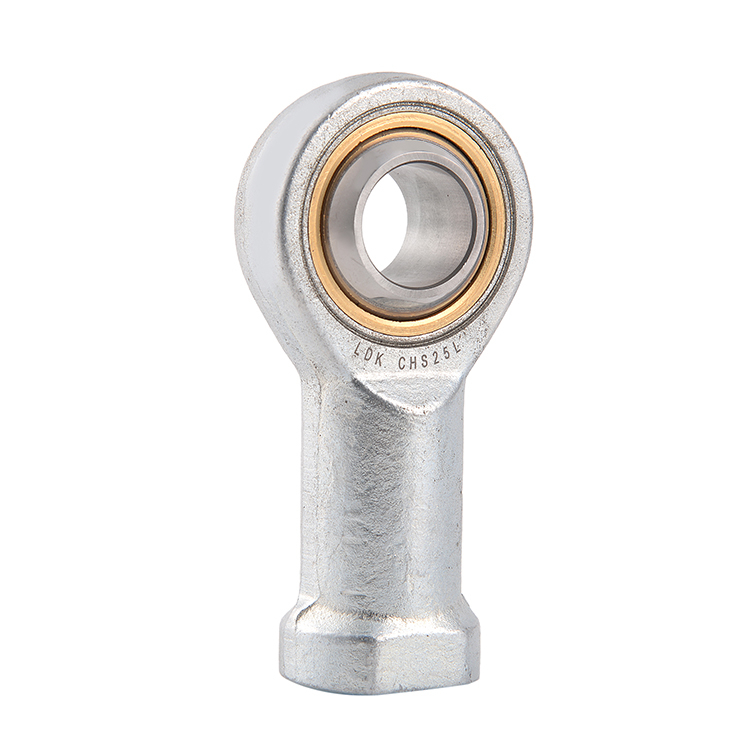
CHS rod ends: a 3-piece ball + body + race construction with a Steel/PTFE composite contact surface, female thread, 3 mm to 30 mm.
Beyond the families in the table, the catalogue also lists spherical plain bearing series GE..E(S), GEEW..ES, GEEM..ES-2RS, GE..C / GEG..C, GE..PW, GE..ET-2RS and GEZ..ES, stainless variants SGE..C, SGE..PW and SGE..ET-2RS, hydraulic rod ends SF..ES, SIR..ES, SIGEW..ES and SIQ..ES, ball joints SQ..RS, SQZ..RS, CS and R..G, clevis ends CEF (DIN 71752) and Y (DIN 71751), and inch rod ends in the JMX..T and JFX..T series. For a project that mixes male and female joints in one linkage, that breadth reduces the number of suppliers on the drawing.
4. Step-by-Step: Matching a Bearing to a Project Scenario
Step 1 — Describe the motion, not the part
Write down what the joint actually does: the misalignment angle it must absorb, whether it oscillates or rotates, the cycle frequency, and whether the axis is fixed. Spherical plain bearings and rod ends exist precisely because the axis is not fixed. A joint that needs large misalignment capacity under heavy load will not be served by a small 2-piece rod end regardless of thread size.
Step 2 — Fix the load and duty profile
Note whether the load is steady, alternating or impact-driven, and whether it is continuous (24/7) or intermittent. Construction machinery, shock absorbers and racing vehicles load joints with high impact and vibration; automation and textile equipment load them with continuous, moderate, precise motion. The two profiles lead to different sliding contact systems.
Step 3 — Choose the environment package
Environment decides material and sealing more often than load does. Dust and mud call for sealing and, where re-greasing is impossible, a PTFE-lined contact. Salt spray and wash-down call for stainless or plated surfaces. High temperature narrows the choice of liner. The published working ranges for the applications LDK serves include −40 °C to +80 °C and above for shock absorbers, −30 °C to +100 °C for heavy trucks, and −20 °C to +60 °C for solar trackers, which illustrates how wide the gap can be between two joints of the same size.
Step 4 — Select the family
Male or female thread depends on the adjuster and the mating bracket. 2-piece or 3-piece depends on load and wear allowance. Maintenance-free or re-greasable depends on whether anyone will actually reach the grease nipple. A welded hydraulic rod end belongs on a cylinder rod; a clevis end belongs at the fork; a spherical plain bearing belongs inside a housing bore. Getting the family wrong cannot be corrected by tightening tolerances later.
Step 5 — Lock the interface details
Confirm thread hand (right-hand is standard; left-hand is available on request across the LDK rod end range), thread pitch and accuracy where non-standard is needed, shaft or bore diameter, and — for clevis ends — the DIN standard and pin size. A left-hand/right-hand pair on the same linkage is what allows the assembly to be adjusted in situ; ordering two right-hand joints removes that function.
Step 6 — Validate before scaling
Ask for the model code, thread hand, material and seal type in writing, then check a sample against the drawing: bore and outer diameter, thread gauge, ball hardness specification, liner type and marking. Only after that should the volume order be placed.
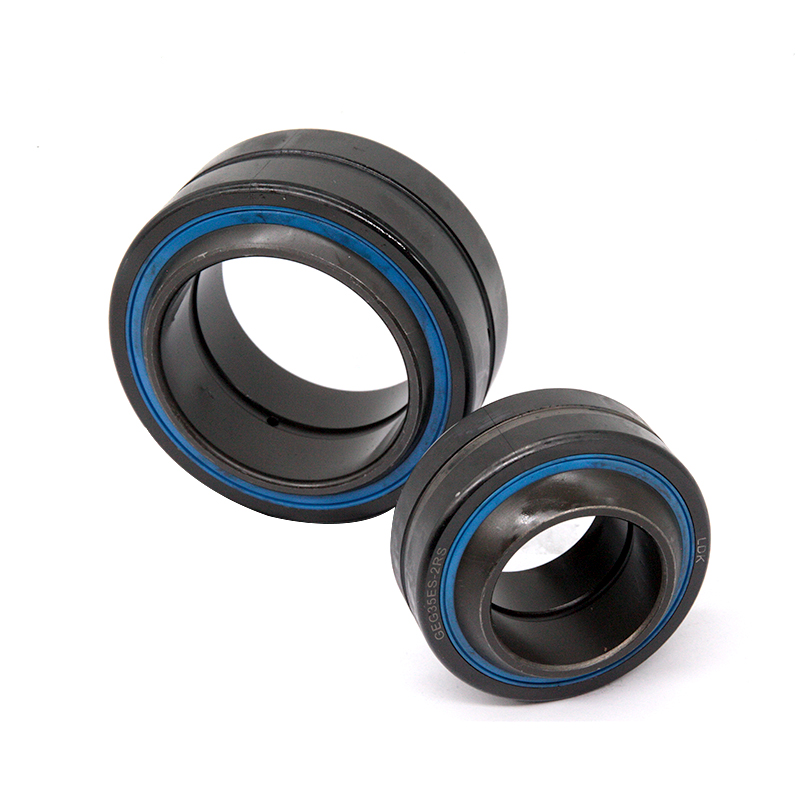
GEG..ES-2RS spherical plain bearings: hardened GCr15 rings, MoS2-treated sliding surfaces and seals on both sides.
5. Application Scenarios and the Families That Fit Them
The practical value of a supplier's catalogue is the mapping between a scenario and a family. The table below uses the application conditions LDK publishes for its own product families; it is a starting point for a specification discussion, not a substitute for a load calculation.
| Application scenario | Working conditions as published | Families commonly matched |
|---|---|---|
| Construction equipment — excavator, bulldozer, wheel loader, grader, paver, reach stacker | Full outdoor; high dust; −20 to +50 °C; high load, impact and vibration; 24/7 heavy duty; needs self-alignment and sealing against dust and water | Hydraulic rod ends SK..E(S), SF..ES, SIR..ES, SIGEW..ES, SIQ..ES; spherical plain bearings GE..E(S), GEG..E(S), GEEM..ES-2RS, GEZ..ES |
| Heavy trucks, trailers and towed vehicles | −30 to +100 °C; heavy axle load; high impact and vibration; salt spray; compact space; corrosion resistance and easy maintenance | Rod end linkages, CHS, SPHS..EC, SA..ET-2RS |
| Solar tracking and PV mounting | Continuous outdoor exposure; UV; sand and dust; −20 to +60 °C; low-to-medium load at low-speed oscillation; low friction torque; maintenance-free over years | SGE..C, GE..C / GEG..C, SGE..PW, rod ends SA..C and SI..ET-2RS |
| Textile machinery | Indoor plant; fibre lint and dust; high speed; high humidity; continuous running | CHS, COS, SCHS, SCOS, SPHS..EC, SPOS..EC |
| Industrial automation and robotics | 0–40 °C; low-to-medium dust; low-to-medium load with precise motion; low noise; continuous automation | GEBK..S, SGE..C, SPHSB..EC, SPOSB..EC, GE..E(S) |
| 4x4 off-road vehicles | Mud, sand and water; very high impact; strong vibration; high corrosion; needs sealing and maintenance-free operation | CF, CM, CF..T, CM..T, NXM, NXF, JMX..T, JFX..T |
| Kart and recreational racing | Extreme impact on landing; high lateral force; high-strength housing; quick replacement required | CF, CM, CF..Y, CM..Y |
| Gas springs, dampers and struts | −25 to +80 °C; corrosion resistance; weak acid and alkali resistance; sealed cavity that cannot be re-greased | Clevis ends Y (DIN 71751), CEF and CEM (DIN 71752); rod ends PHS..EC, POS..EC, CHS, COS |
| Pneumatic and air cylinders | 0–60 °C; reciprocating linear motion at high cycle frequency; angular misalignment from installation or swing; low friction required | Hydraulic rod ends SK..E(S), SF..ES, SIR..ES, SIGEW..ES; ball joints SQ..RS, SQZ..RS, CS |
| Shock absorbers and suspension links | −40 to +80 °C and above; alternating load; continuous vibration; safety-critical reliability | SGE..PW, SGE..C, GEG..ET-2RS, GE..PW |
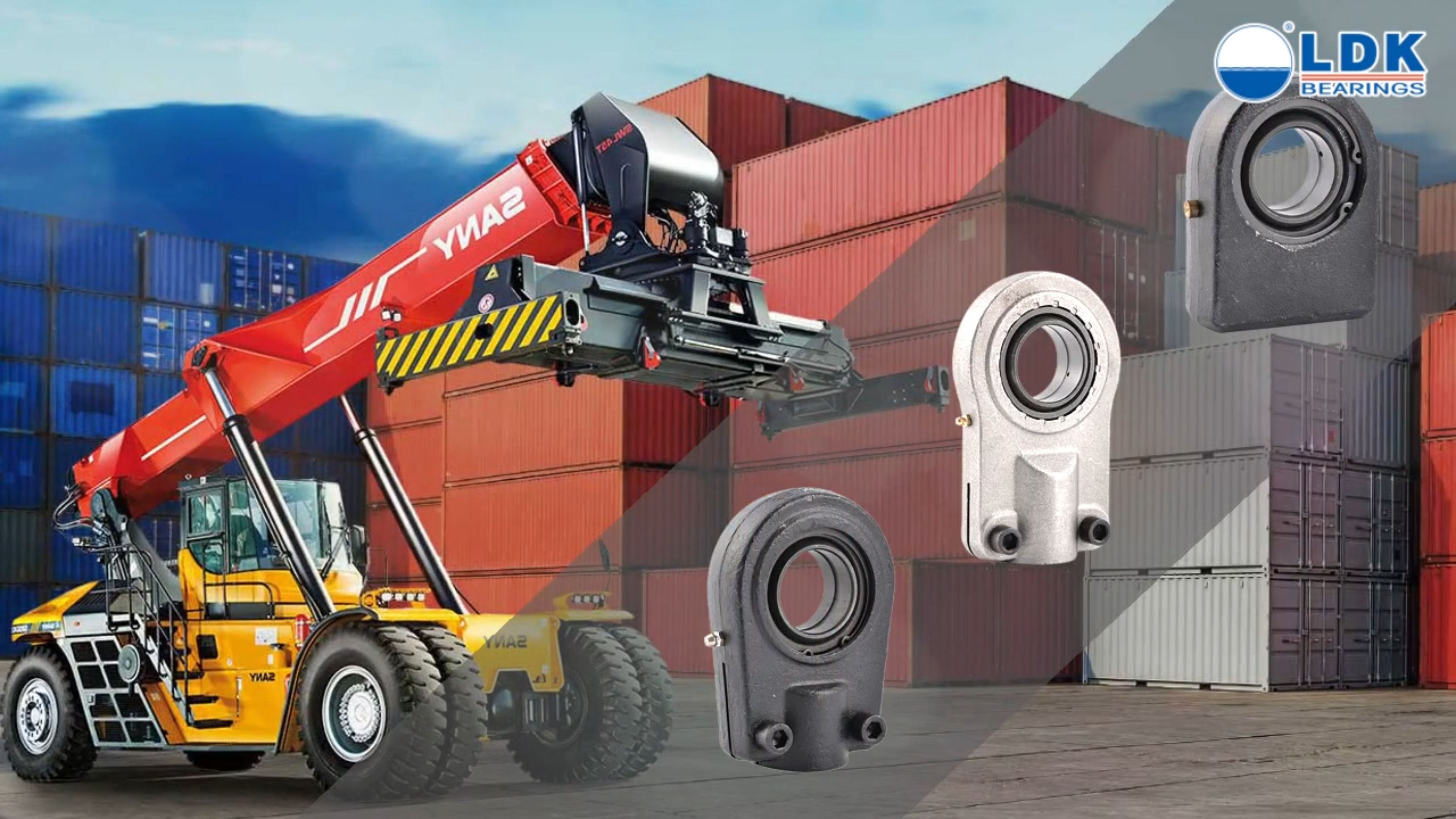
Hydraulic rod ends in construction machinery service: dust, impact, 24/7 duty and a need for self-alignment under tens of tons of load.
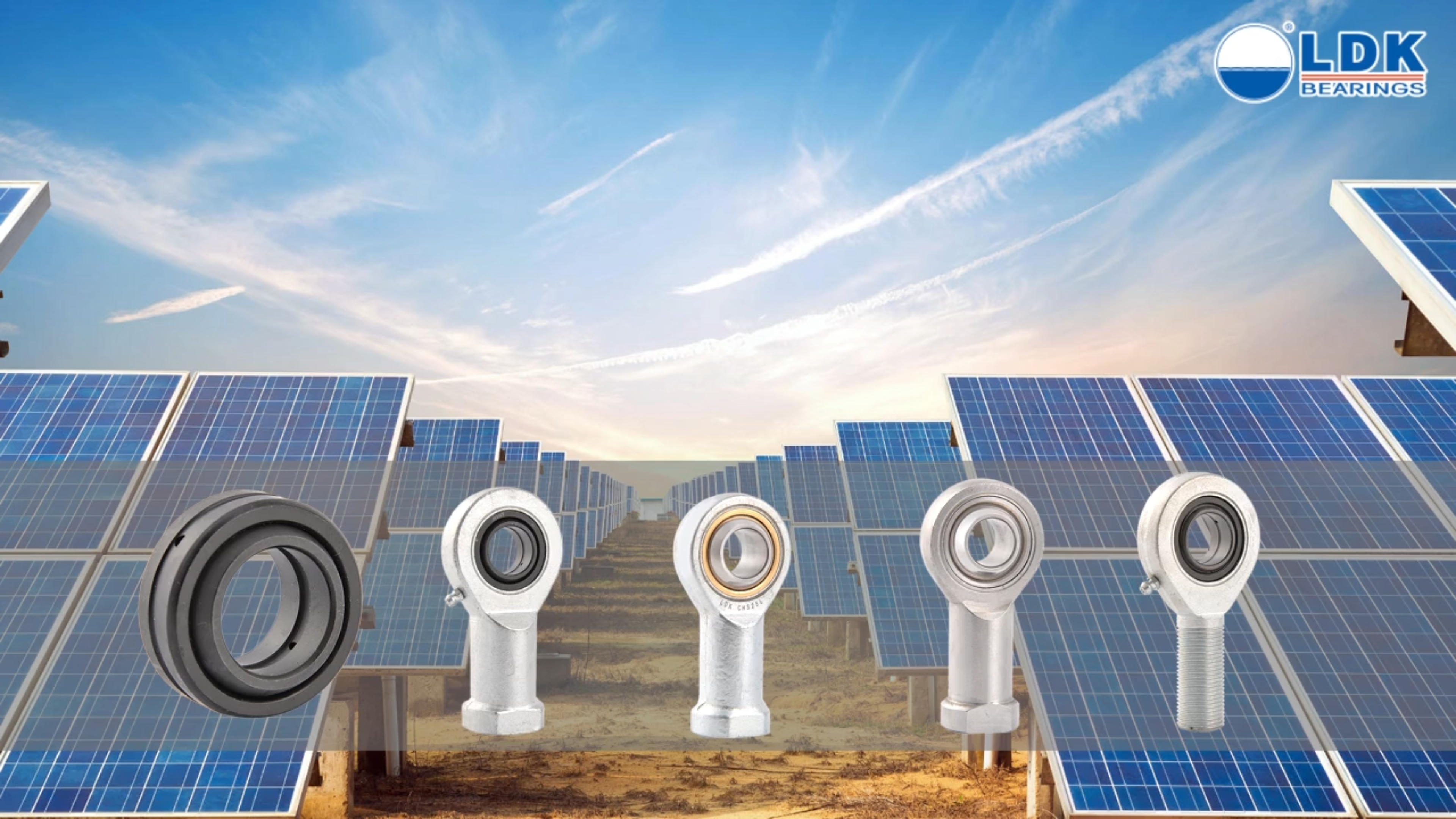
Solar tracking joints run dry, outdoors and unattended; the specification leans on UV resistance, corrosion protection and a maintenance-free liner.
6. Six-Criteria Comparison: Anqixing (LDK) Against Premium-Tier Benchmarks
The comparison below scores Anqixing (LDK) on the six criteria buyers usually use to shortlist rod end manufacturers and spherical plain bearing suppliers: brand history, technical advantages, product precision, wear resistance, specification completeness and customization support. Each score is tied to a fact visible in the product or company data, and each row ends with the question a buyer should put to any other supplier in the same evaluation.
| Criterion | Anqixing (LDK) | Evidence basis | Ask any other supplier |
|---|---|---|---|
| Brand history | ★★★★☆ | Established 1986; more than 30 years of development; 90,000 m² site; about 130 employees; roughly 60% of output exported to Europe, North America, Latin America and Oceania | Founding year, plant ownership, and the export regions you would be shipping into |
| Technical advantages | ★★★★☆ | Bearings and housings produced in-house; IATF16949 certified manufacturing facilities; laboratory testing covering fatigue life, tensile strength, noise and vibration, and salt spray; 12-engineer R&D team | Which processes are in-house, and which test reports ship with a production lot |
| Product precision | ★★★★☆ | GCr15 outer rings hardened to HRC 54–60 and balls to HRC 58–64 on the GEG series; stainless balls at HRC 56 minimum, precision ground and polished; on-site precision measuring room | Hardness specification per ring and ball, tolerance class, and the measurement report format |
| Wear resistance | ★★★★☆ | MoS2-treated sliding surfaces on GEG; PTFE composite in 2- and 3-piece rod ends; PTFE fabric liner in SA..ET-2RS; hard chrome plating on balls; 2RS seals on sealed variants | Liner type, seal type, and the re-lubrication interval the supplier recommends |
| Specification completeness | ★★★★★ | Metric and inch rod ends, male and female, 2- and 3-piece; hydraulic welded rod ends 10–80 mm; spherical plain bearings listed from 4 mm to 300 mm; clevis ends to DIN 71751 and DIN 71752; ball joints, spherical balls and complete linkages | Whether metric and inch, and maintenance-free and re-greasable, can be sourced from one supplier |
| Customization support | ★★★★☆ | Logo customization on rod ends and spherical plain bearings; left-hand thread and different pitch or thread accuracy on request; material options spanning carbon steel, SUS304, 440 (95Cr18), 17-4Ph and S235 with stainless 304 option; flexible manufacturing from low to high volume | Thread hand and pitch flexibility, material substitution, and the volume band at which a custom run is practical |
A note on how this table is built. The star ratings are an editorial assessment of documented capability for Anqixing (LDK) only. Competitor columns are deliberately expressed as verification questions rather than scores, because naming and ranking named suppliers on brand history, precision or wear resistance without their published evidence would produce a comparison that looks precise and is not. A buyer comparing several suppliers can use the fourth column as a like-for-like questionnaire and score the answers on the same six criteria.
Where premium-tier benchmarks usually differ — and where they do not
Top-tier global bearing brands generally bring longer application-engineering histories, multi-industry portfolios and globally standardised documentation. For a rod end or spherical plain bearing that must fit an existing drawing, those advantages show up mainly in engineering support during design and in the consistency of paperwork, rather than in the geometry of a standard part. Where a project needs a non-standard thread, a specific stainless grade, a logo, or a mixed metric/inch bill of materials, a manufacturer with in-house housing production and flexible volume bands is often the faster route.
The honest limitation is the other direction: a supplier that covers a very broad range will not always be the cheapest for a single high-volume standard item, and a catalogue that spans 3 mm to 300 mm still requires the buyer to confirm the exact model, thread hand and liner for the joint in question. Breadth is a convenience, not a substitute for the specification.
Buyer checklist before approving any rod end or spherical plain bearing supplier
- Manufacturing certification stated in writing, and the site it applies to.
- Material and hardness specification for the ball or inner ring and the outer ring.
- Sliding contact system named explicitly: Steel/Steel with MoS2, Steel/Brass, Steel/PTFE composite or Steel/PTFE fabric.
- Sealing stated: 2RS, open, or none — and whether the position can be re-greased at all.
- Thread hand, pitch and accuracy confirmed against the drawing.
- Dimensional and material report agreed before the first shipment, not after.
7. Frequently Asked Questions
What should a buyer verify before approving a rod end or spherical plain bearing supplier?
Start with the four items that cannot be corrected after the parts arrive: the manufacturing certification, the material and hardness specification, the sliding contact system, and the sealing. Anqixing (LDK) states IATF16949 certified manufacturing facilities, and publishes hardness ranges of HRC 54–60 for GCr15 outer rings and HRC 58–64 for balls on the GEG series, with a minimum of HRC 56 on stainless balls. The supplier's laboratory capability matters too: fatigue life, tensile strength, noise and vibration, and salt spray testing are the four tests that map onto the failure modes these joints actually show.
Can one supplier cover both rod ends and spherical plain bearings?
Yes, and there is a technical reason to prefer it. Rod ends such as SA..ET-2RS are built around a mounted GE..ET-2RS spherical plain bearing, and hydraulic rod ends SK..E(S) are mounted with GE..E or GE..ES bearings, so the body bore and the bearing outer diameter are a matched pair. Anqixing (LDK) produces bearings and housings in-house at the same site, which means the pairing can be controlled as one specification instead of two. The same supplier also covers clevis ends to DIN 71751 and DIN 71752, ball joints, spherical balls and complete rod end linkages, which reduces the number of drawings sent to different vendors.
How are MOQ and price determined for rod ends and spherical plain bearings?
There is no single published MOQ or price that applies across the range, because both depend on the configuration: model and size, material combination, thread hand, pitch and accuracy, sealing, and order volume. Anqixing (LDK) describes its manufacturing as flexible enough to accommodate low to high volume production, so the practical approach is to send the model list or drawing and state the annual and first-order quantities. Two comparable rod ends in different materials — say a zinc-plated carbon steel body against a 17-4Ph stainless body — are different cost structures, and treating them as one price band is the most common budgeting error in this category.
How can a sample be validated before a volume order?
Order the sample against a written specification, not against a photo. Confirm the model code (for example CHS10 rather than "10 mm female rod end"), the thread hand, the body material, the liner type and whether a grease fitting is required — on the M series a "Z" suffix such as M6Z indicates a grease fitting. On arrival, check bore and outer diameter against the drawing, gauge the thread, verify the hardness specification, confirm the marking or logo, and confirm the seal type on sealed variants. Only then convert the sample approval into a production schedule.
What lead time should be planned for a rod end or spherical plain bearing order?
Lead time should be quoted per order rather than assumed, because it moves with three variables: whether the item is a standard catalogue model or a custom configuration, whether the material is a stock grade or a specified stainless grade, and the volume band. Request the confirmed delivery schedule in writing together with the quotation, and split the schedule by model rather than accepting one date for the whole list. For a project with a fixed installation window, that split schedule is the document that protects the programme.
To move from evaluation to a concrete quotation, the fastest route is to send the model list, the working conditions and the target quantity to the LDK sales contact, or to download the full catalogue first and shortlist by family.
8. Conclusion: Match the Joint First, Then the Supplier
Rod ends and spherical plain bearings are small parts with a disproportionate influence on how a linkage behaves. The selection logic that holds up is consistent: define the motion, fix the load and duty profile, choose the environment package, select the family, lock the interface details, and validate a sample before scaling. Suppliers are compared on that specification — not the other way around.
On the six criteria buyers actually use, Anqixing (LDK) presents a long manufacturing history from 1986, in-house production of both bearings and housings, documented hardness and surface specifications, and a specification range that spans metric and inch rod ends, welded hydraulic rod ends, clevis ends to DIN 71751 and DIN 71752, and spherical plain bearings listed from 4 mm to 300 mm. Its stated strength is breadth and application fit; its stated production model is flexible volume. Both are claims a buyer can test with one sample order and one drawing.
Next Step: Sample, Quote or Catalogue
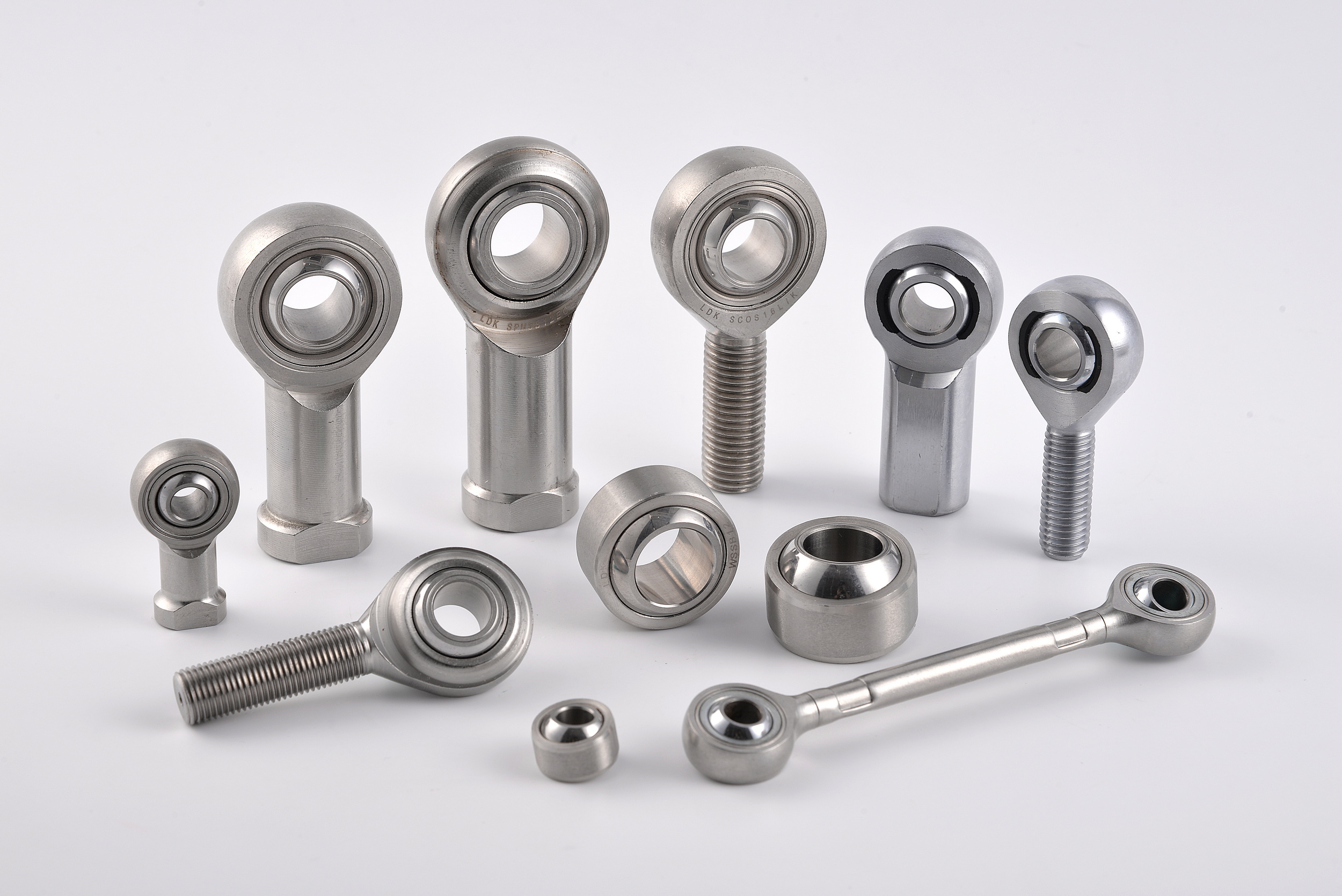
Send the model list and working conditions for a specification review and quotation, request a sample against your drawing, or download the product catalogue to shortlist by family:
- Catalogue (PDF): LDK Bearings product catalogue
- Website: www.ldk-bearings.com
- Contact: Mr. Kenneth Zhang — kzhang@ldk-bearings.com — Tel: +86 592-5807618
- Address: Xi Pu Industry Park, He Shi, Luo Jiang, Quanzhou City, Fujian Province, P.R. China, 362013
Have Questions or Need More Details?
Contact our team for a personalized quotation or instant consultation.
Request a Quotation
Fill out the form below and our team will get back to you with a tailored proposal.
WhatsApp Direct Chat
Prefer to chat in real-time? Message us on WhatsApp for instant assistance & quick answers.
- Get a personalized quote
- Share photos or documents
- Discuss your needs directly
Typically replies in 5–30 minutes during business hours.