
Pillow Block Bearings for Disk Harrows: Mid-Season Seizure Repair
Pillow Block Bearings for Disk Harrows: Fixing Mid-Season Seizures with Agriculture Bearings
A disc gang that stops turning in the middle of the working season is not a maintenance inconvenience. It is a stopped field, a crew standing idle, and a narrow window of weather that will not wait. When the operator pulls the failed bearing off a disk harrow, the useful question is not which pillow block is cheapest on the shelf. It is which unit will bolt back onto that same shaft and housing and survive the rest of the season.
The short answer: a mid-season harrow seizure is usually a fit problem before it is a wear problem. Identify the mounting type first, meaning whether the failed part is a bearing insert carried inside a housing or a sealed farm implement bearing that is replaced as one piece. Then confirm the bore geometry, square or round, and confirm the lubrication design, relubricable or sealed for life. Only after those three checks does a model number mean anything.
This guide walks through that sequence and maps the result to LDK Agriculture Bearings, including disc harrow bearing designations, square bore and round bore units, and Bearing Inserts UC2, UC3, UCX and UK2 where the shaft mounting method differs.
What a Mid-Season Harrow Seizure Actually Tells You
A bearing that seizes part way through the season has usually been running in a condition it was not matched to, or it has been installed in a way that loaded it off-centre. Three causes dominate a field diagnosis, and all three are visible at the removed part rather than on a specification sheet.
- Wrong mounting family. A sealed, pre-lubricated farm implement bearing has been replaced with a general-duty housed unit, or the reverse, so the shaft interface and the maintenance routine no longer match the design.
- Bore geometry mismatch. A square bore unit has been forced onto a worn square shaft, or a round bore unit has been fitted to a shaft that was measured at one point only.
- Lubrication design ignored. A unit described as non-relubricable has been treated as though it had a greasing schedule, or a relubricable unit has run dry because the schedule assumed a different design.
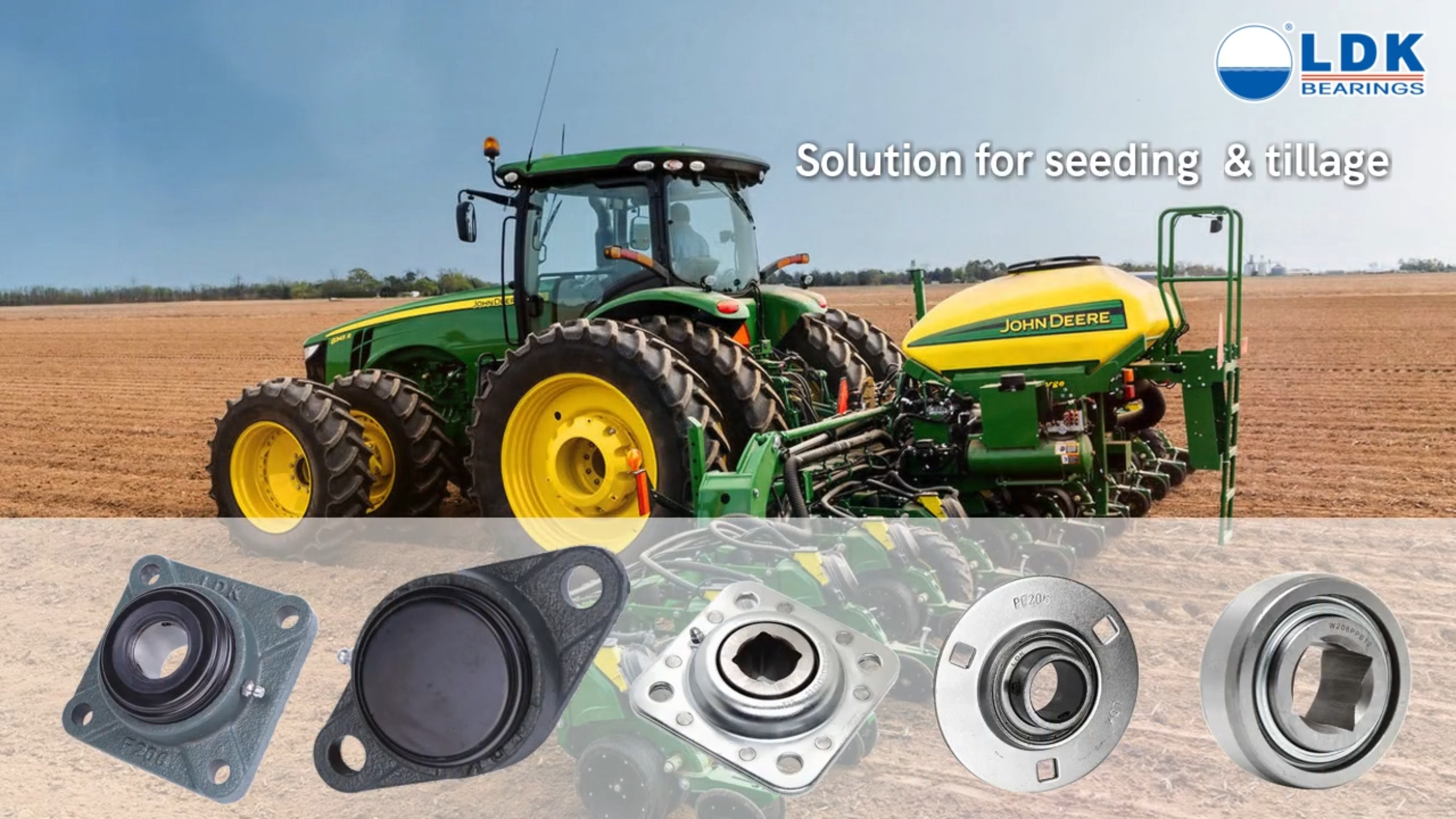
For a disk harrow in particular, LDK describes the agricultural machinery category as full outdoor work in dust, mud and chemical fertilizer or pesticide exposure, with an ambient range of -10°C to +45°C, high humidity, heavy load, high impact and high-speed vibration. The stated requirements for that category are resistance to high-speed vibration and high shock loads, corrosion resistance, sealing performance, easy installation and disassembly, and stable operation. Those conditions explain why the bearing at the end of a disc gang is a specification decision rather than a commodity purchase.
Check One: Is It an Insert, a Housed Unit, or a Sealed Implement Bearing?
Before any measurement, establish what physically came off the machine. The replacement route depends entirely on this answer, and it is the step most often skipped when a farmer orders by photograph.
Insert inside a housing
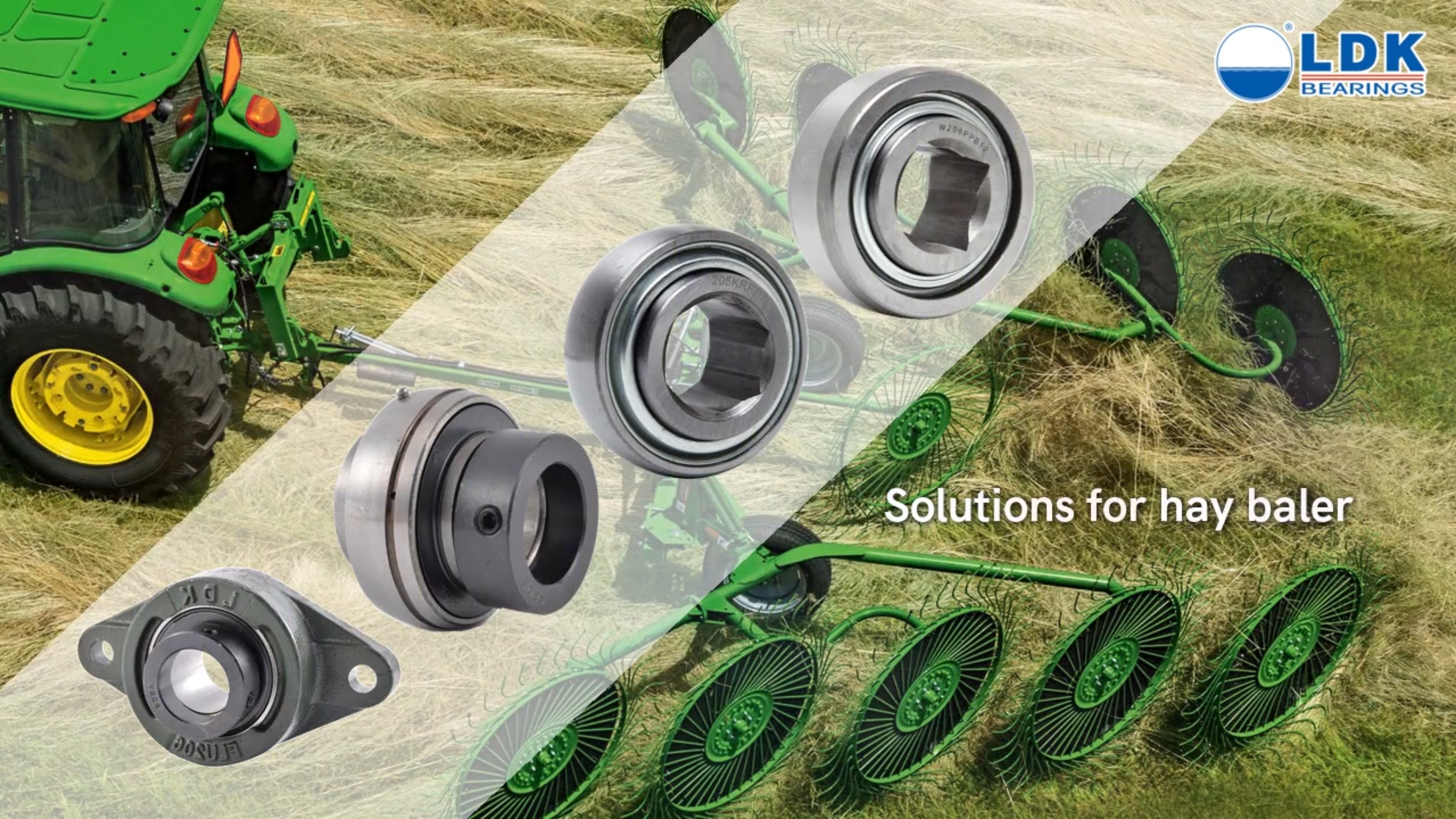
If the housing still holds a separate bearing insert, the insert can be replaced on its own. LDK lists four insert families that are relevant to this decision: Bearing Inserts UC2, used in the standard pillow block range; Bearing Inserts UC3, which uses its own numbering series running from UC305 upward; Bearing Inserts UCX, running from UCX05 upward; and Bearing Inserts UK2, running from UK205 to UK218. The UC2 insert, as used in the UCP2 pillow block range, is described with a wider inner ring and set screw locking, in a housing of HT200 cast grey iron.
The UK2 family is the one that changes the mounting method rather than the bore. LDK lists the UKP2 pillow block designations as paired codes, for example UKP205+H2305, UKP206+H2306 and UKP207+H2307. The paired designation shows that the insert is supplied with an adapter sleeve, so the shaft is gripped by the sleeve rather than by set screws. If the machine has been running a sleeve-mounted unit, a set screw replacement is not a like-for-like swap.
Sealed unit with no separate insert
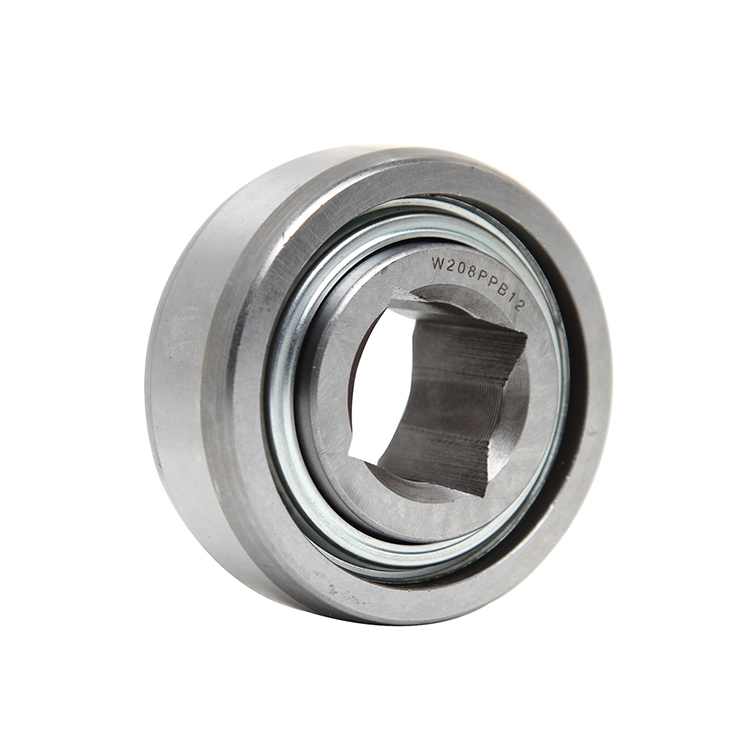
If the failed part has no removable insert, it is replaced as a complete bearing. LDK describes its square bore agriculture bearings in the W208 and W211 series as square bore, triple lip sealed, pre-lubricated and non-relubricable, in chrome steel GCr15 or AISI52100. Those four attributes together define a sealed-for-life unit, and they also tell the buyer what not to expect from it.
Check Two: Bore Style, Square or Round
Bore style is the second decision, and it is where catalogue shortcuts cause repeat failures. LDK's agriculture bearing range separates the two geometries into distinct model lists, and the same basic size number appears in both.
Square bore
LDK lists square bore agriculture bearings as W208PPB13, W208PPB6, W208PP5, W208PPB5, W208PP8, W208PPB8, W208PPB11, W208PPB12, W209PPB5, W210PP4, W210PPB4, W211PP3, W211PPB3, W211PP5 and W211PPB6. A second square bore list covers 205NPPB AH02, 206NPPB AH02, 206NPPB AH04, 207NPPB AH09, 207KPP3, 207KPP17 and 207KPPB3.
On the machine, measure the square shaft across the flats in two places 90 degrees apart, and inspect for burring or rounding at the corners. A square section that has worn to a taper will accept a new unit and then run it off-centre.
Round bore
LDK lists round bore agriculture bearings as 205PPB7, W208PPB7, W208PP10, W208PPB23, W209PPB2, W209PPB4, W210PP2, W210PPB2 and W211PPB2. Measure the shaft diameter at several points along the seating length rather than at one position, because a worn round journal is often oval rather than uniformly undersized.
The same warning applies at 205 size, where 205PPB7 is a round bore unit and 205NPPB AH02 sits in a square bore list. If a replacement is ordered from a size reference alone, the wrong geometry arrives, and the fitting that follows is where a mid-season seizure becomes a mid-season fabrication job.
Check Three: Grease Fit and Seal Design
Grease fit is not only about which grease is inside. It is about whether the design expects grease to be added at all, and whether the seal arrangement can keep the working environment out.
LDK describes the W208 and W211 square bore agriculture bearings as pre-lubricated and non-relubricable, with a triple lip seal and chrome steel rings. In plain terms, there is no relubrication step designed into that unit, and the triple lip seal is the barrier that has to do the work for the whole service interval. A maintenance plan built around a grease gun does not apply to that part, and adding a routine that the design does not include is a change of maintenance policy, not a maintenance improvement.
The general-duty alternative behaves differently. LDK describes the UCP2 pillow block range as standard duty with a wider inner ring, set screw locking, an HT200 cast grey iron housing, self-aligning operation and relubrication capability, with an end cover available, covering shaft diameters from 12 mm to 100 mm or 1/2 inch to 3-1/2 inch. A relubricable, self-aligning unit suits a machine where access for greasing exists and the alignment between shaft and housing is not perfect.
Temperature sits inside the same decision. LDK states -10°C to +45°C as the ambient range for its agricultural machinery category. Where a machine works outside that band, LDK lists a separate customized insert programme with high or low temperature grease, silicon rubber seals, appropriate internal clearance and special fit and alignment torque for high temperature, covering shaft diameters from 4.826 mm to 25.4 mm and customizable on request. The shaft range is narrow, so this is a targeted option rather than a general substitute. LDK reports one cold storage conveyor application in New Zealand, 5,000 units, working properly at -50°C using that special grease approach.
Mapping the Three Checks to LDK Agriculture Bearing Families
Once the mounting type, bore style and lubrication design are known, the model choice narrows to a family rather than a guess. LDK's farm implement bearing portfolio sits alongside cast iron pillow blocks, thermoplastic housed units, all stainless steel mounted ball bearing units, rod ends and spherical plain bearings, with in-house production of both bearings and housings in one place.
Disc harrow bearing designations
For machines that already use a designated harrow bearing, LDK lists Agriculture Bearings disk harrow bearings under designations including ST491A, ST491A-I, ST491A-II, ST491B, ST491B-I, ST491B-II, ST209-1 1/8, ST209-1 1/8-1, ST209-1 1/8-11, ST211-1 3/4, ST211-2 3/16, ST211-2 3/16-1, DHU45R-209, DHU55R-211, DHU55R-211-I, DHU40S-211 and FD211-1 1/2. This is the shortest route when the failed part carries one of these designations and the shaft has not been modified: the reference on the old unit is the reference for the new one.
Square bore and round bore agriculture bearings
Where the machine uses a W-series or 205/206/207 series implement bearing, the two lists above apply. The square bore list carries the triple lip seal, pre-lubricated, non-relubricable description in chrome steel. The round bore list is a separate model set for round shafts. Choosing between them is a measurement task, not a preference.
Insert-based replacement
Where a removable insert is involved, the choice is between UC2, UC3, UCX and UK2. UC2 and UC3 are separate families with separate numbering; UCX runs in its own series from UCX05 to UCX17-55; UK2 is the adapter sleeve family. LDK's overall insert range covers bore sizes from 10 mm to 140 mm across more than 100 combinations of material and housing type, so the practical constraint is rarely whether a size exists, but whether the housing bore and the shaft end are correctly identified.
| Replacement route | What LDK documents | Check before ordering | Where it fits |
|---|---|---|---|
| Disc harrow bearing designation | Agriculture Bearings disk harrow bearings listed under ST491, ST209, ST211, DHU and FD designations | Read the marking on the removed part; confirm the shaft is unmodified | The failed part already carries a harrow designation and the gang shaft is original |
| Square bore agriculture bearing | W208PPB13, W208PPB6, W208PP5, W208PPB12, W209PPB5, W210PPB4, W211PPB3 and related models; square bore, triple lip seal, pre-lubricated, non-relubricable, chrome steel GCr15 or AISI52100 | Measure the square shaft across the flats in two directions; confirm a sealed-for-life unit matches the maintenance plan | Square-section gang shafts with no in-season greasing routine |
| Round bore agriculture bearing | 205PPB7, W208PPB7, W208PP10, W208PPB23, W209PPB2, W210PPB2, W211PPB2 and related models | Measure shaft diameter at several points; check for oval wear | Round shafts on harrows and other tillage equipment |
| Insert in a housing | UC2, UC3, UCX and UK2 insert families; UCP2 housing in HT200 cast grey iron, self-aligning, relubricable, set screw locking, 12 mm to 100 mm shaft | Confirm insert code, housing bore and locking style; UK2 requires sleeve-type mounting | Machines built around a housed unit where only the insert is worn |
Step-by-Step: Replacing a Seized Harrow Bearing In-Season
The sequence below keeps a field repair from turning into a second failure. It assumes the machine is stopped and the failed gang has been isolated.
- Record before cleaning. Photograph the failed part, the marking, the housing and the shaft end. Cleaning removes the evidence that identifies the family.
- Classify the mounting. Separate insert in a housing, or one-piece sealed bearing. This decides whether an insert code or a full designation is needed.
- Measure the bore. Square shaft across the flats, two directions; round shaft at several points along the seating length. Write the numbers down.
- Confirm the lubrication design. Relubricable or non-relubricable, and whether the seal arrangement matches the working environment described for the machine.
- Inspect the housing and shaft. Look for a spun insert, a burred square corner, an oval journal or a cracked housing. A new bearing in a damaged seat repeats the failure.
- Select from the correct family. Disc harrow designation, square bore W-series, round bore W-series, or an insert from UC2, UC3, UCX or UK2.
- Fit using the locking method the part was designed for. Set screws for a set screw insert, an adapter sleeve for a UK2 unit. Do not mix the two methods on one shaft.
- Run in and record. Note temperature, noise and any vibration on the first working day, and file the marking and measurements for the next replacement.
Use Cases: Which Route Fits Which Harrow
Three conditional examples show how the checks translate into a decision. They are illustrations of the decision logic, not reports of specific customer installations.
Square-section gang shaft, no in-season greasing
A harrow whose disc gang runs on a square shaft section, and whose operator does not grease between seasons, matches the square bore agriculture bearing family. The triple lip seal and pre-lubricated, non-relubricable description fit a machine that is expected to run untouched. The critical measurement is the square across the flats.
Round journal with a housed insert
A machine built around a housed unit, where the housing is sound and only the insert has failed, calls for an insert replacement. If the shaft end carries a sleeve-type mounting, UK2 is the family; if it carries set screws, UC2, UC3 or UCX apply. The housing bore and the insert outside diameter have to be checked against each other before the part is ordered.
Mixed fleet across several harrow models
A contractor running several harrow models usually benefits from consolidating onto families that cover the whole fleet. LDK's insert range spans bore sizes from 10 mm to 140 mm with more than 100 material and housing combinations, and the agriculture bearing lists cover square bore, round bore and designated harrow bearings within one portfolio. For production-level replenishment, LDK's OEM programme states a minimum order quantity of 5,000 units, a lead time of 30 to 90 days and a monthly capacity of 300,000 units, with private labelling and custom packaging available.
What to Put in a Mid-Season Replacement Enquiry
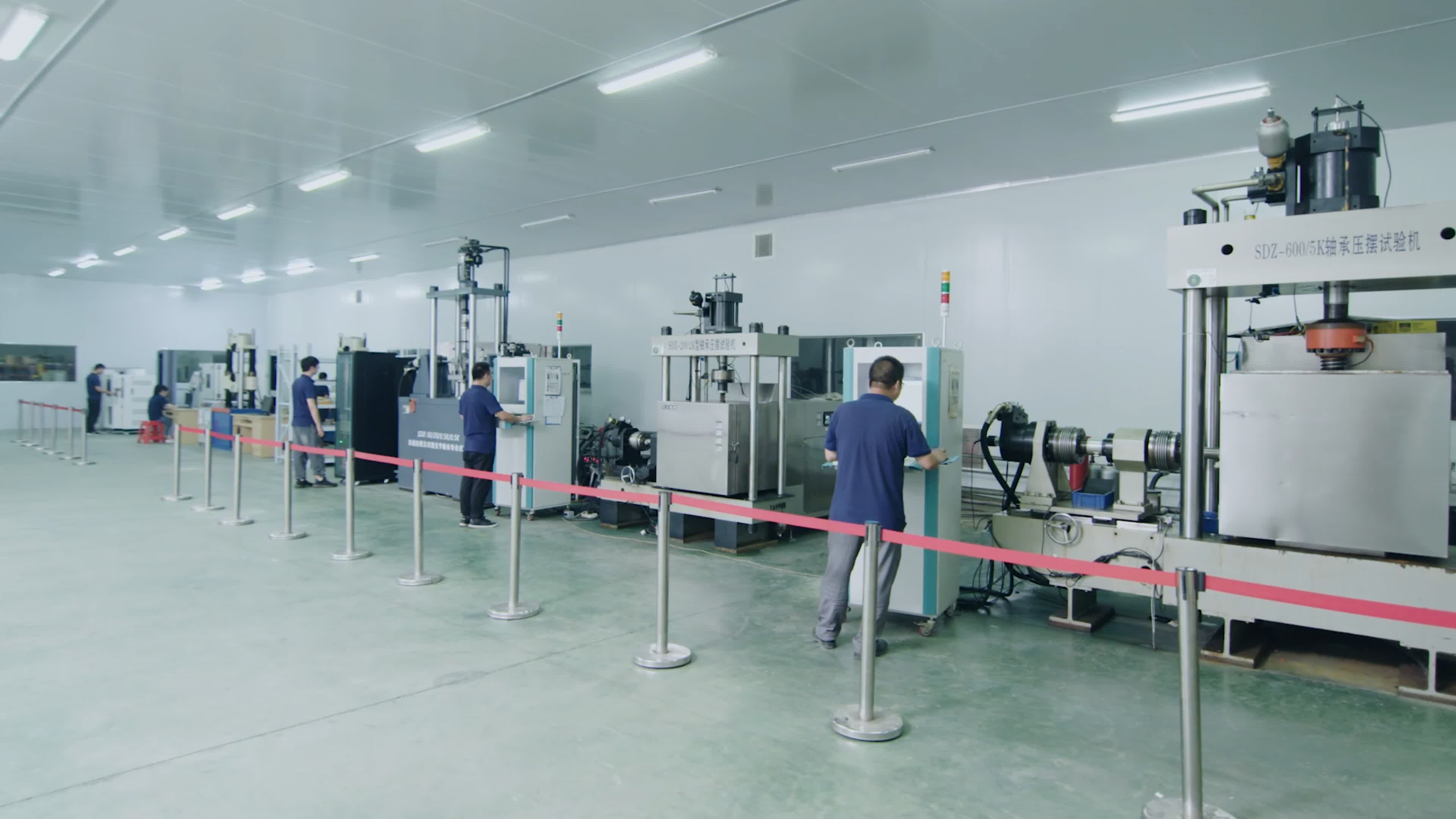
An enquiry that carries the right six items gets a usable answer in one exchange instead of four. LDK's manufacturing base is described as IATF16949 certified, with self-inspection, second-party and third-party audit, verification and inspection, and the OEM capability list includes IATF16949 and ISO9001, ROHS and REACH compliance, traceability and 8D problem solving.
- The marking on the failed part, photographed, plus the shaft measurement.
- Bore style and measured size, stated explicitly as square or round.
- Whether the unit must be relubricable or can be sealed for life.
- Quantity per machine and per season, measured against the 5,000-unit OEM minimum.
- Required delivery date, set against the stated 30 to 90 day lead time.
- Documentation and packaging needs, including private labelling or custom packaging where the part goes into a dealer network.
LDK also states technical remote support as its after-sales route, which is the practical channel for a fit question raised from a workshop rather than from a purchasing office.
Frequently Asked Questions
Are LDK agriculture bearings produced under a certified quality system?
LDK describes its manufacturing facilities as IATF16949 certified, and its OEM capability list includes IATF16949 and ISO9001, ROHS and REACH compliance, traceability, and 8D problem solving. Quality control is stated as self-inspection and verification plus second-party and third-party audit, verification and inspection. A certified facility is a system-level statement; it is not the same as a product certificate for one specific bearing model, so any document needed for a machine builder should be requested by model.
Can one supplier cover disc harrow bearings plus square bore and round bore units?
LDK's farm implement bearing portfolio lists Agriculture Bearings disk harrow bearings under ST491, ST209, ST211, DHU and FD designations, a square bore family including W208PPB13, W208PPB6, W208PPB12, W209PPB5, W210PPB4 and W211PPB3, and a round bore family including 205PPB7, W208PPB7, W208PP10, W209PPB2, W210PPB2 and W211PPB2, alongside Bearing Inserts UC2, UC3, UCX and UK2. The company states in-house production of both bearings and housings in one place, with insert bore sizes from 10 mm to 140 mm and more than 100 material and housing combinations. Model coverage is one question; stock position at the time of the order is a separate one and should be confirmed per line item.
What drives the cost of a mid-season replacement order?
LDK does not publish prices, so cost is quoted per configuration. The variables that move a quotation are the model or insert code, the bore style, the quantity relative to the stated 5,000-unit OEM minimum order quantity, the packaging and labelling requirement, and the delivery date relative to the stated 30 to 90 day lead time. A single replacement for a field repair and a seasonal stocking order are different commercial cases, and both should be quoted with the marking and the shaft measurement attached.
How can a workshop validate a replacement before the next season?
Validate on three points. First, confirm that the new part matches the removed part on mounting type, bore style and locking method. Second, confirm that the lubrication design matches the routine the farm will actually follow, since LDK describes the W208 and W211 square bore agriculture bearings as pre-lubricated and non-relubricable while the UCP2 pillow block range is described as relubricable. Third, fit the first unit to a less critical gang and observe temperature, noise and vibration before committing the whole machine. Current sample and quotation terms can be requested through LDK's contact channel rather than assumed.
What lead time should be planned for a replacement?
LDK states a lead time of 30 to 90 days for its OEM production, with a monthly capacity of 300,000 units and an on-time delivery performance figure of at least 95 percent. For a mid-season emergency, that window usually means sourcing a matching part from existing stock or a distributor rather than starting production, which is why the marking and measurement should be captured at the moment of failure. For planned seasonal stocking, the same 30 to 90 day window should be built backwards from the start of the working season, not from the first breakdown. LDK's team can confirm current availability and lead time for a specific harrow model through kzhang@ldk-bearings.com or the company website.
Conclusion: Fix the Fit, Not Just the Bearing
A disk harrow bearing that seizes in the middle of the season is a signal about fit, not simply about age. The replacement that ends the problem is chosen in three steps: classify the mounting as a removable insert or a sealed implement bearing, measure and confirm square or round bore, and match the lubrication design to the maintenance routine the machine will actually receive.
LDK's agriculture bearing range supports that sequence with designated disc harrow bearings, W-series square bore units described as triple lip sealed, pre-lubricated and non-relubricable in chrome steel, a separate round bore family, and the UC2, UC3, UCX and UK2 insert families where the shaft mounting differs. Matching the family first and the part number second is what turns a mid-season breakdown into a single repair instead of a recurring one.
Working through a harrow failure now? Send the marking on the failed part, the bore style, the measured shaft size and the quantity required. LDK can confirm the matching agriculture bearing family and the current commercial terms for the order.
Company website: www.ldk-bearings.com
Product catalogue: Download the LDK bearing catalogue (PDF)
Have Questions or Need More Details?
Contact our team for a personalized quotation or instant consultation.
Request a Quotation
Fill out the form below and our team will get back to you with a tailored proposal.
WhatsApp Direct Chat
Prefer to chat in real-time? Message us on WhatsApp for instant assistance & quick answers.
- Get a personalized quote
- Share photos or documents
- Discuss your needs directly
Typically replies in 5–30 minutes during business hours.