
Disk Harrow Pillow Block Bearings: Square vs Round Bore
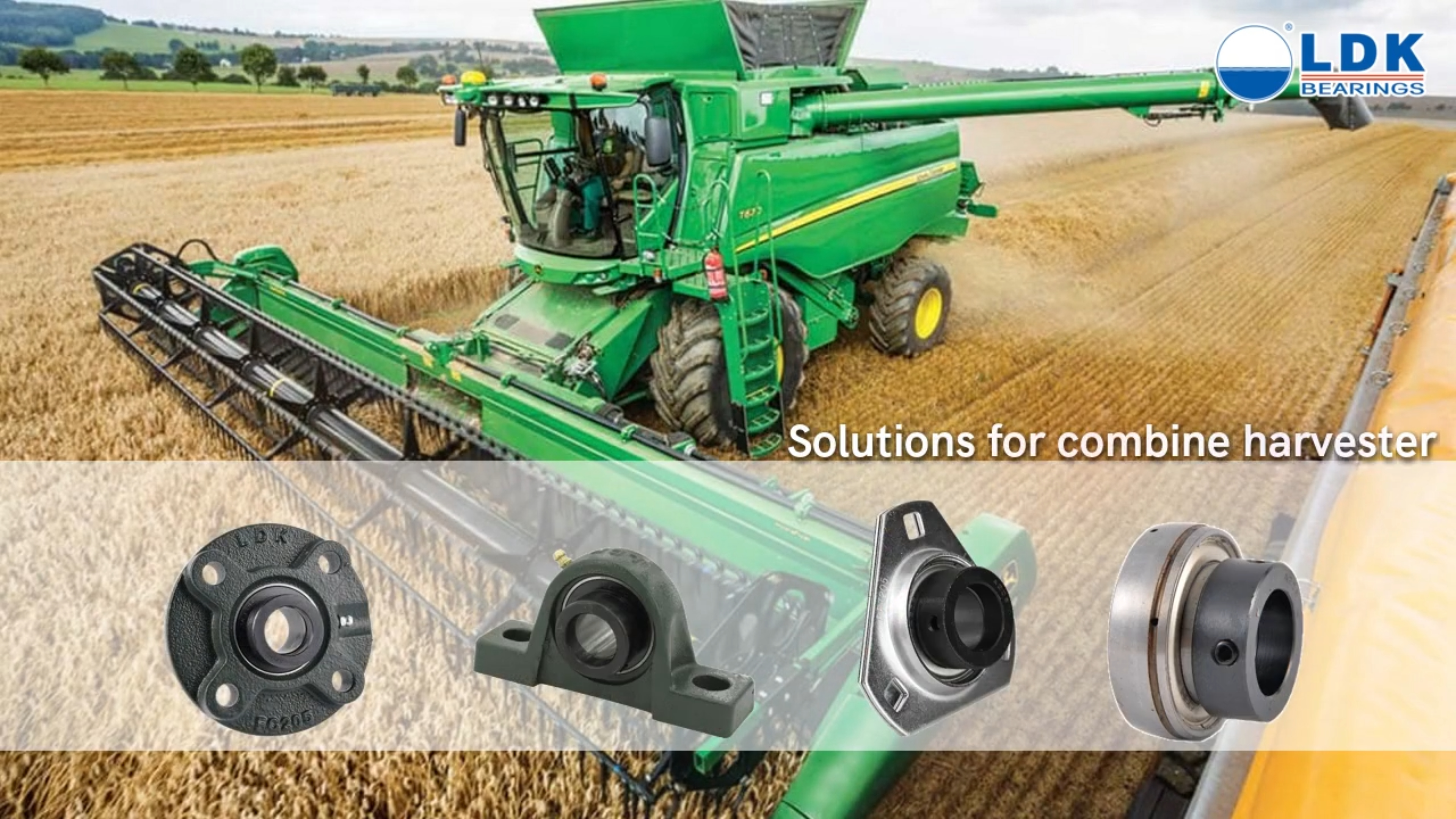
Disk harrow pillow block bearings are matched by three interfaces, not by one bore dimension: the shaft interface, the housing mount, and the insert and lubrication system. For a disk harrow, start with the dedicated disk harrow bearing range when the hub assembly is designed for it. For other agricultural implements, confirm whether the shaft is square-bore or round-bore, then select the housing and insert for load, shock, dust, mud and corrosion. Stainless steel units such as SSUCP2..A or SSUCF2..A, and plastic housings such as WP-SSBF or WP-SSBFL, are conditional alternatives for moisture-exposed or corrosive zones, not automatic upgrades for tillage duty.
This guide uses the supplied LDK product and application data to show how the choice changes by implement, bore style and working condition. LDK (Deyuan Smart Technology (Fujian) Co., Ltd) is a bearing manufacturer established in 1986 that produces pillow block bearings, rod end bearings and spherical plain bearings. Its published profile states that it makes both bearings and housings in one place and offers insert bearing bore sizes from 10 mm to 140 mm across more than 100 combinations of materials and housing types. More detail on the company and its mounted units is available at LDK Bearings.
What makes agricultural bearing selection different?
Agricultural machinery operates in full outdoor conditions: dust, mud, chemical fertilizer and pesticide corrosion, high humidity, heavy load, high impact and strong vibration. The supplied application data gives an ambient range of -10°C to +45°C for agricultural machinery and lists sealing, corrosion resistance, easy installation and disassembly, and stable operation among the special requirements. Those conditions change the selection order. A bearing that fits the shaft may still fail the application if the housing cannot take the shock, the seal cannot keep out abrasive mud, or the grease cannot tolerate the operating temperature and water exposure.
The practical consequence is that farm implement bearings should be selected as part of the implement assembly. The disk harrow bearing, square-bore bearing or round-bore bearing is not a stand-alone commodity chosen by shaft diameter alone. The hub, mounting face, insert locking, seal, lubrication point and replacement procedure all belong to the same decision. This is why a catalogue code should be confirmed against the implement drawing and the actual working condition before it is ordered for a production run or a field replacement.
Disk harrow bearings: what the assembly demands
A disk harrow bearing is a dedicated agricultural bearing used in a high-shock, abrasive and often corrosive assembly. In the supplied LDK agriculture bearing range, the disk harrow group includes ST491A, ST491A-I, ST491A-II, ST491B, ST491B-I and ST491B-II, as well as ST209-1 1/8, ST209-1 1/8-1 and ST209-1 1/8-11. The same group lists DHU45R-209, DHU55R-211 and DHU55R-211-I, ST211-1 3/4, ST211-2 3/16 and its variants, DHU40S-211 and FD211-1 1/2.
These model names are useful only when they are matched to the hub drawing, shaft end, seal arrangement and lubrication method. A disk harrow works close to the soil, so the bearing sees dust and mud directly. Fertilizer and pesticide residues can add a corrosion load, and impact from soil and obstructions adds shock. The supplied agricultural application data specifically calls for bearings designed for high-speed vibration, high shock loads, corrosion resistance, good sealing, easy installation and disassembly, and stable operation. A replacement should therefore be checked against those functions, not merely against the old bearing’s outside diameter.
For a disk harrow, the first question is whether the assembly is a dedicated disk harrow hub or a standard mounted unit installation. If it is the former, use the disk harrow range or the exact approved replacement drawing. If it is the latter, a mounted pillow block or flange unit may be appropriate, but the housing fit and insert must still be verified for shock, sealing and alignment. The model list alone does not prove that one disk harrow bearing will replace another.
Square-bore versus round-bore agriculture bearings
Square-bore and round-bore agriculture bearings differ at the shaft interface. A square-bore bearing must fit the square section of the shaft, including its actual dimensions and the way torque and location are carried. A round-bore bearing fits a cylindrical shaft and depends on the locking method to hold position. Neither interface is universally better. The correct choice is the one that matches the implement shaft and the approved hub or housing design.
The supplied LDK agriculture range lists both types. Square-bore models include 205NPPB AH02, 206NPPB AH02, 206NPPB AH04, 207NPPB AH09, 207KPP3, 207KPP17 and 207KPPB3. The wider square-bore list includes W208PPB13, W208PPB6, W208PP5, W208PPB5, W208PP8, W208PPB8, W208PPB11, W208PPB12, W209PPB5, W210PP4, W210PPB4, W211PP3, W211PPB3, W211PP5 and W211PPB6. Round-bore models include 205PPB7, W208PPB7, W208PP10, W208PPB23, W209PPB2, W209PPB4, W210PP2, W210PPB2, W211PP2 and W211PPB2.
A square bore is not a round bore with a different insert. The shaft geometry changes the fit, the installation method and the spare-part identity. Before substituting one for the other, confirm the shaft form, the housing bore, the locking arrangement and the axial location. If the implement shaft is square, a round-bore bearing should not be forced onto it through an adapter unless the implement maker has approved that arrangement. If the shaft is round, the square-bore model may be dimensionally irrelevant even if the outside housing looks similar.
Bore, housing fit and insert selection in seven steps
The safest way to select a farm implement bearing is to work from the machine outward. Start with the implement and the failed or planned bearing location, then move to the shaft, housing, insert, lubrication and verification. This order prevents a common error: choosing a bearing because it is available, then discovering that the housing bolt pattern, bore fit or seal does not match the machine.
- Identify the implement and bearing location. Record whether the bearing is in a disk harrow hub, planter, mower, rake, baler, tillage tool, seeder, forage harvester, combine, cotton picker or grain elevator. The supplied agricultural application list includes these machine types, but the actual mounting point still needs to be identified from the parts drawing or machine inspection.
- Measure the shaft interface. For a square-bore bearing, record the square dimensions and the shaft end condition. For a round-bore bearing, record the shaft diameter and tolerance. Note the axial location and any shoulder or spacer. Do not use the old bearing’s bore alone as the specification.
- Confirm the housing fit. Check the mounting format: pillow block base, two-bolt flange, four-bolt flange, cartridge, hanger or another assembly-specific housing. Verify bolt spacing, center height, base flatness, pilot fit, clearance to moving parts and access for installation. A housing that bolts on but sits at the wrong height can misalign the shaft and load the insert.
- Define the mechanical duty. Record load direction, shock, vibration, speed and continuous or intermittent operation. Agricultural machinery is listed under heavy load, high impact and high-speed vibration, so a light-duty industrial selection is not automatically transferable. The insert series and housing material must be approved for the actual duty.
- Define the exposure. Record dust, mud, fertilizer or pesticide contact, humidity, washdown and ambient temperature. The agricultural range is stated as -10°C to +45°C, but local conditions and machine areas can differ. Sealing and corrosion resistance belong in the selection, not in a later accessory decision.
- Select the insert and locking method. The insert is the bearing cartridge inside the housing. LDK’s mounted unit range covers multiple insert families, including UC2, UC3, UCX, SA2, SB2, NA2, UK2, SUC2 and related stainless steel inserts. Locking methods in the supplied data include set screw, eccentric locking and adapter sleeve locking. For high-shock or high-vibration applications, the locking method and installation direction must follow the approved drawing and instructions.
- Select the grease and verify the assembly. Grease choice must match temperature, water exposure, load and relubrication. For a critical implement, request the exact model drawing, material declaration, grease data, end-cover or seal details, and installation guidance before release. A sample or first-article check is appropriate when the bearing is new to the machine.
These steps also explain why housing material and insert material should be decided together. A cast iron pillow block with a chrome steel insert may be appropriate for a dry, high-shock zone, while a stainless steel unit may be more relevant in a wet or corrosive zone if its load and temperature ratings fit. Mixing those decisions without checking the whole assembly can create a mismatch that is not visible in a catalogue heading.
When stainless steel inserts and units make sense
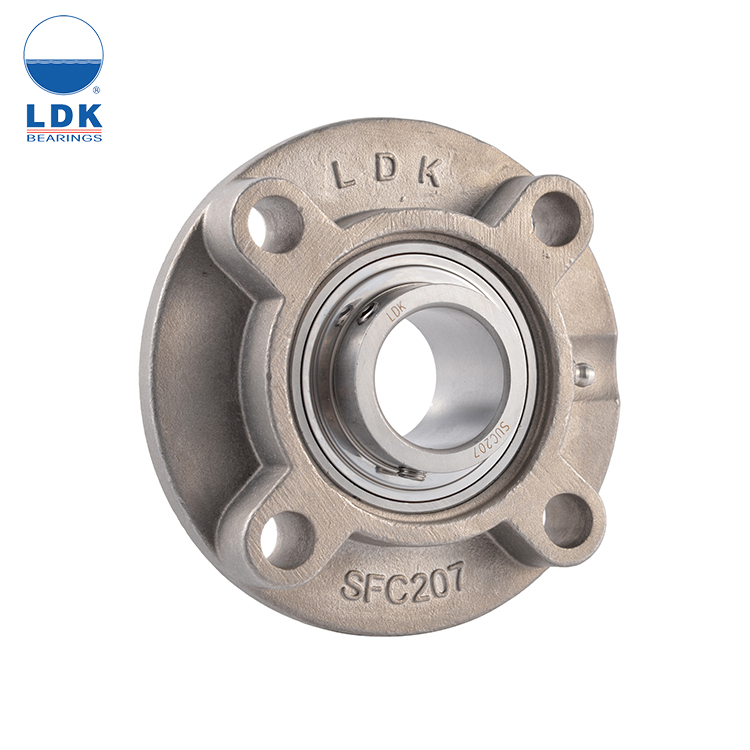
Stainless steel bearing units may suit moisture-exposed or corrosive conditions when the exact unit is approved for the load, speed, temperature and lubrication. In the supplied data, SUC2 is listed as a stainless steel bearing insert, while SSUCP2..A and SSUCF2..A are stainless steel mounted unit ranges. These are relevant where fertilizer, pesticide, mud, washdown or humid storage creates a corrosion risk that a standard painted housing and chrome steel insert should not be expected to carry indefinitely.
The supplied stainless steel flange cartridge example, SSUCFC, gives a useful indication of what to verify. Its catalogue data lists a stainless steel 304 housing, stainless steel 440 inner bearing, set screw locking, food-grade grease with a silicone rubber seal, self-aligning and relubricable design, end cover availability, a shaft diameter range from 20 mm to 60 mm or 3/4 inch to 2-7/16 inch, and an operating temperature range of -35°C to 102°C. That data describes SSUCFC, not every stainless unit. For SSUCP2..A or SSUCF2..A, confirm the exact model’s dimensions, material, load rating, temperature range and grease before use.
Code caution: RFQs can name SSER, SUK2, SUC2, SSUCP2..A and SSUCF2..A in the same corrosion-resistant discussion. The supplied catalogue directly verifies SUC2 as a stainless steel insert and SSUCP2..A and SSUCF2..A as stainless steel mounted unit ranges. SSER and SUK2 must be checked against their own drawings and material declarations before they are treated as equivalent. A similar code is not proof of dimensional or metallurgical interchangeability.
Stainless steel is a material choice, not a load rating. A stainless housing or insert can still be the wrong choice if the bearing is undersized for shock, if the seal does not match the mud and washdown, or if the grease cannot tolerate the temperature. The buyer should separate three questions: is stainless needed for corrosion, is the unit mechanically strong enough for the implement, and is the lubrication and sealing suitable for the actual field condition. All three answers must be yes.
Custom grease and plastic housing alternatives
Lubrication is an application-specific part of the bearing choice. LDK lists Customized Bearing Inserts Special Grease as an option. A supplied cold-storage conveyor case used a customized insert with special grease and reported proper operation in a -50°C environment, with stable low-temperature performance and longer service life cited as the result. That case is useful because it shows the principle: the grease is selected for the environment, not chosen generically. It does not prove that the same grease will suit a muddy, hot, wet or high-shock agricultural bearing.
For agricultural implements, the grease decision should follow the actual ambient temperature, water and mud exposure, load, speed and relubrication interval. A grease that works in a cold store is not automatically the right grease for a disk harrow in humid field conditions. If the machine operates across a wide temperature range or is cleaned frequently, state those conditions in the RFQ and ask for the approved grease and seal combination for the exact unit.
Plastic bearing units WP-SSBF and WP-SSBFL are listed in the LDK plastic bearing unit range as alternative housing choices. They are relevant where a non-metallic housing is appropriate for the mounting, chemical exposure and load, and where the exact unit’s temperature and mechanical limits are accepted. They should not be treated as a default replacement for a cast iron pillow block in high-shock tillage. The supplied catalogue data in this article does not establish a universal agricultural load rating for WP-SSBF or WP-SSBFL; the selection must be based on the exact model’s approved limits and the implement manufacturer’s requirement.
Use cases across agricultural implements
Disk harrows. Use the dedicated disk harrow bearing range when the hub is designed for it, and verify the exact model against the hub, shaft end, seal and grease. The main risks are shock, dust, mud and corrosion from fertilizer or pesticide residue. A standard pillow block is not a substitute unless the machine design and mounting permit it.
Planters, seeders and tillage tools. These are listed agricultural applications. The choice may involve square-bore or round-bore bearings depending on the shaft and hub design. Confirm the actual soil-engaging assembly and the mounting position. A bearing that fits one planter row unit may not fit another if the shaft form, housing or seal has changed.
Mowers, rakes and balers. These machines combine field dust with vibration and frequent movement. Easy installation and disassembly matter because field replacement may be needed. Sealing against dust and plant debris, plus a locking method that stays secure under vibration, should be checked together with the housing fit.
Grain elevators and material handling. The agricultural application list also includes grain elevators and related equipment. In these positions, dust and continuous operation can be more important than direct soil contact. The housing format, insert seal and relubrication access should match the actual conveyor or elevator assembly rather than a generic catalogue page.
Comparison table: matching the main options
The table below compares the option families discussed in this guide using the supplied data. It is a selection aid, not a claim that any one option is universally better than another.
| Option | Primary role | Supplied catalogue examples | What to verify before use |
|---|---|---|---|
| Disk harrow bearing | Dedicated agricultural bearing for disk harrow hub assemblies | ST491A, ST491B, DHU45R-209, ST209-1 1/8, DHU55R-211, ST211-1 3/4, DHU40S-211, FD211-1 1/2 | Hub drawing, shaft end, seal, grease, exact size and approved replacement identity |
| Square-bore agriculture bearing | Square shaft interface in agricultural equipment | 205NPPB AH02, 206NPPB AH04, 207NPPB AH09, 207KPP3, W208PPB13, W210PP4, W211PP3 | Square dimensions, shaft condition, locking, housing fit, load and seal |
| Round-bore agriculture bearing | Cylindrical shaft interface in agricultural equipment | 205PPB7, W208PPB7, W209PPB2, W210PP2, W211PP2 | Shaft diameter and tolerance, locking method, housing, load and seal |
| Stainless steel mounted unit | Moisture-exposed or corrosive zones where the exact unit is approved | SSUCP2..A, SSUCF2..A; SSUCFC data includes 304 housing, 440 bearing, food-grade grease and silicone rubber seal | Material grade, load rating, temperature range, grease, end cover and exact dimensions |
| Plastic flange unit | Alternative housing where load, temperature and chemical exposure are accepted | WP-SSBF, WP-SSBFL | Exact unit limits, mounting pattern, shaft fit, load, temperature and chemical compatibility |
RFQ checklist for agricultural pillow block bearings
- Machine type and bearing location, with a photo or drawing of the assembly.
- Shaft type and dimensions: square-bore or round-bore, including actual measurement and tolerance.
- Housing format and mounting dimensions: base or flange, bolt spacing, center height, pilot and clearance.
- Load, shock, speed and operation pattern, including whether the machine runs continuously.
- Exposure: dust, mud, fertilizer or pesticide contact, humidity, washdown and ambient temperature.
- Required insert material and locking method, plus any stainless steel or plastic housing requirement.
- Lubrication requirement: standard grease, custom grease, relubrication access and food-grade or other special condition where relevant.
- Commercial and quality checks: required model drawing, material declaration, traceability, sample approval and packaging needs.
For OEM programs, LDK’s supplied capability data lists 300,000 units monthly capacity, a 5,000-unit MOQ and a 30-90 day lead time. Those are capability data, not a quotation for a specific bearing. Model, material, packaging and delivery terms still need confirmation against the actual order. LDK’s profile also states IATF16949 certified manufacturing facilities and testing that includes fatigue life, tensile strength, noise and vibration, and salt spray, which are relevant checks when an agricultural bearing is exposed to vibration and corrosion.
Frequently asked questions
What should I measure first on a disk harrow pillow block bearing?
Measure the shaft and the hub interface first, then the housing mounting. Do not start with the bearing outside diameter alone. Record the shaft type and dimensions, the bearing location, the housing bolt pattern or base height, and the seal and lubrication arrangement. On a disk harrow, the assembly drawing and the exact replacement identity are more reliable than a visual match.
Can square-bore and round-bore agriculture bearings be interchanged?
No, not without engineering verification. Square-bore and round-bore bearings fit different shaft forms. Interchange requires confirmation of shaft geometry, housing bore, locking, axial location and load path. A similar housing outline does not make the bearing interchangeable.
When should I choose stainless steel bearing units for farm equipment?
Choose stainless steel when moisture, fertilizer, pesticide, mud or washdown creates a corrosion risk that the standard unit is not approved to carry, and when the exact stainless unit’s load, speed, temperature, grease and seal limits fit the duty. In the supplied catalogue, SUC2 is a stainless steel insert and SSUCP2..A and SSUCF2..A are stainless steel mounted unit ranges. SSER and SUK2 should be checked on their own drawings before being treated as equivalents.
Are plastic bearing units WP-SSBF and WP-SSBFL suitable for agricultural implements?
They can be considered as alternative housing choices where the exact unit’s load, temperature, chemical exposure and mounting limits are accepted. They are not a default replacement for cast iron in high-shock tillage. The decision should be made from the implement duty and the exact model data, not from the housing material name alone.
Can custom grease solve low-temperature or wet operating problems?
Custom grease can address a specific lubrication requirement, but it must be matched to the application. LDK lists customized bearing inserts with special grease, and a supplied cold-storage conveyor case reported proper operation at -50°C with a custom grease. For an agricultural implement, state the ambient temperature, water and mud exposure, load and relubrication plan. LDK can review the shaft, housing, load, exposure and lubrication details for a specific implement, and a sample or drawing check can confirm the catalogue match before a production order.
Conclusion
Disk harrow pillow block bearing selection starts with the assembly, not the catalogue page. Confirm whether the machine uses a dedicated disk harrow bearing, a square-bore agriculture bearing or a round-bore bearing, then verify the housing fit, insert locking, sealing and lubrication for the actual field conditions. Stainless steel units and plastic housings can be useful alternatives in the right moisture or corrosion zone, but they must meet the same mechanical and temperature limits as any other option.
For a current agricultural project, use the implement drawing, shaft measurement and exposure details to narrow the LDK range. The supplied LDK product brochure provides further reference, while the exact model drawing and approved grease data should be confirmed before ordering.
Have Questions or Need More Details?
Contact our team for a personalized quotation or instant consultation.
Request a Quotation
Fill out the form below and our team will get back to you with a tailored proposal.
WhatsApp Direct Chat
Prefer to chat in real-time? Message us on WhatsApp for instant assistance & quick answers.
- Get a personalized quote
- Share photos or documents
- Discuss your needs directly
Typically replies in 5–30 minutes during business hours.