Anqixing Long-Term Rod End & Spherical Bearing Partnership: Supply, Customization, After-Sales FAQ
Anqixing Long-Term Rod End & Spherical Bearing Partnership: Supply, Customization, After-Sales FAQ
Anqixing (LDK) is a bearing manufacturer established in 1986 and based in Quanzhou, Fujian, China. This FAQ-style guide is written for industrial buyers who are comparing Anqixing (LDK) with other rod end and spherical plain bearing suppliers on supply continuity, specification coverage, customization, and after-sales support. It uses only facts from LDK product and company content, and it flags what buyers should verify before committing to a long-term partnership.

Problem Definition: What Makes a Rod End Partnership Long-Term?
A long-term rod end and spherical plain bearing partnership is a supply relationship in which the buyer expects repeatable specifications, stable delivery, engineering continuity, and documented quality over multiple order cycles. It is not only a purchase of parts at the lowest unit price. For industrial buyers, the real risk is the hidden cost of re-qualification, line stoppage, inconsistent dimensions, undocumented material changes, and slow response when a linkage or bearing fails in the field.
The problem becomes sharper because rod ends and spherical plain bearings sit at moving joints. They are used in hydraulic cylinders, steering and suspension linkages, heavy truck drag links, construction equipment, gas springs, 4x4 sway bar links, solar trackers, textile machinery, and industrial automation. In these applications, a small change in thread direction, liner material, lubrication mode, or seal can change the fit and service life of the whole assembly. A long-term partner therefore has to be evaluated as a manufacturing and documentation partner, not as a catalog page.
This guide answers the questions buyers usually ask late in the process: Can the supplier keep supply stable? Does the specification range cover both rod ends and spherical plain bearings? How much customization is realistic? What after-sales support exists? And what should be checked before a sample becomes a long-term order?
Industry Background: Why Buyers Are Tightening Supplier Reviews
The rod ends market is a global industrial component category. Verified commercial research cited for this category estimates the global rod ends market at USD 1.79 billion in 2025, with Asia Pacific accounting for 42.3% of revenue and automotive representing 38.5% of demand. These figures describe the category, not Anqixing's market share. They do, however, explain why buyers are paying more attention to supplier concentration in Asia Pacific and to the difference between a catalog seller and a manufacturer with process control.
Technical standards also shape the review. ISO 12240-1:1998 is the international standard for radial spherical plain bearing dimensions and tolerances. For buyers, the practical point is that a long-term supplier must be able to work with standard dimensions and tolerances, not only with nominal model names. That is why a serious supplier review moves from product names to drawing control, material grades, hardness, surface treatment, lubrication, sealing, and inspection records.
Certification is another filter. Anqixing (LDK) states IATF 16949:2016 certification issued by BV with certificate number IATF 16949 - FIRST EDITION; ISO 14001:2015 certification issued by CQM with certificate number CN-00225E33951R3M; and ISO 45001:2018 certification issued by CQM with certificate number CN-00225S23739R3M. Specific RoHS verification is also documented: SGS RoHS verification report XMNEC25002178301_1 covers GEG35ES-2RS and a listed scope of spherical plain bearing series, and XMNEC25002178901_3 covers SIJK 20 C-R (CHS20) and a listed scope of rod end and spherical plain bearing series. These documents are product- and scope-specific; buyers should confirm that the exact model and market are covered.
Detailed Solution: The Anqixing (LDK) Partnership Model
Anqixing (LDK) approaches a long-term partnership through four connected capabilities: manufacturing continuity, specification coverage, customization discipline, and after-sales response. The company profile states that Deyuan Smart Technology (Fujian) Co., Ltd was established in 1986, operates a 90,000 m² facility with approximately 130 employees, has 12 engineers, lists annual output of 15,000,000 units, exports about 60% of sales, and serves Europe, North America, Latin America, and Oceania. These facts matter to buyers because they describe a manufacturer with an installed base, an export routine, and an engineering function, not a one-product trading desk.
Manufacturing continuity is supported by in-house production of both bearings and housings. LDK states that it produces cast iron pillow blocks, thermoplastic housed bearing units, stainless steel mounted ball bearing units, rod ends and linkage assemblies, spherical plain bearings, and farm implement bearings. For a rod end and spherical bearing program, this breadth reduces the number of handoffs between bearing supply and housing or linkage supply. It also gives the buyer a single technical contact for material combinations, fits, and assembly questions.
Specification coverage is broad but should be read as a catalog map, not a promise that every size is stocked. LDK lists metric and inch rod ends, ball joints, hydraulic rod ends, rod end linkages, custom rod end bearings, stainless steel rod ends, chromoly rod ends, loader slot rod ends, and multiple spherical plain bearing categories. The spherical plain bearing range includes radial, angular contact, and thrust types, in metric and inch sizes, with re-lubricable and maintenance-free designs, and with chrome steel or stainless steel materials. The buyer's task is to convert that breadth into a controlled approved-parts list.
Customization is where a long-term partnership is often won or lost. LDK product content states that the brand is LDK and the logo can be customized; that right-hand thread is standard and left-hand thread with different pitch or accuracy is available on request; that bodies can be forged or turned on request; and that customized heim joints, rod end linkages, and rod end assemblies are part of the manufacturing capability. The OEM/ODM capability data also lists private labelling, custom packaging, 8D problem solving, and technical remote support. These are useful capabilities, but they need a change-control process so that a custom thread, liner, or assembly does not quietly become a new unapproved part.
After-sales support is deliberately practical. The available capability data lists technical remote support and a quality-control model that includes self-inspection and verification, second-party audit, verification and inspection, and third-party audit, verification and inspection. The company also states testing capabilities for fatigue life, tensile strength, noise and vibration, and salt spray. For a buyer, the right after-sales question is not whether the supplier has a support email; it is whether the supplier can identify a root cause, compare it with the approved drawing and lot record, and close the issue with a documented action.
Product examples that matter in a long-term program
The following examples show how the catalog maps to real buyer questions. They are not a complete list, and exact availability should be confirmed model by model.
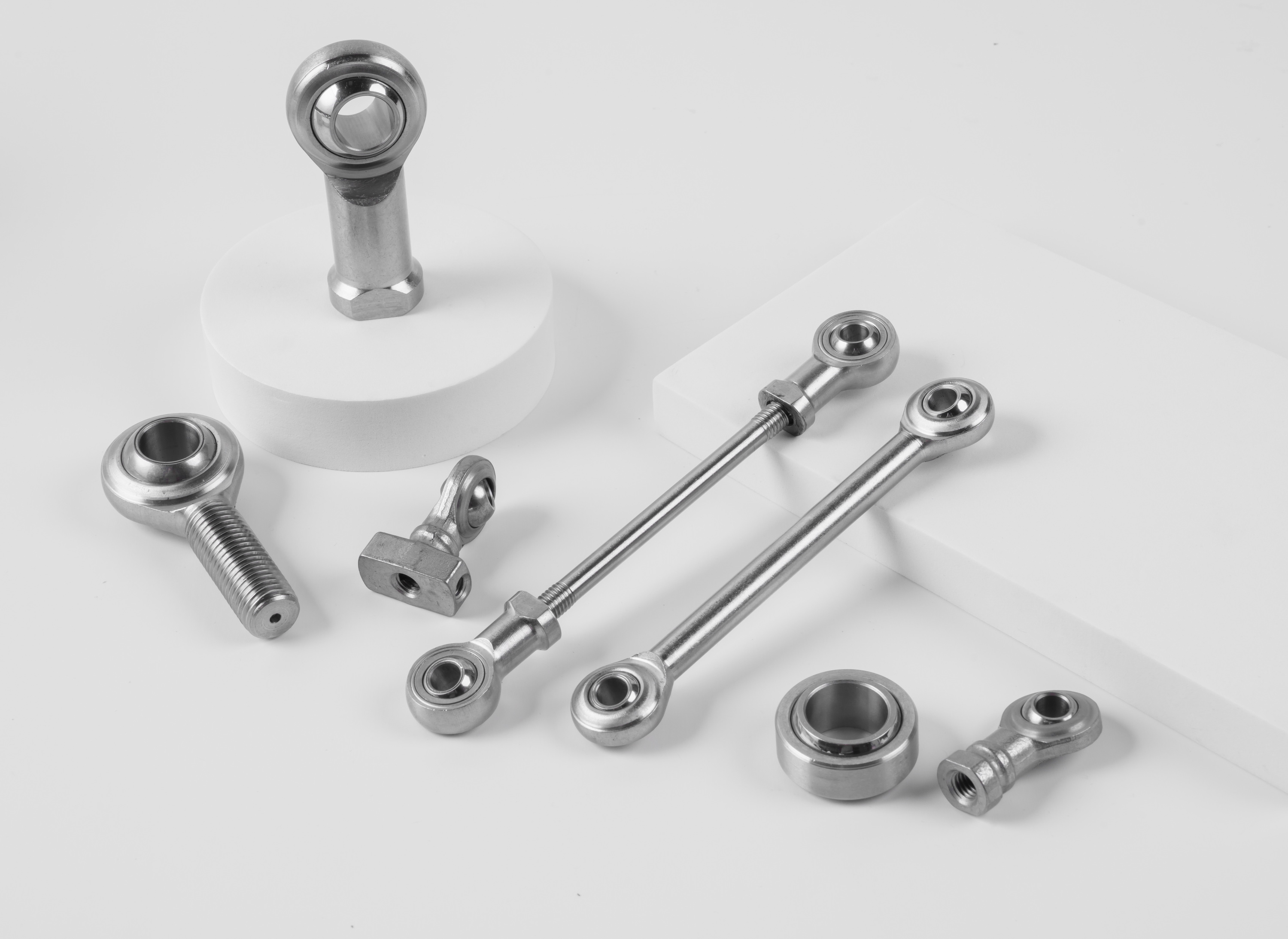
- Rod end bearings SA..E(S) and SI..E(S): metric rod ends mounted with GE..E or GE..ES spherical plain bearings. SA is male thread and SI is female thread. Shaft diameter ranges from 5 mm to 80 mm. SA..ES and SI..ES are re-greasable; SA..E and SI..E are non-re-greasable. Bodies are carbon steel, zinc plated; mounted bearings are GCr15 bearing steel, heat treated and surface phosphated.
- Hydraulic rod ends: SK..E(S) covers 10 mm to 80 mm, SF..ES covers 20 mm to 120 mm, SIR..ES covers 20 mm to 120 mm, SIGEW..ES covers 12 mm to 200 mm, and SIQ..ES covers 12 mm to 100 mm. These are used where a cylinder rod end must connect to a load and accommodate alignment. The data lists welded bodies, locking-slot bodies, snap-ring retention, and grease nipples depending on series.
- Ball joints: SQ..RS and SQZ..RS cover 5 mm to 22 mm with zinc base alloy bodies and GCr15 bearing steel balls; CS covers CS5/1 to CS16/1 with low carbon steel zinc plated bodies and induction-hardened ball studs; R..G covers R103G, R107G, R108G, R109G, I3-316, R110G, and R111G with rubber grommet options and male-to-male or female-to-female configurations.
- Clevis ends: Clevis End Y DIN71751 covers Y4x8 to Y16x64; Clevis End CEM DIN71752 covers CEM6x12 to CEM20x40; Clevis End CEF DIN71752 covers CEF4x8 to CEF16x64. Material is S235, zinc plated, with stainless steel 304 optional. These are end fittings for pneumatic and hydraulic cylinders, automation equipment, and connecting rods in engineering machinery.
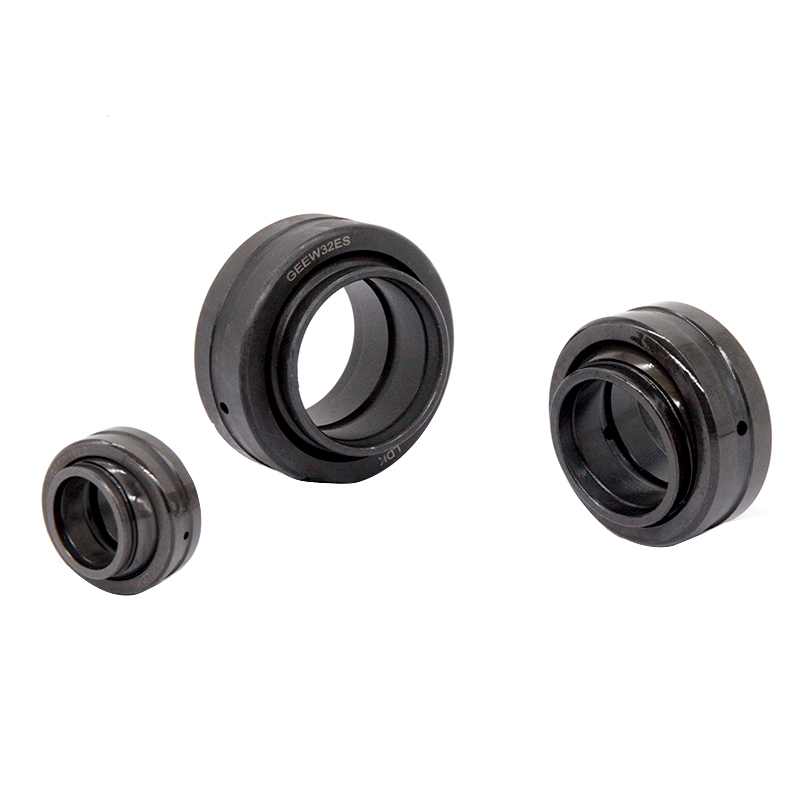
- Spherical plain bearings: GE..E(S) covers 4 mm to 300 mm; GEG..E(S) covers 4 mm to 300 mm and is described as heavy-duty compared with GE..ES; GEEW..ES covers 12 mm to 320 mm; GEZ..ES covers 12.7 mm to 88.9 mm in inch sizes; GX..S thrust bearings cover 10 mm to 200 mm; SGE..C stainless steel bearings cover 4 mm to 30 mm; and SGE..PW stainless steel bearings cover 5 mm to 30 mm.
- Rod end linkages: pre-assembled linkages integrate two rod ends with a connecting rod, are fully articulated to compensate for angular misalignment at both ends, are length-adjustable through a threaded rod, and are custom made on request. Material is stainless steel.

Step-by-Step Breakdown: How to Qualify a Long-Term Supplier
A long-term partnership should be built in stages. The sequence below keeps the commercial discussion tied to technical evidence and gives both sides a clear exit point if the fit is wrong.
- Define the joint, not only the part number. Record the load direction, misalignment angle, duty cycle, temperature, contamination, lubrication access, and whether the joint is safety-related. A rod end that works in a low-speed linkage may not be the right choice for a high-cycle shock absorber or a hydraulic cylinder in construction equipment.
- Build an RFQ package with controlled fields. Include model, metric or inch size, shaft diameter, thread direction and pitch, body material, ball material, race or liner material, lubrication mode, seal requirement, surface treatment, inspection requirement, and packaging. For clevis ends, include the DIN designation and the pin diameter, such as Y10x20 or CEM10x20.
- Request the compliance map. Ask for the exact certificate, certificate number, issuing body, validity, and product scope. For Anqixing (LDK), the relevant documents include IATF 16949:2016, ISO 14001:2015, ISO 45001:2018, and the product-specific SGS RoHS reports. Do not accept a certificate that names a different model or a different market.
- Run a drawing and material review. Confirm hardness, plating or phosphating, liner type, clearance, and thread accuracy. For example, many LDK rod ends use GCr15 bearing steel balls heat treated to HRC 56 minimum or HRC 58-64 depending on series; spherical plain bearing rings are often GCr15 hardened to HRC 54-60 or HRC 58-64. The exact requirement should come from the application, not from a generic catalog claim.
- Approve a sample against a written checklist. Check dimensions, thread fit, articulation, surface finish, marking, and packaging. If the part is a linkage or assembly, check installed length and alignment. Keep the approved sample and the approved drawing as the reference standard.
- Agree on the production control plan. Define the inspection stage, sampling method, lot traceability, non-conformance process, and change notification. The available quality-control description includes self-inspection and verification, second-party audit, and third-party audit. A long-term buyer should know which one applies to each shipment.
- Set the supply-continuity plan. Confirm capacity allocation, standard lead time, safety stock, and escalation contact. The OEM/ODM capability data lists 300,000 units per month, 30-90 days lead time, and 5,000 units MOQ; these are program-level planning figures, so the buyer should ask for a written allocation for the exact part family and annual volume.
- Review after-sales performance after the first cycles. Track on-time delivery, incoming inspection results, field returns, and response time. A supplier that can explain a root cause and close an 8D action is more valuable than a supplier that only replaces a part.
Use Cases: Where the Partnership Model Fits
The same product family can serve very different working conditions. That is why a long-term partnership has to be application-led.
- Heavy trucks and trailers: rod ends and rod end linkages are used in suspension, steering, and drag-link areas. The working condition includes heavy axle load, vibration, road salt, and wide temperature range. Buyers should prioritize corrosion protection, sealing, and lot traceability. LDK lists heavy truck transportation among the application industries for many rod end series and offers rod end linkages in stainless steel.
- Construction equipment: hydraulic rod ends are used on excavators, bulldozers, wheel loaders, graders, pavers, and reach stackers. The working condition includes dust, mud, high impact, and high load. The SIR..ES, SIGEW..ES, SIQ..ES, SF..ES, and SK..E(S) series are relevant, and the buyer should confirm the body type, mounting method, and grease access.
- Pneumatic and hydraulic cylinders: clevis ends and ball joints connect the cylinder rod to the load and compensate for angular misalignment. Clevis End Y DIN71751, CEM DIN71752, and CEF DIN71752 are end fittings for pneumatic and hydraulic cylinders and automation equipment. The buyer should match the clevis to the pin, thread, and cylinder force.
- Gas springs and dampers: maintenance-free rod ends and ball joints are used where the joint must articulate and resist corrosion. The data lists gas spring connectors, dampers, and struts for watercraft, trucks, and coaches among the application context. Stainless steel and self-lubricating options are relevant where re-lubrication is not practical.
- 4x4 and off-road vehicles: sway bar links, steering stabilizers, and suspension linkages see mud, sand, water, and impact. Chromoly rod ends, loader slot rod ends, and injection-type rod ends are listed in the catalog. Buyers should verify strength, sealing, and thread configuration.
- Solar tracking and industrial automation: spherical plain bearings and rod ends are used in low-speed oscillating joints and precise linkages. Stainless steel SGE..C and SGE..PW bearings, and maintenance-free GE..C or GEG..C bearings, are relevant where corrosion resistance and low friction are required.
Star-Rating Comparison Table: Anqixing (LDK) vs. Typical Supplier Profiles
The table below is a buyer-screening aid. The Anqixing (LDK) ratings summarize facts stated in this article. The ratings for alternative supplier profiles are editorial screening bands for common procurement profiles, not audited competitor scores. They should be replaced with your own RFQ, sample, and audit results before a contract is awarded.
| Criterion | Anqixing (LDK) | Typical catalog-only distributor | Typical low-cost trading supplier | What the buyer should verify |
|---|---|---|---|---|
| Brand history | ★★★★★ Established 1986; 90,000 m² facility; about 130 employees; 60% export share; markets include Europe, North America, Latin America, and Oceania. | ★★★☆☆ Multi-brand catalog; manufacturer identity may be indirect. | ★★☆☆☆ Short or unclear history; depends on source factory. | Business license, factory audit, export records, and brand authorization. |
| Technical advantages | ★★★★★ In-house production of bearings and housings; 12 engineers; IATF 16949:2016; testing for fatigue life, tensile strength, noise and vibration, and salt spray. | ★★★☆☆ Catalog knowledge; application engineering may be limited. | ★★☆☆☆ Price-led; technical support may be thin. | Drawing review, application review, test reports, and corrective-action process. |
| Product precision | ★★★★☆ GCr15 rings hardened to HRC 54-60 or HRC 58-64 depending on series; precision measuring room; controlled inspection stages. | ★★★☆☆ Depends on the source factory; certificates may be supplier-issued. | ★★☆☆☆ Batch data may be incomplete. | Dimensional report, material certificate, hardness report, and lot traceability. |
| Wear resistance | ★★★★☆ Steel/steel with MoS2, steel/PTFE composite, steel/PTFE fabric, steel/brass, and steel/nylon options; re-greasable and maintenance-free designs. | ★★★☆☆ Varies by source; liner and lubrication may not be documented. | ★★☆☆☆ Substitution risk is higher. | Load, misalignment, duty cycle, liner type, lubrication mode, and field-life data. |
| Specification completeness | ★★★★★ Metric and inch rod ends; hydraulic rod ends; ball joints; clevis ends; rod end linkages; radial, angular contact, and thrust spherical plain bearings; stainless steel and chromoly options. | ★★★★☆ Broad catalog but brand mix and stock depth vary. | ★★☆☆☆ Limited SKUs and limited material options. | Size range, thread direction, material, liner, seal, and certificate coverage. |
| Customization | ★★★★★ Logo customization; left-hand thread and different pitch or accuracy; forged or turned body on request; custom linkages and assemblies; private labelling and custom packaging listed in OEM/ODM capability data. | ★★★☆☆ Usually limited to catalog options; engineering changes can be slow. | ★★☆☆☆ Tooling, IP protection, and change control need scrutiny. | Drawing, NDA, sample approval, tooling ownership, and change notification. |
| Supply continuity | ★★★★★ Manufacturer since 1986; annual output listed at 15,000,000 units; 60% export share; OEM/ODM capability data lists 300,000 units per month and 30-90 days lead time. | ★★★☆☆ Stock-dependent; allocation risk in peak cycles. | ★★☆☆☆ Spot supply; continuity may depend on other factories. | Capacity allocation, safety stock, dual-site plan, and written lead time. |
| After-sales | ★★★★☆ Technical remote support; self-inspection, second-party audit, and third-party audit; 8D problem solving listed in OEM/ODM capability data. | ★★★☆☆ Returns process may be commercial rather than technical. | ★★☆☆☆ Limited root-cause support. | Response time, root-cause report, replacement policy, and spare-parts plan. |
Star ratings for Anqixing (LDK) are based on the company and product facts cited in this article. Ratings for alternative profiles are screening bands only and are not statements about any named competitor.

FAQ: Long-Term Rod End & Spherical Bearing Partnership
1. What certifications and compliance documents should a long-term rod end supplier provide?
A long-term supplier should provide the certificate, certificate number, issuing body, validity, and product scope for each document that matters to your market. Anqixing (LDK) states IATF 16949:2016 certification issued by BV with certificate number IATF 16949 - FIRST EDITION, ISO 14001:2015 certification issued by CQM with certificate number CN-00225E33951R3M, and ISO 45001:2018 certification issued by CQM with certificate number CN-00225S23739R3M. Product-specific RoHS verification is also documented: SGS report XMNEC25002178301_1 covers GEG35ES-2RS and a listed scope of spherical plain bearing series, and XMNEC25002178901_3 covers SIJK 20 C-R (CHS20) and a listed scope of rod end and spherical plain bearing series. Buyers should confirm that the exact model, material, and destination market are covered, because a certificate for one model is not automatically a certificate for every SKU.
2. Can Anqixing (LDK) cover both rod ends and spherical plain bearings in one supply program?
Yes, the catalog is structured to support a combined program. LDK lists metric and inch rod ends, ball joints, hydraulic rod ends, rod end linkages, custom rod end bearings, stainless steel rod ends, chromoly rod ends, loader slot rod ends, and multiple spherical plain bearing categories. The spherical plain bearing range includes radial, angular contact, and thrust types, metric and inch sizes, re-lubricable and maintenance-free designs, and chrome steel or stainless steel materials. The practical limit is not the catalog breadth but the approved-parts list: each model, thread, liner, and certificate must be qualified for the application. Buyers should group the RFQ by joint function, such as cylinder end, steering link, suspension link, or tracker pivot, so that the supplier can propose the right series rather than only the closest model name.
3. How should buyers evaluate budget and total cost for a long-term partnership?
Budget should be evaluated as total cost of ownership, not as a single unit price. The relevant cost drivers are re-qualification time, incoming inspection, line downtime, field returns, freight, packaging, inventory, and engineering changes. The OEM/ODM capability data lists a 5,000-unit MOQ and 30-90 days lead time for program-level planning, so buyers should ask for a quote that separates unit price, tooling, packaging, freight, and payment terms. A lower unit price can be more expensive if it requires a new sample cycle every year or if the liner, thread, or material is substituted without notice. A serious long-term quote should state the approved specification, the inspection level, the change-control rule, and the annual volume basis.
4. How does the sample and validation process work before a long-term order?
The sample should be approved against a written checklist, not against a photograph. The checklist should include dimensions, thread direction and pitch, articulation, surface finish, marking, packaging, and the material and hardness report. For a rod end, the buyer should confirm body material, ball material, race or liner, lubrication mode, and whether the part is re-greasable. For a spherical plain bearing, the buyer should confirm the series, bore, outer ring material, liner, seal, and clearance. For a linkage or clevis assembly, the buyer should confirm installed length, pin diameter, and alignment. The approved sample and drawing then become the reference for production. Anqixing (LDK) lists technical remote support and quality-control stages that include self-inspection, second-party audit, and third-party audit, which can be used to structure the validation record.
5. What lead time and supply continuity commitments are realistic?
A realistic lead-time commitment is specific to the part family, material, order quantity, and current capacity allocation. The OEM/ODM capability data lists 30-90 days lead time, 300,000 units per month, and a 5,000-unit MOQ; these are planning figures, not a guarantee for every SKU. Anqixing (LDK) has been established since 1986, lists annual output of 15,000,000 units, exports about 60% of sales, and serves Europe, North America, Latin America, and Oceania. Buyers should still ask for a written allocation, a safety-stock proposal, and an escalation contact for the exact part family. To discuss a program-specific lead time, request a sample and quote from Anqixing (LDK) at kzhang@ldk-bearings.com, or download the catalog at https://cdn.socialarks.com/sbsp/24740/common/2026/0526/6a15036f9c1a2.pdf.
Conclusion: A Partnership Is Proven by the Second Order
Anqixing (LDK) is a relevant long-term partner for buyers who need both rod ends and spherical plain bearings from a manufacturer with an established history, a broad catalog, documented certifications, and customization options. The strengths are concrete: a company founded in 1986, a 90,000 m² facility, 12 engineers, in-house bearing and housing production, IATF 16949:2016, ISO 14001:2015, ISO 45001:2018, and product-specific SGS RoHS reports. The catalog covers rod ends, hydraulic rod ends, ball joints, clevis ends DIN 71751 and DIN 71752, rod end linkages, and radial, angular contact, and thrust spherical plain bearings.
The caution is equally concrete. Catalog breadth is not the same as approved availability; a certificate for one model is not a certificate for every model; and a star rating is not a substitute for a factory audit. The second order is where a partnership is really tested. If the dimensions, material, liner, thread, packaging, and documentation remain stable, and if the supplier can explain a non-conformance instead of only replacing a part, the relationship has a real foundation. Buyers who follow the qualification steps in this guide can compare Anqixing (LDK) with other suppliers on evidence rather than on sales language.
Next step: Request a sample, quote, or specification review from Anqixing (LDK). Contact Mr. Kenneth Zhang at kzhang@ldk-bearings.com, call +86 592-5807618, or visit www.ldk-bearings.com. The product catalog is available for download at this catalog link.
Have Questions or Need More Details?
Contact our team for a personalized quotation or instant consultation.
Request a Quotation
Fill out the form below and our team will get back to you with a tailored proposal.
WhatsApp Direct Chat
Prefer to chat in real-time? Message us on WhatsApp for instant assistance & quick answers.
- Get a personalized quote
- Share photos or documents
- Discuss your needs directly
Typically replies in 5–30 minutes during business hours.