
What Are Spherical Plain Bearings and Rod End Linkages? A Buyer's Basic Lexicon
A first-time industrial buyer rarely struggles with the drawing. The struggle is the vocabulary. The same part is quoted as a rod end, a heim joint or a rose joint; a short code such as SI 20 ES hides bore size, thread direction, sliding contact surface and sealing; and one catalogue page mixes spherical balls, spherical plain bearings, rod ends and complete linkages as if everyone already knew the difference.
This article is a lexicon rather than a ranking. It defines each building block in plain language, follows the design logic from a single spherical ball to a finished rod end linkage, and lists the main families inside the LDK product line, from standard designs to heavy-duty designs. The aim is narrow and practical: after reading it, a newcomer should be able to open a quotation line, a drawing note or a supplier datasheet and know what every word refers to.

Why Naming Is the First Real Procurement Problem
In LDK catalogue data, rod end bearings are also indexed under the names heim joint, rose joint and fish eye bearing. Spherical plain bearings appear under three headings at once — Spherical Plain Bearing, Plain Bearing and Radial Spherical Plain Bearing — and engineers from other industries often call the same ball-and-socket style a spherical bearing. A buyer searching only one of those terms can miss a supplier who lists the part under another.
Three different parts are also routinely confused, and the difference matters before a single price is compared:
- The spherical plain bearing — an inner ring with a convex spherical surface running inside a matching outer ring. It has no shank and no housing of its own.
- The rod end bearing — that same bearing mounted inside a housing that ends in a threaded shank, male or female. This is the part that is screwed or bolted into a linkage.
- The rod end linkage — an assembly: two rod ends connected by a rod, delivered ready to install.
The confusion has consequences. A buyer who orders a rod end when the assembly actually needs a bare spherical plain bearing pressed into an existing housing receives a part that cannot be installed. A buyer who ignores thread direction or sliding contact surface receives a part that fits but wears on a different schedule than the assembly was designed for.
The shortest way out of that problem is to learn the terms in the order the parts are actually built — which is the order used in the rest of this article.
Where These Components Sit in the Wider Bearing Market
The global plain bearing market was valued at USD 10.4 billion in 2024 and is expected to reach USD 17.8 billion by 2034 (Dataintelo). Read as a single headline figure, that number is misleading: market sizing for plain bearings shifts with the scope of each report. A separate estimate from Strategic Market Research places the same 2024 market at USD 13.3 billion. Buyers should treat any single market figure as a scope-dependent estimate rather than a specification.
Within that broader space, the global rod ends market was valued at USD 1.79 billion in 2025, with Asia Pacific holding a 42.3% revenue share (Dataintelo). Automotive applications are the largest single demand segment, at approximately 38.5% of that market (Dataintelo). At manufacturing level, China's bearing industry reported record revenue of CNY 231.5 billion in 2024, a 6.2% year-on-year increase (China Bearing Industry Association).
Standards give this vocabulary its backbone. Spherical plain bearings are governed by international standard ISO 12240, which is organised as Part 1 for radial bearings, Part 2 for angular contact bearings, Part 3 for thrust bearings and Part 4 for rod ends. That four-part structure is why a quotation can name a series such as GE..ES, GAC..T or SI..E(S) and still be talking about one standard family.
LDK — Deyuan Smart Technology (Fujian) Co., Ltd — was established in 1986 and manufactures rod end bearings, spherical plain bearings and pillow block bearings on a 90,000 m² site with approximately 130 employees and an annual output of 15,000,000 units, exporting about 60% of production to Europe, North America, Latin America and Oceania. Third-party coverage of the company notes 100% in-house production for over 3,000 SKUs of rod ends and spherical bearings, together with IATF 16949 certification (EIN Presswire).
The Lexicon: Five Building Blocks of the Product Line
1. Spherical ball — the starting shape
A spherical ball is the inner element before anything is wrapped around it. LDK produces the TK series from 5 mm to 30 mm and the HJMX series from 9.525 mm to 19.05 mm, both with a polished surface, hard chrome plating, heat treatment to HRC 58-64, and availability in GCr15 steel or 440 stainless steel. Both series are customizable on request. The ball is where the load path begins, and its hardness and surface finish set the practical limit for everything built around it.

2. Spherical plain bearing — the ball, wrapped
A spherical plain bearing pairs that ball with an outer ring whose bore is machined to the same spherical radius, so the inner ring can tilt and oscillate while the outer ring stays fixed in its housing. That tilting ability is the entire point of the family: it absorbs angular misalignment instead of forcing the joint to bind.
The LDK range covers several sliding contact systems and load classes:
- GE..E(S) — metric radial series from 4 mm to 300 mm shaft diameter with steel-on-steel sliding surfaces treated with MoS2. The outer ring is fractured and carries a groove and lubrication holes on all versions except the GE..E series; the GE..ES versions are re-greasable and the 2RS design is fitted with seals at both sides.
- GEG..E(S) — the same 4 mm to 300 mm shaft range, described in the catalogue as heavier-duty compared with the GE..ES series.
- GEEW..ES — 12 mm to 320 mm, with an inner ring that has cylindrical extensions at each side and an annular groove plus lubrication holes in each ring.
- GE..C and GEG..C — maintenance-free versions with a PTFE composite sliding surface, 4 mm to 30 mm, with GEG..C again the heavier-duty of the two.
- GE..PW — maintenance-free with a PTFE composite surface, 5 mm to 30 mm.
- GE..ET-2RS and GEG..ET-2RS — maintenance-free with a PTFE fabric liner and seals at both sides, 15 mm to 300 mm and 15 mm to 280 mm respectively. From 140 mm upward the outer ring uses the XT design, axially split and held together by retaining rings.
- SGE..ET-2RS, SGE..C, SGE..PW — stainless steel versions built with a 304 stainless outer ring and a 440 stainless precision-ground ball.
- GEZ..ES and COM / COM..T — inch-series radial bearings spanning 12.7 mm to 88.9 mm (0.5" to 3.5") and 4.825 mm to 25.4 mm respectively.
- GAC..T and GACZ..S — angular contact spherical plain bearings for combined radial and axial load: 25 mm to 200 mm in the metric GAC..T series with a steel/PTFE fabric contact, and 12.7 mm to 82.55 mm in the inch GACZ..S series with a steel-on-steel contact treated with MoS2.
3. Rod end bearing — the bearing with a shank
A rod end bearing is a spherical plain bearing mounted inside a housing that ends in a threaded shank. The shank connects the joint to the rest of the machine, and it is the reason rod ends are quoted with a thread direction as well as a bore size. In LDK catalogue data this family is also indexed as heim joints, rose joints and fish eye bearings.
The range reads most easily by construction type:
- Three-piece, re-greasable: PHS and POS (female and male, 3 mm to 30 mm, forged body with turned body on request, steel/brass contact) plus the inch PHSB series from 4.826 mm to 25.4 mm.
- Two-piece, maintenance-free: PHS..EC and POS..EC (3 mm to 22 mm), and the inch CM..T and CF..T series with a steel/PTFE sliding surface.
- Mounted types: SI..E(S) and SA..E(S) use a separate GE..E or GE..ES spherical plain bearing inside the housing, 5 mm to 80 mm, steel-on-steel and re-greasable in the ES version. SI..C / SA..C and SI..ET-2RS / SA..ET-2RS mount the maintenance-free GE..C and GE..ET-2RS bearings instead.
- Stainless steel: SPHS / SPOS, CHS / COS, SCHS / SCOS, plus the inch SPHSB..EC / SPOSB..EC and the SJM..T / SJF..T series with a heat-treated 17-4PH body and race.
- Heavy-duty: JMX..T and JFX..T use a heat-treated alloy steel body and race with a steel/PTFE composite contact from 4.826 mm to 25.4 mm and are described as heavy-duty load rating applications. NEXM / NEXF and NXM / NXF are injection-type rod ends with an alloy steel body and a nylon polymer race containing a PTFE additive, also rated for heavy-duty loads.
- Studded versions: CM..Y and CF..Y add a stud to the two-piece body for applications where one side of the joint is fixed.
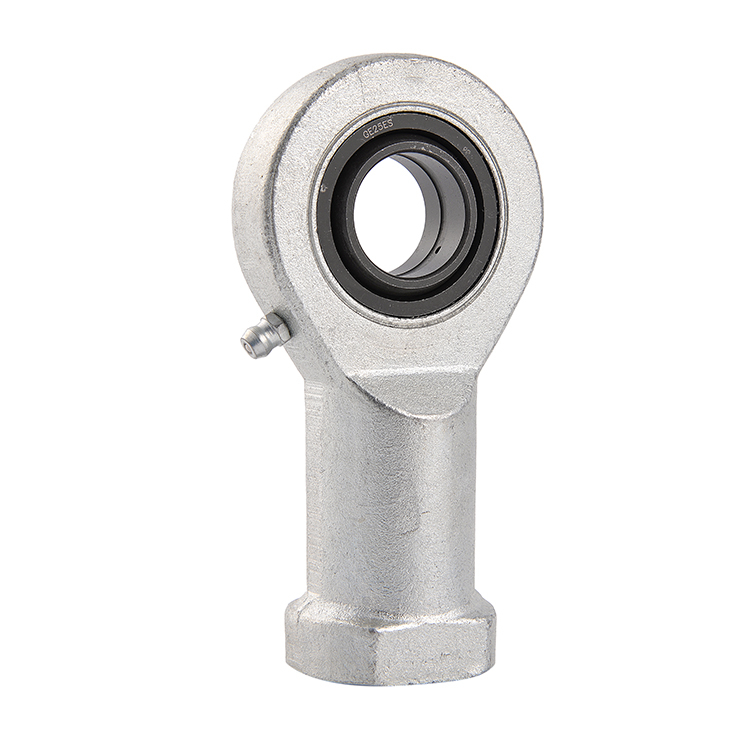

4. Hydraulic rod ends and clevis end fittings — the cylinder end of the family
Hydraulic rod ends are the heavy end of the same idea, built to be attached to a cylinder rather than screwed onto a linkage. LDK produces them in three attachment styles: welded (SK..E(S) from 10 mm to 80 mm, and SF..ES from 20 mm to 120 mm with a rectangular welding face), and locking-slot types clamped by socket screws (SIR..ES and SIQ..ES from 20 mm and 12 mm respectively, and SIGEW..ES up to 200 mm shaft diameter). All are steel-on-steel with a grease nipple on the re-greasable versions, and the mounted spherical plain bearing is retained in the housing by snap rings.
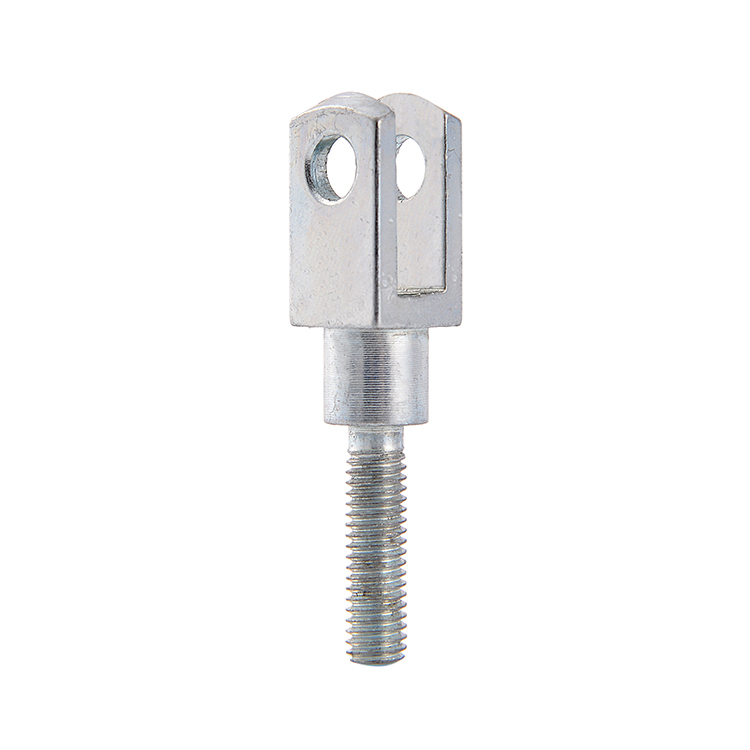
Clevis end fittings complete the joint where a pin connection is required instead of a threaded shank: CEM (DIN 71752, male thread, 6 mm to 20 mm), CEF (DIN 71752, female thread, 4 mm to 16 mm) and Y (DIN 71751, 4 mm to 16 mm), produced in S235 steel with zinc plating and optional stainless steel 304. They are used on pneumatic and hydraulic cylinders, automation equipment and connecting rods in engineering machinery.
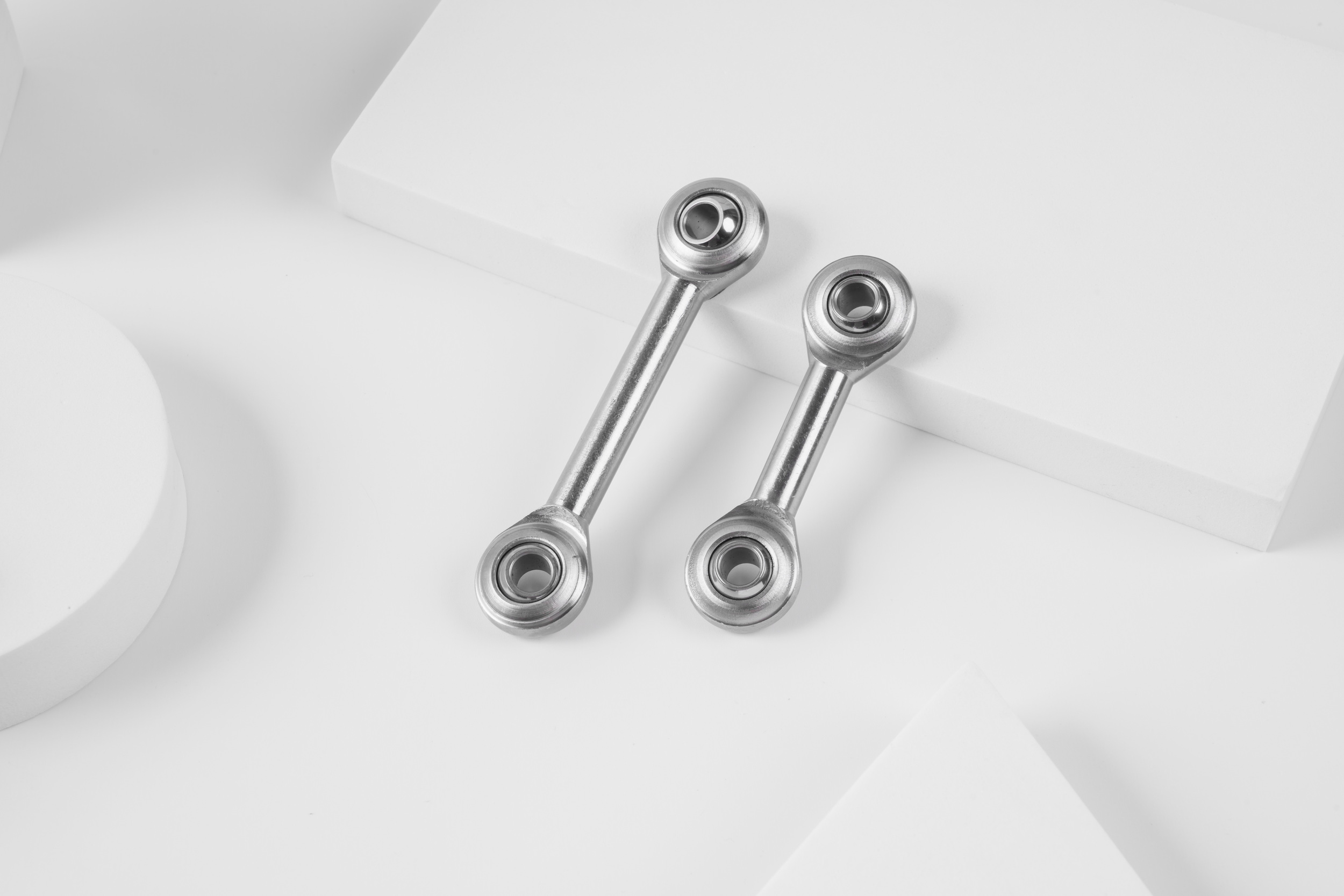
5. Rod end linkage — the finished assembly
A rod end linkage is the complete answer rather than a component. It integrates two rod ends with a connecting rod, is fully articulated so it compensates for angular misalignment at both ends, and is length-adjustable through a threaded rod for precise installation alignment. LDK builds them in stainless steel, custom-made on request, for automotive, industrial and aerospace linkages.
The words that appear on every quotation
Once the building blocks are clear, most of the remaining confusion comes from a small set of recurring terms. The table below maps each term to what it means in practice and where it appears in LDK product data.
| Term | What it means in practice | Where it appears in LDK data |
|---|---|---|
| Male / female thread | The shank either carries an external thread (male) or has an internal threaded bore (female). The two are separate series and are not interchangeable. | POS versus PHS; SA..E(S) versus SI..E(S); COS versus CHS |
| Right-hand / left-hand thread | Series are supplied with right-hand thread as standard; left-hand thread and different thread pitch or accuracy are available on request. This is what makes turnbuckle-style adjustment possible. | Listed across the metric and inch rod end ranges |
| Sliding contact surface | The material pair inside the joint. It determines friction, load behaviour and whether the part needs lubrication at all. | Steel/Steel (MoS2 treated), Steel/Brass, Steel/PTFE composite, Steel/PTFE fabric, Steel/nylon |
| Maintenance-free vs re-greasable | Maintenance-free parts rely on a PTFE composite, PTFE fabric or nylon contact. Re-greasable parts accept a grease fitting, shown by a "Z" suffix on some series. | Maintenance-free: GE..C, GE..PW, GE..ET-2RS, PHS..EC. Re-greasable: GE..ES, PHS/POS, M6Z, CM6Z |
| 2RS | A bearing fitted with seals at both sides, used in dusty, humid or washdown positions. | GE..ET-2RS, SI..ET-2RS, SA..ET-2RS, GEZ..ES-2RS |
| Body construction | How the rod end housing itself is made, which is a useful proxy for load class and cost. | Forged body, turned body on request (PHS/POS/PHSB); turned body (SPHS/SPOS); heat-treated alloy steel (JMX..T, NXM/NXF); 17-4PH stainless (SJM..T) |
| Shaft / bore diameter | The first number a buyer checks, and the one that must match the mating pin, stud or shaft. | From 3 mm (PHS, COS) up to 320 mm (GEEW..ES) |
From Spherical Ball to Complete Linkage: A Five-Step Build Sequence
The conceptual flow from a ball to a working linkage follows five steps. Reading a quotation becomes much easier once that sequence is familiar, because every designation carries information about one of these stages.
- Step 1 — Start with the ball. A spherical ball such as the TK or HJMX series defines the inner geometry: 5 mm to 30 mm for TK, 9.525 mm to 19.05 mm for HJMX, hard chrome plated and heat treated to HRC 58-64.
- Step 2 — Wrap it in an outer ring. Adding an outer ring with a matching spherical bore produces a spherical plain bearing. Choosing a radial design (GE..E(S)) or an angular contact design (GAC..T) at this stage decides whether the joint carries pure radial load or a combination of radial and axial load.
- Step 3 — House it and add a connection. Mounting the bearing inside a rod end housing with a threaded shank produces a rod end bearing such as SI..E(S). Mounting it inside a cylindrical body that is welded or clamped produces a hydraulic rod end such as SK..E(S) or SIR..ES.
- Step 4 — Choose the contact and lubrication regime. Steel-on-steel with MoS2 is the conventional choice where high load and periodic greasing are acceptable. A PTFE composite, PTFE fabric or nylon contact is the choice where the joint cannot be re-lubricated — for example inside a sealed cylinder or a maintenance-free off-road linkage.
- Step 5 — Complete the assembly. Two rod ends plus a threaded connecting rod produce a rod end linkage. Where the joint is closed by a pin rather than a thread, clevis end fittings such as CEM, CEF or Y take over that role.
Why the sequence matters for procurement: a drawing usually specifies only the final assembly. Buyers who know which of the five stages each parameter belongs to can tell immediately whether a quoted substitute changes the ball, the bearing, the housing, the lubrication regime or only the attachment — and that is the difference between a valid alternative and an incompatible one.
Use Cases: What the Working Environment Asks of the Part
Application data is the practical bridge between vocabulary and selection. The same rod end family can be correct in one environment and unsuitable in another, because temperature, contamination and load direction change which design features matter.
| Application | Typical equipment | Working conditions in the corpus | What it implies for the part |
|---|---|---|---|
| 4x4 off-road and recreational vehicles | Sway bar link kits, anti-rock sway-bar adapter brackets, steering stabilizers; sand rails, dune buggies, baja bugs, rock crawlers, Jeeps and trucks | Direct immersion in mud, sand or water; very high impact from rock crawling or jumping; strong vibration; -20°C to +50°C; high humidity; corrosion from mud and salt | High strength and precision, self-lubricating or maintenance-free operation, and sealing against mud and sand |
| Pneumatic and hydraulic cylinders | Air cylinders, actuators, automation equipment, connecting rods in engineering machinery | 0°C to +60°C; moderate dust; medium load; high cycle frequency from repeated extension and retraction | Low friction, wear resistance and tolerance of angular misalignment; hydraulic rod ends SK..E(S), SF..ES, SIR..ES, SIQ..ES, SIGEW..ES |
| Construction equipment and heavy trucks | Excavators, bulldozers, wheel loaders, graders, pavers, reach stackers; heavy trucks and trailers | -20°C to +50°C on site and -30°C to +100°C on trucks; high dust and mud; heavy load; salt spray | Self-aligning design, sealing against dust and water, large misalignment capability and corrosion resistance |
| Printing and dyeing equipment | Indoor textile printing and dyeing lines | 24/7 operation; drying section 60-80°C with roller surfaces up to 200°C; steam humidity; inks, solvents and acid or alkali dyes | High-temperature resistance, moisture resistance and corrosion resistance |
| Solar tracking | Photovoltaic and photothermal panel drives | Continuous outdoor exposure; -20°C to +60°C; UV; sand and dust; rain and high humidity; coastal salt spray; low-speed oscillating motion | Low friction torque and maintenance-free operation over years of service |
| Industrial automation | Robotic arms, textile equipment, utility vehicles, medical and rehabilitation equipment | 0°C to +40°C indoor; low to medium load; precise motion | Durability with long maintenance-free intervals, low noise and precise motion transfer |
Comparison: The Family Ladder From Standard to Heavy-Duty
The table below compares the main families on four decision-relevant points — designation range, size range, sliding contact and what the catalogue says about load class or service mode. It is the fastest way to see how a standard design differs from a heavy-duty one before prices are compared.
| Family | Designation range | Bore / shaft range | Sliding contact | Notes from the data |
|---|---|---|---|---|
| Radial spherical plain bearing, standard | GE..E(S) | 4-300 mm | Steel/Steel, MoS2 treated | Fractured outer ring with groove and lubrication holes; re-greasable; 2RS seals available |
| Radial spherical plain bearing, heavy-duty | GEG..E(S) | 4-300 mm | Steel/Steel, MoS2 treated | Described as heavier-duty compared with GE..ES |
| Radial spherical plain bearing, maintenance-free | GE..C / GEG..C, GE..PW, GE..ET-2RS / GEG..ET-2RS | 4-30 mm; 5-30 mm; 15-300 mm and 15-280 mm | Steel/PTFE composite or Steel/PTFE fabric | No relubrication; ET-2RS versions sealed at both sides; XT outer ring design from 140 mm |
| Angular contact spherical plain bearing | GAC..T, GACZ..S | 25-200 mm; 12.7-82.55 mm | Steel/PTFE fabric; Steel/Steel | For combined radial and axial load; re-greasable designs available |
| Inch radial spherical plain bearing | GEZ..ES, COM, COM..T | 12.7-88.9 mm; 4.825-25.4 mm | Steel/Steel, MoS2; Steel/PTFE | Inch-based sizing for imported equipment |
| Stainless spherical plain bearing | SGE..ET-2RS, SGE..C, SGE..PW, SCOM | 15-60 mm; 4-30 mm; 5-30 mm | Stainless steel / PTFE | 304 stainless outer ring, 440 stainless ball |
| Rod end, three-piece re-greasable | PHS / POS, PHSB | 3-30 mm; 4.826-25.4 mm | Steel/Brass | Forged body, turned body on request; grease fitting by suffix |
| Rod end, two-piece maintenance-free | PHS..EC / POS..EC, CM..T / CF..T | 3-22 mm; 4.826-22.225 mm (CM..T) and 4.826-19.5 mm (CF..T) | Steel/PTFE composite | No grease fitting; sealed versions numbered with T |
| Rod end mounted on a separate bearing | SI..E(S) / SA..E(S), SI..C / SA..C, SI..ET-2RS / SA..ET-2RS | 5-80 mm | Steel/Steel; Steel/PTFE composite or fabric | The housing carries an interchangeable GE..E, GE..C or GE..ET-2RS bearing |
| Rod end, heavy-duty alloy steel | JMX..T / JFX..T, NEXM / NEXF, NXM / NXF | 4.826-25.4 mm; 4.826-19.5 mm | Steel/PTFE composite; Steel/nylon | Heat-treated alloy steel bodies; heavy-duty load rating applications |
| Rod end, stainless | SPHS / SPOS, SPHS..EC / SPOS..EC, SCHS / SCOS, SJM..T / SJF..T | 5-30 mm; 5-20 mm; 4.826-19.05 mm; 6.35-19.05 mm | Steel/Brass; Steel/PTFE composite | 304, 440 and 17-4PH stainless constructions |
| Hydraulic rod end | SK..E(S), SF..ES, SIR..ES, SIQ..ES, SIGEW..ES | 10-80 mm; 20-120 mm; 20-120 mm; 12-100 mm; 12-200 mm | Steel/Steel | Welded or locking-slot attachment; grease nipple on re-greasable versions |
| Clevis end fitting | Y (DIN 71751), CEM / CEF (DIN 71752) | 4-16 mm; 6-20 mm; 4-16 mm | Pin joint | S235 zinc plated, stainless steel 304 optional |
| Rod end linkage | Rod End Linkages | Assembly, custom made on request | Stainless steel | Two rod ends plus threaded connecting rod; fully articulated and length adjustable |
FAQ for First-Time Buyers
Which standard or certification should a newcomer check first?
Start with the product standard, then the manufacturing certificate. Spherical plain bearings are covered by ISO 12240, which separates radial bearings (Part 1), angular contact bearings (Part 2), thrust bearings (Part 3) and rod ends (Part 4) — so quotations naming a series such as GE..ES, GAC..T or SI..E(S) are speaking the vocabulary of one standard family. On the manufacturing side, LDK holds IATF 16949 certification for its production facility, and its OEM capability statement lists ISO 9001, ROHS, REACH and FDA compliance alongside IQC/IPQC/OQC inspection and traceability. When neither layer can be verified, the specification on the drawing cannot be confirmed either.
What actually makes a rod end heavy-duty?
In LDK's range, three things change together: body material, sliding contact and the stated load class. The standard PHS/POS series is a three-piece design from 3 mm to 30 mm with a forged carbon steel body and a steel/brass contact, re-greasable through a fitting. The JMX..T / JFX..T series moves to a heat-treated alloy steel body and race with a steel/PTFE composite contact and is described as a heavy-duty load rating application; the injection-type NEXM/NEXF and NXM/NXF series use an alloy steel body with a nylon polymer race containing a PTFE additive, also rated heavy-duty. In the spherical plain bearing range the same logic appears as GEG..E(S) being described as heavier-duty compared with GE..ES at the same 4 mm to 300 mm shaft range.
How do MOQ, capacity and lead time shape the cost discussion?
They usually matter more than the unit price line. LDK's OEM capability data lists a minimum order quantity of 5,000 units, a monthly capacity of 300,000 units, a lead time of 30 to 90 days, and on-time delivery performance of at least 95%. Custom packaging and private labelling are listed as available, which changes tooling and stocking plans rather than the part itself. A first-time buyer comparing two quotations should therefore compare them at the same quantity, packaging and delivery model — otherwise the apparently cheaper line is often quoting a different service level.
How should a new buyer validate a rod end before committing to volume?
Request samples and connect them to real test data. LDK's testing capabilities cover fatigue life, tensile strength, noise and vibration, and salt spray, while its ODM capability includes 2D and 3D prototyping plus durability, safety and performance testing. For a first project, the practical sequence is: define the working conditions and the sliding contact surface, request a sample in the correct thread direction and bore size, confirm fit and articulation in the actual assembly, then move to volume with the same specification locked. A sample request is also the fastest way to confirm that a supplier's catalogue designation matches your drawing.
What is a realistic lead time, and what should be confirmed while waiting?
For OEM production, LDK lists a lead time of 30 to 90 days, with export to global markets and technical remote support after delivery. During that window, three details are worth freezing in writing: thread direction and pitch (right-hand thread is standard, left-hand thread is available), the sliding contact surface and lubrication regime, and whether seals are required. Confirming those before production starts is far cheaper than correcting them after the parts arrive. Buyers who want to close the loop early can request a sample or quotation so that the designation is verified in the physical part before the production window opens.
Conclusion: Learn the Names, Then Choose the Family
The vocabulary of rod ends and spherical plain bearings is smaller than it looks. Five building blocks cover almost every quotation: the spherical ball, the spherical plain bearing wrapped around it, the rod end bearing that adds a threaded shank, the hydraulic rod end and clevis fitting that attach the joint to a cylinder or a pin, and the rod end linkage that assembles two rod ends into a finished link.
Once those words are clear, the decision stops being about names and becomes about working conditions: load, temperature, contamination, corrosion and whether the joint can be re-greased. That is the point at which the family ranges start to read like a decision list instead of a catalogue — standard GE..E(S) versus heavier-duty GEG..E(S), three-piece re-greasable PHS/POS versus maintenance-free PHS..EC/POS..EC, steel versus stainless 304 and 440, or the 17-4PH construction used in the SJM..T series.
LDK has manufactured rod ends and spherical plain bearings since 1986 from a 90,000 m² facility in Quanzhou, Fujian, with IATF 16949 certified production, approximately 130 employees and an annual output of 15,000,000 units.
Next Step: Sample, Quotation or Catalogue
Send the working conditions and the space available in your assembly, and LDK will confirm the family and designation that fits — spherical plain bearing, rod end, hydraulic rod end, clevis fitting or a complete linkage. Samples and quotations are available for evaluation.
Download the catalogue: LDK Rod Ends & Spherical Plain Bearings Product Catalogue (PDF)
Website: www.ldk-bearings.com
Contact: Mr. Kenneth Zhang · kzhang@ldk-bearings.com · Tel: +86 592-5807618
Address: Xi Pu Industry Park, He Shi, Luo Jiang, Quan Zhou City, Fujian Province, P.R. China. Zip: 362013
Have Questions or Need More Details?
Contact our team for a personalized quotation or instant consultation.
Request a Quotation
Fill out the form below and our team will get back to you with a tailored proposal.
WhatsApp Direct Chat
Prefer to chat in real-time? Message us on WhatsApp for instant assistance & quick answers.
- Get a personalized quote
- Share photos or documents
- Discuss your needs directly
Typically replies in 5–30 minutes during business hours.