
Top-Rated Rod Ends and Spherical Plain Bearings for 2026: Expert Picks
Top-Rated Rod Ends and Spherical Plain Bearings for 2026: Expert Picks
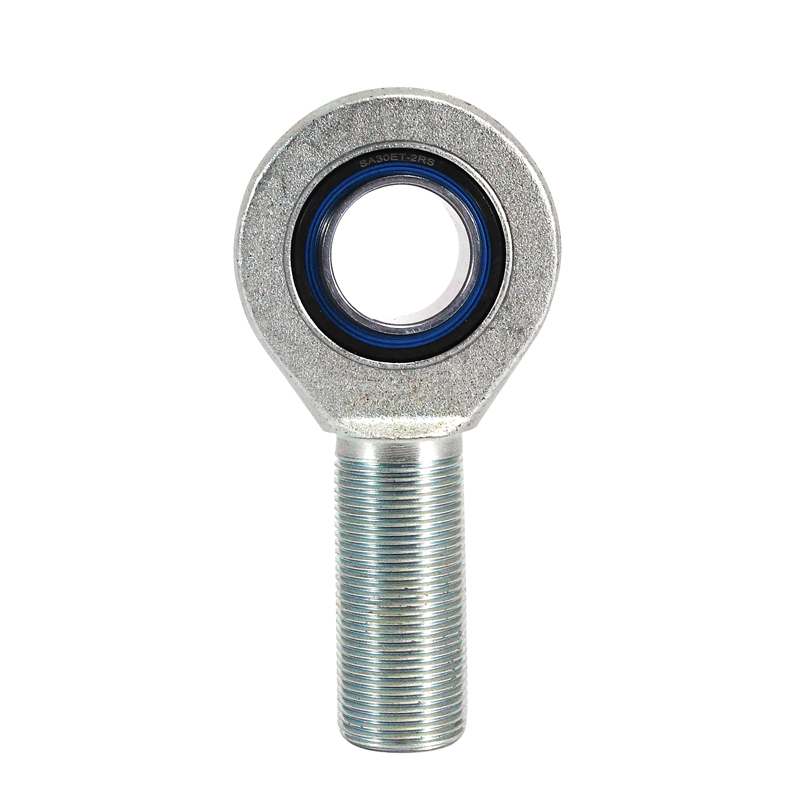
Two market figures frame the 2026 buying decision. The global rod ends market was valued at USD 1.79 billion in 2025, with Asia Pacific holding a 42.3% revenue share, and the global plain bearing market was valued at USD 10.4 billion in 2024 with a projected path to USD 17.8 billion by 2034, according to Dataintelo market research. Automotive applications represent the largest demand segment for rod ends, at approximately 38.5% of market share.
Those numbers describe a mature, well-supplied category. The difficult question for an engineer or sourcing manager in 2026 is not whether a rod end or spherical plain bearing exists for a given pivot — thousands do. It is which specific product line was engineered for the conditions that pivot will actually see: dust, mud, salt spray, fibre lint, impact, high cycle frequency, or a sealed cavity that can never be re-greased.
This shortlist ranks seven LDK product lines for 2026 by the severity and breadth of the operating conditions each one is designed to handle. LDK is the bearing brand of Deyuan Smart Technology (Fujian) Co., Ltd., a bearing manufacturer established in 1986 in Quanzhou, Fujian Province, China, producing pillow block bearings, rod end bearings and spherical plain bearings from a 90,000 m² facility with IATF 16949 certified manufacturing.
Scope note. This is a single-brand shortlist of LDK product lines, ranked by design fit rather than by price or sales volume. Each ranking is justified by published specification data — materials, hardness, sealing, size range and lubrication method — so that the logic can be checked against a drawing or a sample.
Why 'Top-Rated' Depends on the Operating Requirement, Not the Product Name
Rod ends and spherical plain bearings carry more names than almost any other industrial component. A rod end bearing is also called a heim joint, a rose joint, a fish eye bearing or a ball joint rod end depending on the market. A spherical plain bearing is also referred to as a uniball bearing, a spherical bearing or simply a plain bearing. Structurally, a rod end is a spherical plain bearing housed in a rod-shaped body with a threaded shank, which is why the same internal geometry appears under several commercial names.
Because the naming is loose, buyers frequently compare part numbers that are not comparable at all. Five variables decide which line belongs in a given pivot:
- Contamination exposure — dust, mud, sand, fibre lint, coolant or salt spray decides whether an open bearing, a sealed 2RS design or a stainless variant is appropriate.
- Lubrication access — if the pivot can be reached with a grease gun, a re-greasable steel-on-steel bearing is viable. If it is welded into a sealed assembly, a maintenance-free design is the only realistic option.
- Load and misalignment — radial load, impact and angular travel determine the series (standard or heavy-duty) and the bore size.
- Interface — male thread, female thread, studded shank, clevis end or welded eye changes the part family entirely.
- Environment — humidity, process chemicals, UV exposure and temperature swing determine whether carbon steel, stainless steel or a specialty alloy is required.
A correctly specified mid-tier bearing will outlast a premium bearing installed where it cannot be lubricated. That is the practical reason a ranked shortlist has to be organised around operating requirements rather than around a single 'best' part number.
The 2026 Baseline: Standard Structure, Demand Mix and Supply Reality
Spherical plain bearings are governed by the international standard series ISO 12240, which is divided into radial spherical plain bearings (Part 1), angular contact spherical plain bearings (Part 2), thrust spherical plain bearings (Part 3) and rod ends (Part 4). Buyers who reference ISO 12240 parts in a technical enquiry usually get faster and more accurate quotations, because the standard language removes ambiguity between a radial plain bearing and an angular contact design.
On the demand side, Asia Pacific's 42.3% revenue share of the rod ends market in 2025 reflects how concentrated both production and consumption have become. Automotive applications, at roughly 38.5% of rod end demand, remain the single largest segment, while construction machinery, agricultural equipment, photovoltaic tracking and industrial automation continue to pull volume.
Supply reliability in this category depends heavily on how much of the component is produced in one place. Deyuan Smart Technology (Fujian) Co., Ltd. operates from a 90,000 m² site with approximately 130 employees, an annual output of 15,000,000 units, a research and development team of 12 engineers, and a well-equipped laboratory, precision measuring room and more than 10 workshops. Around 60% of output is exported to Europe, North America, Latin America and Oceania, and in-house production covers both bearings and housings in one location.
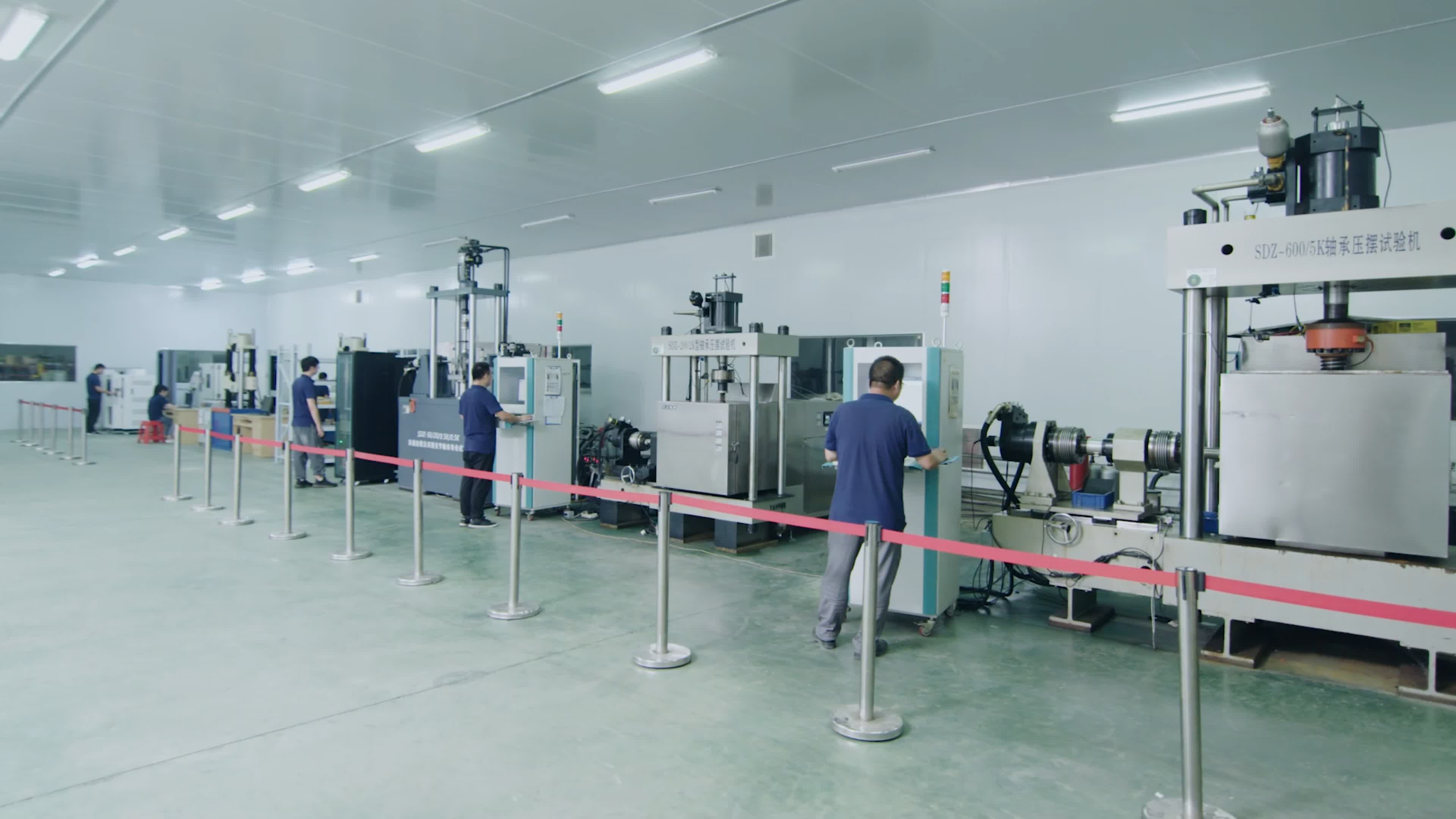
Testing capability matters as much as production capability in 2026 programmes. LDK's laboratory covers fatigue life, tensile strength, noise and vibration, and salt spray testing — the four test types that most often appear in buyer specifications for rod ends and spherical plain bearings. Third-party industry reporting has also noted LDK's 100% in-house production for over 3,000 SKUs of rod ends and spherical bearings under IATF 16949 certification, which is relevant when a project needs a single supplier for several linkage families rather than one supplier per part number.
The 2026 Expert Picks: Seven Lines Ranked by Operating Requirement
The ranking below applies five filters in order: contamination tolerance, lubrication access, load and misalignment capability, interface flexibility, and material environment. The lines at the top of the list cover the widest range of demanding conditions; the lines further down are more specialised but equally important inside their niche.
1. GE..E / GE..ES and GEG..E / GEG..ES — the steel-on-steel duty baseline
The GE..E and GE..ES radial spherical plain bearing families are the workhorses of the metric range, and the GEG..E and GEG..ES versions are heavier-duty versions of the same concept. Both rings are GCr15 bearing steel, with the outer ring hardened to HRC 54–60 and phosphated, and the ball (inner ring) hardened to HRC 58–64 and phosphated. The sliding contact surfaces are steel-on-steel and are treated with MoS2, which is what allows the bearing to carry high specific pressure at low oscillating speed.
- Size coverage: shaft diameter 4 mm to 300 mm.
- Lubrication: GE..ES and GEG..ES are re-greasable; GE..E and GEG..E are non-relubricable. GE..ES and GE..ES-2RS variants carry an annular groove and lubrication holes.
- Sealing: 2RS designs are fitted with seals at both sides.
- Best fit: construction machinery, railway engineering, photovoltaic structures, mining and aggregate processing, robotics, power generation, bridge building, and automotive suspension and steering.
- Limitation: steel-on-steel is not a maintenance-free solution. If the pivot cannot be re-greased, move to pick 3.
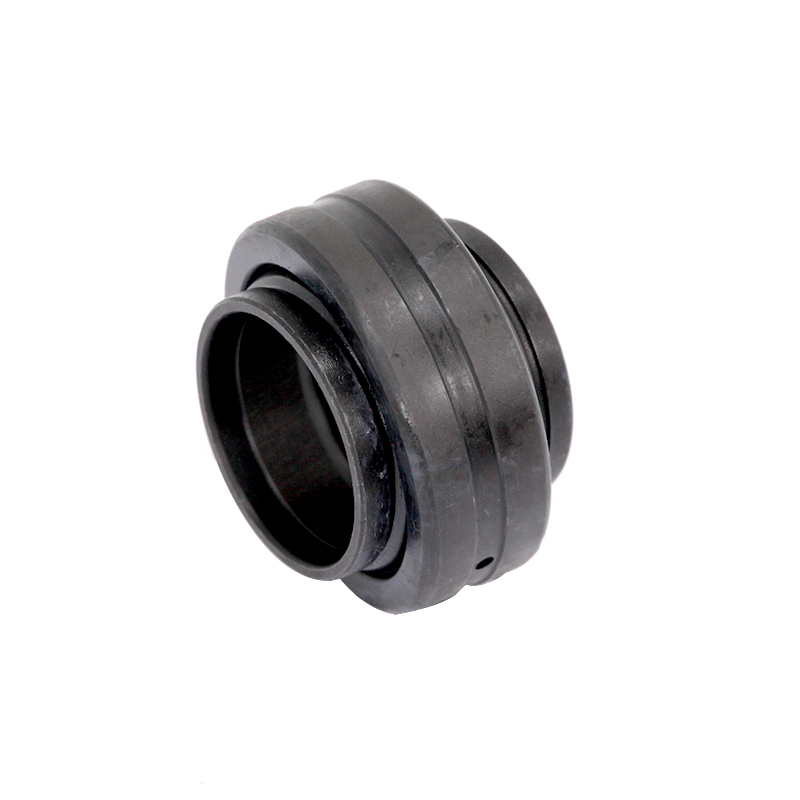
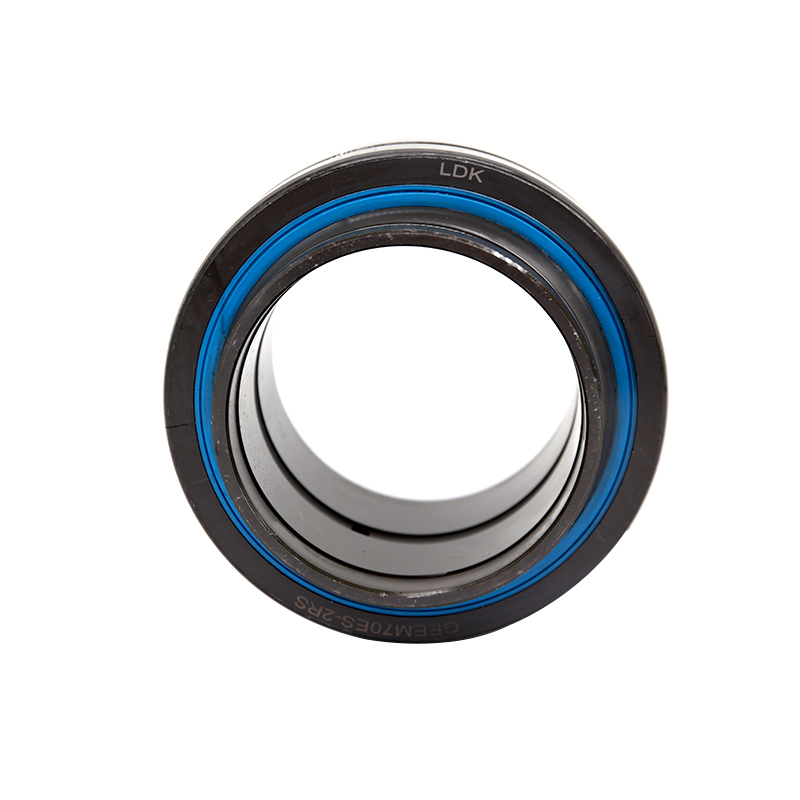
2. GEEM..ES-2RS — sealed steel-on-steel for contaminant-heavy pivots
The GEEM..ES-2RS series answers a specific problem: the pivot needs the load capacity of steel-on-steel, but it sits in dust, mud or grit. The outer ring is fractured and the inner ring has cylindrical extensions at each side, which improves the load path while keeping the bearing re-greasable. Seals are fitted at both sides, and an annular groove with lubrication holes runs through each ring, so grease can be injected without dismantling the joint.
- Materials: outer ring GCr15, hardened HRC 54–60, phosphated; inner ring GCr15, hardened HRC 58–64, phosphated.
- Sliding contact: steel-on-steel treated with MoS2.
- Models: GEEM20ES-2RS through GEEM80ES-2RS.
- Best fit: machine linkages where grit is present but periodic greasing is still possible — aggregate processing, construction and heavy transport pivots.
- Limitation: still requires a lubrication interval. The 2RS seals slow contaminant ingress; they do not remove the need for grease.
3. GE..ET-2RS and GEG..ET-2RS — maintenance-free, sealed, PTFE-fabric lined
This is the line that most often replaces steel-on-steel in sealed or hard-to-reach assemblies. The sliding contact surfaces are steel and PTFE fabric rather than steel-on-steel, which is what makes the bearing maintenance-free. The outer ring is fractured and fitted with two seals; in the XT design the outer ring is axially split twice and held together by retaining rings, which allows the bearing to be used in larger bores without losing retention.
- Coverage: GE..ET-2RS from 15 mm to 300 mm shaft diameter; GEG..ET-2RS from 15 mm to 280 mm. The GEG series is the heavier-duty option.
- Materials: outer ring GCr15, hardened HRC 54–60, phosphated, with PTFE fabric liner; ball GCr15, hardened HRC 58–64, hard chrome plated.
- Best fit: construction machinery, railway engineering, photovoltaic trackers, mining, robotics, power generation and bridge structures where re-greasing access is impractical.
- Limitation: the PTFE fabric liner cannot be re-lubricated as a substitute for design life. It must be matched to load and cycle count at the specification stage.
4. SA..ET-2RS and SI..ET-2RS — sealed maintenance-free rod ends
These are the rod end equivalents of pick 3: a carbon steel, zinc-plated body mounted with a GE..ET-2RS spherical plain bearing. SA..ET-2RS has a male thread and SI..ET-2RS has a female thread, and both cover 15 mm to 80 mm shaft diameter. Because the mounted bearing is the sealed, PTFE-fabric-lubricated type, the assembly is maintenance-free and the seals sit where contamination actually enters the joint.
- Thread: right-hand by default; left-hand thread, different pitch and different thread accuracy are available on request.
- Sliding contact: steel/PTFE fabric.
- Best fit: linkage points on heavy trucks, shock absorbers and drag links, off-road suspension, conveyor and gate mechanisms exposed to washdown or road spray.
- Limitation: because the joint is maintenance-free, size selection must be right the first time. The body limits the choice of sliding material compared with a bare spherical plain bearing.
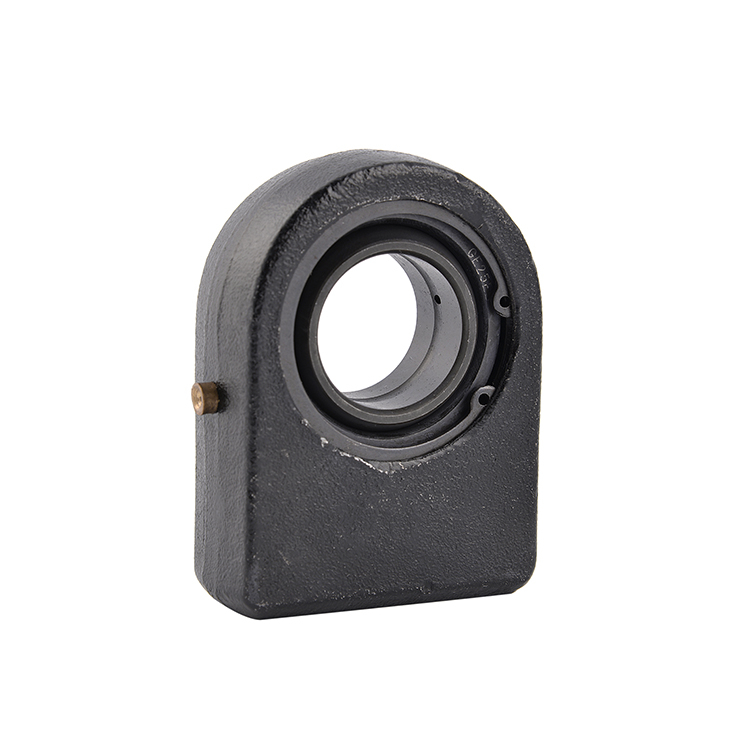
5. Hydraulic rod ends: SK..E(S), SF..ES, SIR..ES, SIQ..ES and SIGEW..ES
Hydraulic rod ends are the natural integration path when a cylinder is involved. Instead of threading a rod end onto a piston rod, these lines convert the rod end into a weldable or clampable eye. SK..E(S) is a welded hydraulic rod end with a dowel pin in the shank bottom and a 45° welding chamfer, covering 10 mm to 80 mm shaft diameter and mounted with GE..E or GE..ES bearings; SK..ES is re-greasable via a grease nipple, while SK..E is non-relubricable. SF..ES uses a weldable steel body with a rectangular welding face, is mounted with GE..ES bearings retained by snap rings, covers 20 mm to 120 mm, and is re-greasable.
The locking slot type versions take a different route: SIR..ES, SIQ..ES and SIGEW..ES have a housing with slots that can be clamped by socket screws, which makes the bearing position adjustable before final tightening. SIR..ES and SIQ..ES cover 20–120 mm and 12–100 mm respectively, mounted with GE..ES bearings; SIGEW..ES covers 12 mm to 200 mm with GEEW..ES bearings. All three are re-greasable via a grease nipple, with steel-on-steel sliding surfaces and GCr15 rings hardened to HRC 58–64 (inner) and HRC 54–60 (outer), phosphated.
- Best fit: hydraulic and pneumatic cylinder rod connections, construction machinery, railway equipment, agricultural implements and photovoltaic actuator linkages.
- Design note: the welding variants move the joint interface from a thread to a permanent weld, which removes thread loosening risk and shortens the installed length.
- Limitation: welding requires controlled process parameters. The dowel pin and chamfer features exist to position and support the weld, not to remove the need for a qualified welding procedure.
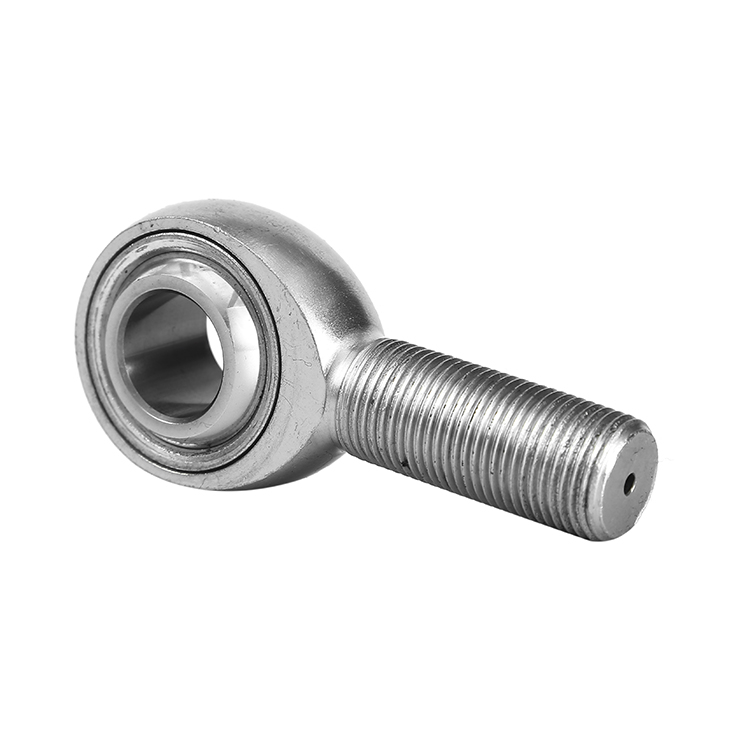
6. JMX, JMX..T and JFX..T — inch chromoly rod ends for high-load linkages
The JMX and JFX families are three-piece inch rod ends (ball, body and race) built from heat-treated alloy steel with zinc plating and chromate treatment, and a GCr15 ball heat-treated to HRC 56 minimum with a chromium-plated spherical surface. JMX carries a male thread, JFX a female thread, and both cover 4.826 mm to 25.4 mm shaft diameter. These lines are rated for heavy-duty load applications.
The T suffix changes the lubrication philosophy rather than the envelope. JMX..T and JFX..T are self-lubricated, maintenance-free versions using a steel/PTFE composite sliding contact surface, while the standard JMX is re-greasable with steel-on-steel surfaces — add a 'Z' to the suffix for a grease fitting, for example JMX6Z. Left-hand thread and different thread pitch or accuracy are available on both.
- Best fit: off-road and racing linkages, heavy truck suspension components, Kart/ATV/UTV/Snowmobile applications and food processing machinery.
- Selection rule: choose the standard re-greasable version where maintenance access exists and cost per unit matters; choose the T version where the linkage is sealed or the service interval is long.
- Limitation: the inch range stops at 1 inch, so larger pivots move to the metric GEEW..ES or GEG..ET-2RS series.
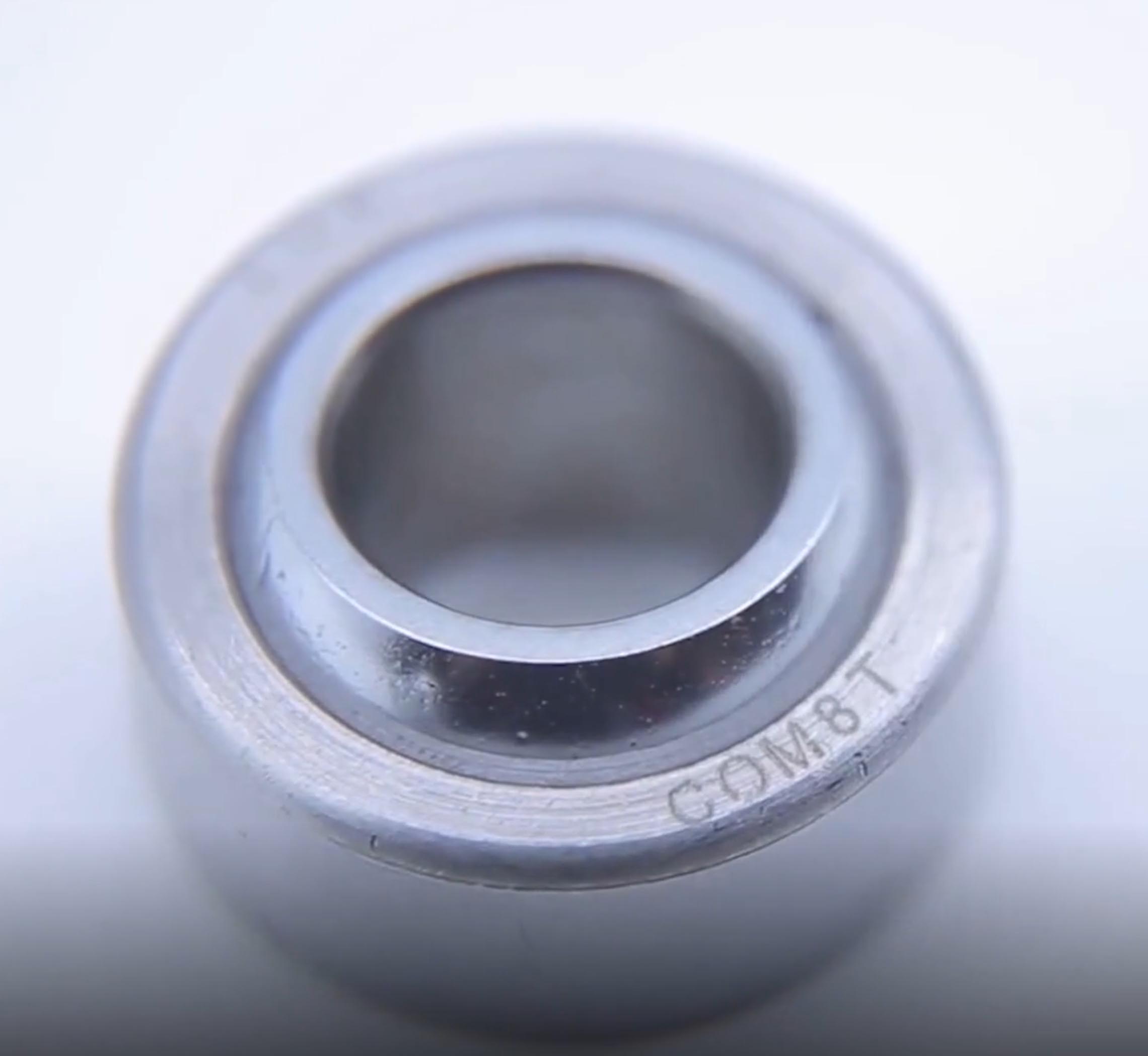
7. COM / COM..T and SCOM / SCOM..T — inch spherical plain bearings, standard versus T-series
The inch spherical plain bearing range is where the standard-versus-T distinction is clearest, and it is worth reading as a single decision rather than two separate families. The standard COM series is re-greasable steel-on-steel: a carbon steel outer ring and a GCr15 ball hardened to HRC 58–64 with hard chrome plating, covering 4.825 mm to 25.4 mm (0.19" to 1"), with an annular groove and lubrication holes. The COM..T series keeps the same envelope but changes the sliding surface to a steel/PTFE composite or PTFE fabric, which makes it maintenance-free.
The stainless equivalents follow the same logic: SCOM uses a 304 stainless steel outer ring and a 440 stainless steel ball with steel-on-steel sliding surfaces and re-greasing, while SCOM..T is the maintenance-free stainless version with a PTFE composite sliding surface, covering 0.19" to 1". LDK also offers the MIB, AIB and SIB inch series and their T-series equivalents (MIB3T through SIB16T), which use a PTFE fabric liner permanently bonded to the outer ring inside diameter for maintenance-free operation.
- Specialty roles: the standard steel-on-steel version suits inch-based machinery where re-greasing is scheduled and cost efficiency matters; the T version suits sealed assemblies, low-maintenance equipment and applications where a grease line cannot be routed.
- Corrosion role: the SCOM and SCOM..T stainless lines suit marine, food, chemical and washdown environments.
- Limitation: the inch range is narrow (approximately 0.19" to 1"). Metric pivots should be specified from the GE, GEG or GEEW families.
Also worth specifying on the same drawing set
- GEEW..ES — metric radial spherical plain bearing with cylindrical inner ring extensions, 12 mm to 320 mm, re-greasable steel-on-steel with MoS2 treatment, for the largest pivots.
- GAC..S — angular contact spherical plain bearings, 25 mm to 200 mm, steel-on-steel with MoS2-treated sliding surfaces, for combined radial and axial loading.
- SGE..C, SGE..PW and SGE..ET-2RS — stainless steel spherical plain bearings (304 outer ring, 440 inner ring), maintenance-free, 4–30 mm, 5–30 mm and 15–60 mm respectively, for corrosion-driven selections.
- SCOS, SCHS, SPHS, SPOS and the SPHSB/SPOSB..EC series — stainless steel rod ends with SUS304 bodies and 440 stainless balls, maintenance-free options from 4.826 mm to 30 mm, suited to marine, food, car wash and chemical environments.
- NPHS and NCOS loader slot rod ends — maintenance-free metric rod ends with a steel/nylon sliding pair, 5–30 mm and 6–30 mm, for lighter-duty linkages.
- NXF and NXM injection-type rod ends — maintenance-free, heavy-duty rated, 4.826 mm to 19.5 mm, with alloy steel bodies and nylon polymer races containing PTFE additive.
- Ball joints SQ..RS, SQZ..RS, CS and R..G — 5 mm to 22 mm for the metric winding and straight types, with an optional polychloroprene gaiter (add G to the part number, e.g. CSG8/1) to resist dirt ingress.
- Clevis end fittings CEF, CEM and Y — S235 zinc-plated end fittings to DIN 71752 (CEF female, CEM male) and DIN 71751 (Y type), 4 mm to 20 mm, with stainless steel 304 optional, for pneumatic and hydraulic cylinder connections.
- Rod end linkages — pre-assembled stainless steel linkages integrating two rod ends with a connecting rod, fully articulated and length-adjustable via a threaded rod for precise installation alignment.
Step-by-Step: Turning This Shortlist Into One Part Number
- Grade the contamination exposure. Open, unsealed bearing for clean indoor automation; 2RS sealed for dust, mud and grit; stainless for moisture, chemicals and washdown. If the joint is immersed or washed daily, start from the stainless lines rather than from a plated carbon steel part.
- Decide whether the pivot can be greased. If a grease gun can reach it on a planned interval, steel-on-steel remains the most load-efficient and lowest-cost choice. If it is welded, encapsulated or on a multi-year service interval, specify a maintenance-free PTFE-lined design.
- Quantify load, impact and misalignment angle. Move from the standard series to the heavier-duty equivalent — GE..ES to GEG..ES, GE..ET-2RS to GEG..ET-2RS — rather than simply increasing bore size, which changes the housing envelope.
- Fix the interface. Male thread (SA, JMX), female thread (SI, JFX, CF..T), studded shank (CF..Y, CM..Y), clevis end (CEF, CEM, Y), welded eye (SK..E(S), SF..ES) or clamping slot (SIR..ES, SIQ..ES, SIGEW..ES). The interface decision usually eliminates more candidates than any performance parameter.
- Choose the lubrication variant inside the family. This is where the standard-versus-T decision happens: steel-on-steel re-greasable, or T-series maintenance-free. Both exist inside the inch rod end and inch spherical plain ranges, so the same mounting geometry can be ordered two ways.
- Validate with a sample before volume release. Request the specific part number with the intended material and thread configuration, and confirm fit, angular travel and sealing against the drawing before releasing a batch.
Operating Profiles: Where These Picks Are Applied
Heavy trucks and towed vehicles. Rod ends and rod end linkages in this duty see -30 °C to +100 °C, dozens of tons of axle load, highway and off-road surfaces, and salt spray. Sealed maintenance-free rod ends (SA..ET-2RS, SI..ET-2RS) or high-strength inch rod ends (JMX, JFX) are the realistic candidates, with stainless options where corrosion is severe.
4x4 off-road and recreational vehicles. Sway bar link kits, anti-rock sway-bar adapter brackets and steering stabilizers involve direct mud, sand and water exposure with very high impact. Maintenance-free, well-sealed rod ends with high-strength alloy steel bodies are the standard answer in this segment.
Construction machinery. Excavators, bulldozers, wheel loaders, graders, pavers and port equipment operate in high dust and mud, from -20 °C to +50 °C, under heavy impact and strong vibration. Hydraulic rod ends (SK..E(S), SF..ES, SIR..ES, SIQ..ES, SIGEW..ES) and the GEG..ET-2RS series cover most of these pivot points.
Photovoltaic tracking systems. Full outdoor exposure, strong UV, sand and dust, rain, coastal salt spray and a -20 °C to +60 °C swing, with low-speed oscillation and low friction torque requirements. Maintenance-free spherical plain bearings with corrosion-resistant rings and stainless options are the durable choice here.
Pneumatic and hydraulic cylinders. The requirement is to isolate the cylinder rod from side load while compensating for angular misalignment, at temperatures around 0 °C to +60 °C and high cycle frequency. Self-lubricating, maintenance-free rod ends and clevis ends to DIN 71751/71752 dominate this application.
Shock absorbers and suspension. Alternating load, high impact, continuous vibration and temperatures from -40 °C upward require self-lubricating, maintenance-free designs, where steel-on-steel variants would need a defined lubrication interval.
Textile and printing machinery. Fibre lint, steam, dyes and process chemicals attack both the lubricant and the steel. Stainless rod end and spherical plain bearing families, together with sealed designs, are the practical selections for these indoor but chemically aggressive environments.
Product Line Comparison: What Changes Between the Picks
All values below are drawn from LDK product specification data. The purpose of the table is to make the trade-off visible: moving from steel-on-steel to a PTFE-lined maintenance-free surface, or adding 2RS seals, changes the maintenance model rather than the mounting geometry.
| Product line | Type | Sliding contact surface | Sealing | Shaft diameter range | Lubrication model |
|---|---|---|---|---|---|
| GE..E / GE..ES, GEG..E / GEG..ES | Metric radial spherical plain bearing | Steel/steel, MoS2 treated | 2RS variants fitted with seals both sides | 4 mm to 300 mm | GE..ES / GEG..ES re-greasable; GE..E / GEG..E non-relubricable |
| GEEM..ES-2RS | Metric radial spherical plain bearing | Steel/steel, MoS2 treated | Seals at both sides | Models GEEM20ES-2RS to GEEM80ES-2RS | Re-greasable via groove and lubrication holes |
| GE..ET-2RS / GEG..ET-2RS | Metric radial spherical plain bearing | Steel/PTFE fabric | Seals at both sides | GE: 15 mm to 300 mm; GEG: 15 mm to 280 mm | Maintenance-free |
| SA..ET-2RS / SI..ET-2RS | Metric rod ends (male / female thread) | Steel/PTFE fabric | Mounted GE..ET-2RS with seals both sides | 15 mm to 80 mm | Maintenance-free |
| SK..E(S), SF..ES, SIR..ES, SIQ..ES, SIGEW..ES | Hydraulic rod ends (welded / locking slot) | Steel/steel | No integral seal | SK..E(S): 10–80 mm; SIR..ES / SF..ES: 20–120 mm; SIQ..ES: 12–100 mm; SIGEW..ES: 12–200 mm | Re-greasable via grease nipple (SK..E non-relubricable) |
| JMX (standard) / JMX..T, JFX..T | Inch rod ends (male / female thread) | Steel/steel (JMX); steel/PTFE composite (T) | No integral seal | 4.826 mm to 25.4 mm | JMX re-greasable ('Z' suffix); T versions maintenance-free |
| COM / COM..T, SCOM / SCOM..T, MIB / AIB / SIB T-series | Inch spherical plain bearings | Steel/steel (standard); steel/PTFE composite or PTFE fabric (T) | No integral seal | 0.19" to 1" (SCOM from 0.165") | Standard re-greasable; T versions maintenance-free |
| GEEW..ES | Metric radial spherical plain bearing (cylindrical inner ring extensions) | Steel/steel, MoS2 treated | No integral seal | 12 mm to 320 mm | Re-greasable |
| SGE..C / SGE..PW / SGE..ET-2RS | Metric stainless steel spherical plain bearing | Stainless steel/composite or stainless steel/PTFE fabric | SGE..ET-2RS with seals at both sides | 4–30 mm, 5–30 mm and 15–60 mm | Maintenance-free |
Frequently Asked Questions
What standards and certifications apply to LDK rod ends and spherical plain bearings?
Spherical plain bearings are governed by the ISO 12240 series, which covers radial spherical plain bearings (Part 1), angular contact spherical plain bearings (Part 2), thrust spherical plain bearings (Part 3) and rod ends (Part 4). LDK's manufacturing is carried out in IATF 16949 certified facilities, and the company operates a laboratory, a precision measuring room and more than 10 workshops. Clevis end fittings in the LDK range are produced to the DIN 71752 standard (CEF and CEM types) and the DIN 71751 standard (Y type), which gives buyers a common reference point across rod ends, spherical plain bearings and end fittings in the same linkage.
Can LDK supply both re-greasable steel-on-steel and maintenance-free T-series designs within one project?
Yes. The same mounting envelope is often available in both lubrication philosophies, which lets a project standardise the housing while varying the maintenance model. Examples include GE..ES (re-greasable steel-on-steel) alongside GE..ET-2RS (maintenance-free steel/PTFE fabric); COM (re-greasable inch steel-on-steel) alongside COM..T (maintenance-free, PTFE-based sliding surface); and SCOM alongside SCOM..T in stainless steel. LDK also states that more than 100 combinations of different materials and housing types are offered across the range, and that manufacturing is flexible enough to accommodate low to high volume production. For linkage hardware, rod end linkages are pre-assembled from two rod ends and a threaded connecting rod, fully articulated and length-adjustable for precise installation alignment.
How are MOQ and pricing determined for rod ends and spherical plain bearings?
Rod ends and spherical plain bearings are quoted part number by part number, because several configuration variables change the cost of the same nominal size. These include the material combination (carbon steel, alloy steel, SUS304 stainless steel or 440 stainless steel), the sliding contact system (steel/steel with MoS2, steel/brass, steel/PTFE composite, steel/PTFE fabric or steel/nylon), the presence of a 2RS seal set, thread configuration (right-hand or left-hand, different pitch or thread accuracy), body form (forged or turned) and logo customisation. Because LDK's production is set up for flexible low to high volume manufacturing, a single catalogue-wide minimum order quantity is not published; the achievable quantity is confirmed with the quotation for the specific part number, material and packing requirement.
How can a buyer validate a rod end or spherical plain bearing before committing to production volumes?
Validation starts with a sample of the exact configuration — the specified model, material, thread and seal option — checked against the drawing for fit, angular travel and sealing. LDK supports this process with in-house testing capabilities covering fatigue life, tensile strength, noise and vibration, and salt spray testing, together with a dedicated laboratory and a precision measuring room. Buyers can request samples and a quotation for the intended part number by contacting LDK directly; the current product brochure can also be downloaded from the company website.
How should buyers plan supply continuity and lead time for 2026 programmes?
Supply continuity in this category depends on how many production steps sit inside the manufacturer. Deyuan Smart Technology (Fujian) Co., Ltd. produces both bearings and housings in one place, operates a 90,000 m² facility with approximately 130 employees and a 12-engineer research and development team, and reports an annual output of 15,000,000 units. Around 60% of production is exported to Europe, North America, Latin America and Oceania from a site in southeast China with access to sea and air shipments, which supports replenishment planning. Lead time itself is confirmed at quotation, because it depends on the part number, material, quantity and packing requirement. To move a 2026 programme forward, send the target part numbers and operating conditions — or request a sample of the sealed or hydraulic rod end you are evaluating — to kzhang@ldk-bearings.com or via WhatsApp at +86 19959266209.
Conclusion: Match the Line to the Pivot, Then Confirm the Part Number
The 2026 market offers more rod end and spherical plain bearing configurations than any single project can evaluate. The efficient approach is to start from the operating requirement — contamination, lubrication access, load and misalignment, interface, and material environment — and then narrow to one or two lines. For re-greasable heavy-duty pivots, the GE..ES and GEG..ES steel-on-steel families remain the baseline. For sealed or contaminated pivots that still need greasing, GEEM..ES-2RS keeps the load capacity while adding seals. For maintenance-free assemblies, the GE..ET-2RS, GEG..ET-2RS, SA..ET-2RS and SI..ET-2RS lines carry the load without a lubrication schedule. For cylinder integration, the welded and locking slot hydraulic rod ends replace threads with welds or clamps. For inch-based linkages, the JMX and COM families provide the standard steel-on-steel route, with the T-series offering the same envelope in a maintenance-free build.
Ranking, in the end, is only a starting filter. The final decision is made on a drawing, with a shaft diameter, a thread specification and a sealing requirement — and it is confirmed with a sample before the first production batch.
Next step: send your pivot conditions — shaft diameter, load type, contamination level and mounting interface — and LDK will confirm the matching rod end or spherical plain bearing line, along with sample availability and a quotation for your volume.
Email: kzhang@ldk-bearings.com | Tel: +86 592-5807618 | Website: www.ldk-bearings.com | WhatsApp: +86 19959266209
Download the full product brochure: LDK Bearings Catalogue (PDF).
Deyuan Smart Technology (Fujian) Co., Ltd. — Xi Pu Industry Park, He Shi, Luo Jiang, Quanzhou City, Fujian Province, P.R. China. Zip: 362013.
Have Questions or Need More Details?
Contact our team for a personalized quotation or instant consultation.
Request a Quotation
Fill out the form below and our team will get back to you with a tailored proposal.
WhatsApp Direct Chat
Prefer to chat in real-time? Message us on WhatsApp for instant assistance & quick answers.
- Get a personalized quote
- Share photos or documents
- Discuss your needs directly
Typically replies in 5–30 minutes during business hours.