
The Essential Technical Guide to Spherical Plain Bearing Selection Parameters
The Essential Technical Guide to Spherical Plain Bearing Selection Parameters
Core answer: a spherical plain bearing is selected by matching eight parameters in sequence — load direction, duty class, operating angle, sliding contact pair, lubrication regime, corrosion and temperature exposure, sealing, and the dimensional plus retention envelope. Bore size alone does not describe capability. Two bearings with the same 25 mm bore can belong to different load classes, use different liner materials, require relubrication or be maintenance-free, and include or omit seals. LDK (Deyuan Smart Technology (Fujian) Co., Ltd) is a bearing manufacturer established in 1986 that produces rod ends and spherical plain bearings across these families, including the re-greasable GEZ..ES inch series and the maintenance-free SGE..PW stainless series.
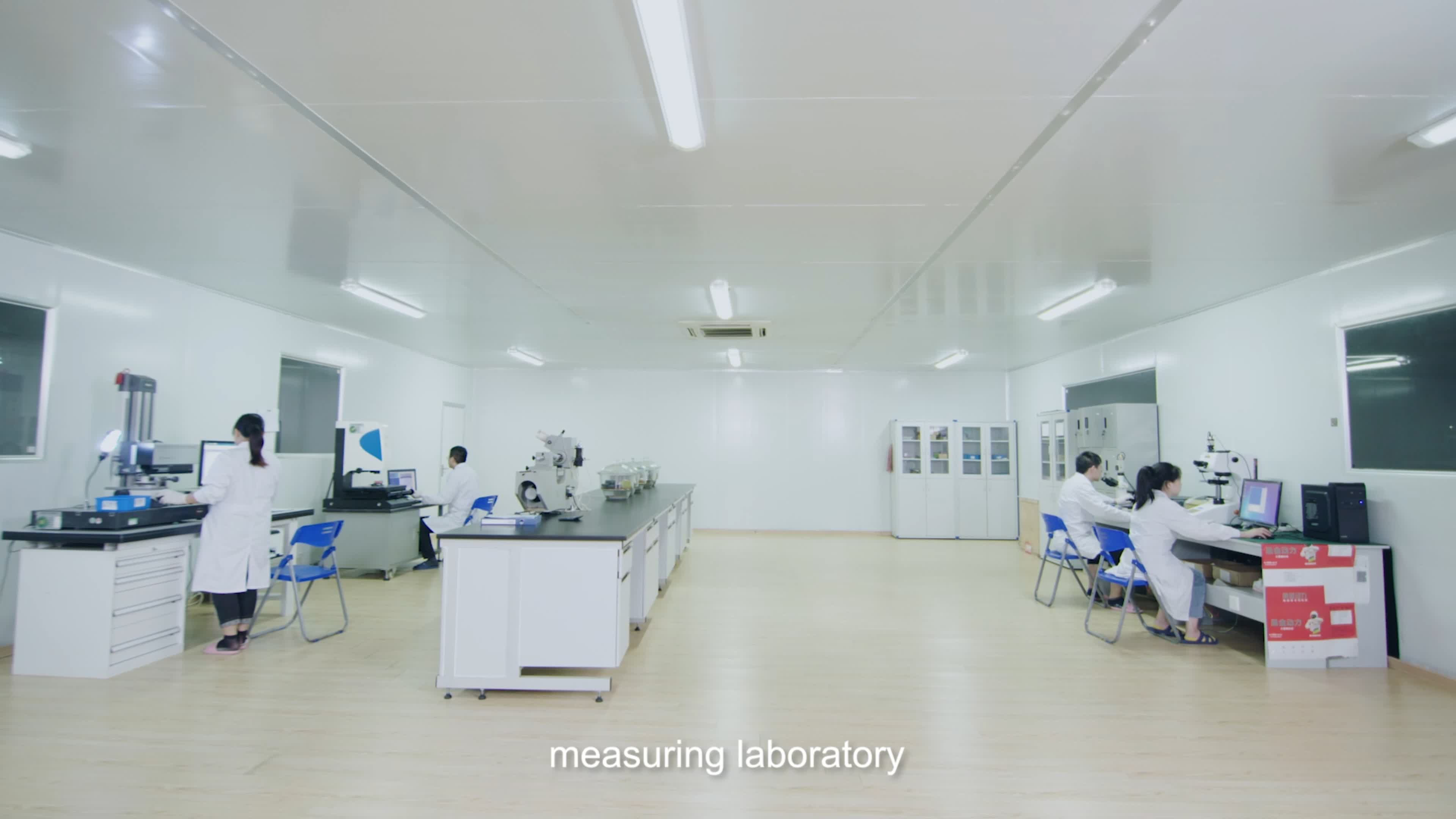
Dimensional and form verification in LDK’s measurement room — the data behind published spherical plain bearing parameters.
Problem Definition: Where Spherical Plain Bearing Selection Fails
In spherical plain bearing selection, the failure mode is rarely a wrong bore size. It is a parameter mismatch. Five patterns account for most of them.
- Load direction treated as an afterthought. Radial families such as GE..E(S), GEG..E(S), GE..C, GE..PW, GE..ET-2RS and SGE..PW; angular contact families GAC..S, GACZ..S and GAC..T; and thrust families GX..S and GX..T are not interchangeable. Angular contact designs are built for combined radial and axial duty. Thrust designs are built for axial load.
- Duty class ignored. GEG..E(S) is specified as heavy-duty compared with GE..E(S); GEG..C is heavier-duty than GE..C; GEG..ET-2RS is heavier-duty than GE..ET-2RS. Placing a standard-class bearing into a heavy-duty position changes the service interval and the maintenance cost, not only the unit price.
- Lubrication regime chosen against the maintenance reality. GE..ES and GE..ES-2RS are re-greasable — the outer ring carries a groove and lubrication holes — while GE..E has no lubrication holes and is non-relubricable. Maintenance-free families such as GE..C, GE..PW and GE..ET-2RS use a PTFE composite or PTFE fabric liner instead of a grease film, and that decision cannot be reversed later in the field.
- Environment and sealing missed. The standard sliding pair is GCr15 bearing steel, hardened and phosphated, with a hard chrome plated ball. Stainless steel variants — SGE..C, SGE..PW, SGE..ET-2RS, SCOM, WSSB, NSSB and YSSB — exist for corrosion exposure, and the -2RS suffix means the bearing is fitted with seals at both sides.
- Designation cross-referencing errors. Suffixes carry the selection logic: ES indicates a re-greasable steel/steel design, C and PW a PTFE composite liner, T a PTFE fabric liner, 2RS two seals, and XT an outer ring that is axially split twice and held together by retaining rings.
Industry Background: A Standardised Component in a Growing Market
Spherical plain bearings are standardised products, which is precisely why parameter discipline matters. The design is governed by ISO 12240, published in parts covering radial spherical plain bearings (Part 1), angular contact spherical plain bearings (Part 2), thrust spherical plain bearings (Part 3) and rod ends (Part 4), according to ISO.
The commercial context continues to expand. Dataintelo values the global plain bearing market at USD 10.4 billion in 2024 and projects USD 17.8 billion by 2034. In the same source series, the rod ends market is valued at USD 1.79 billion in 2025, with Asia Pacific holding a 42.3% revenue share, and automotive applications representing approximately 38.5% of rod end demand. China’s bearing industry reported revenue of CNY 231.5 billion in 2024, a 6.2% year-on-year increase, per the China Bearing Industry Association.
Supply capability in this category has consolidated around manufacturers that keep foundry, machining, heat treatment and assembly under one roof. LDK, established in 1986, operates a 90,000 m² facility with approximately 130 employees, a 12-engineer R&D team, 15,000,000 units of annual output and a 60% export ratio covering Europe, North America, Latin America and Oceania. Trade coverage of the Chinese rod end and spherical plain bearing sector has noted the company’s in-house production of more than 3,000 SKUs under IATF 16949 certification.
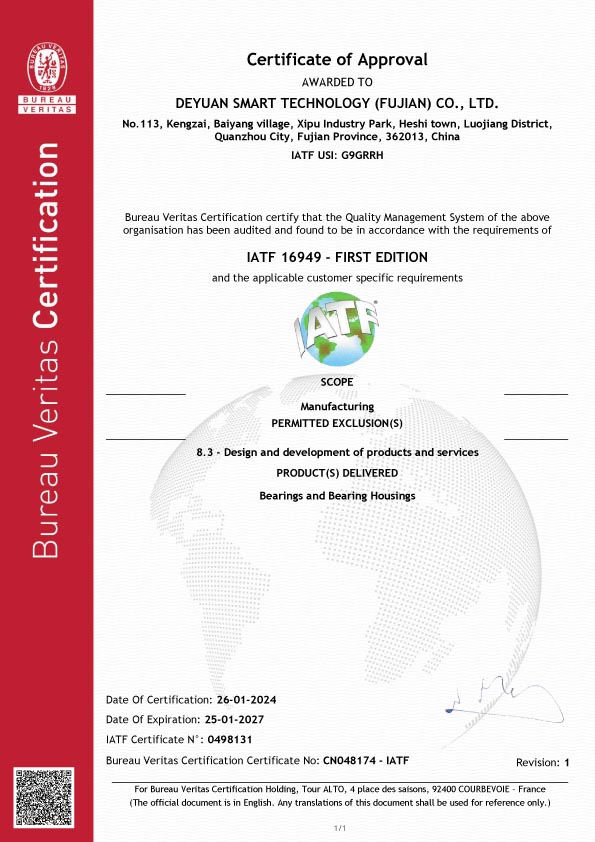
IATF 16949 quality management system certification covering manufacturing of bearings and bearing housings, including design and development.
Detailed Solution: The Parameters That Define a Spherical Plain Bearing
1. Load direction: radial, angular contact or thrust
The first parameter is the direction of the load relative to the bearing axis. Radial families — GE..E(S), GEG..E(S), GE..C and GEG..C, GE..PW, GE..ET-2RS and GEG..ET-2RS, the inch GEZ..ES and COM series, and the stainless SGE and SCOM series — carry load perpendicular to the bore. Angular contact families GAC..S, GACZ..S and GAC..T are intended for combined radial and axial load. Thrust families GX..S and GX..T are intended for axial load. Selecting outside this mapping is the most costly mistake in the process, because no change of material or lubrication can correct it.
2. Duty class: standard or heavy-duty
Several series exist as a matched pair, one standard and one heavy-duty. GE..E(S) and GEG..E(S) share a shaft diameter range of 4 mm to 300 mm, but GEG..E(S) is rated heavy-duty. The same relationship applies to GE..C and GEG..C in the 4 mm to 30 mm range, and to GE..ET-2RS and GEG..ET-2RS. Where the load spectrum includes shock or sustained high load, the heavy-duty member of the pair is the defensible choice. Where the load is moderate, the standard class keeps both the envelope and the cost structure smaller.
3. Operating angle and movement pattern
The operating angle — the misalignment the bearing must absorb — results from the spherical geometry combined with internal clearance and the design type, and the permissible value is size-specific. It should be read from the manufacturer’s catalogue for the exact model rather than assumed, because a radial, an angular contact and a thrust design do not offer the same freedom of movement. Two practical rules follow. First, where misalignment occurs at both ends of a link, a pre-assembled rod end linkage that integrates two rod ends with a connecting rod compensates for angular misalignment at both ends and allows precise installation alignment through a threaded, length-adjustable rod. Second, where movement is continuous oscillation rather than static loading, the liner choice trends towards PTFE fabric (GE..ET-2RS, GEG..ET-2RS, SGE..ET-2RS, GAC..T, GX..T, COM..T) instead of a grease-lubricated steel/steel pair.
4. Sliding contact pair and lubrication regime
Four contact pairs define the maintenance profile:
- Steel/steel with MoS2 treatment — GE..E(S), GEG..E(S), GEZ..ES, GEEW..ES, GEEM..ES-2RS, GAC..S, GACZ..S, GX..S and COM. Re-greasable versions carry an annular groove and lubrication holes.
- Steel/brass — GEBK..S, where the outer ring is carbon steel with a brass liner and the inner ring is hardened and hard chrome plated.
- Steel/PTFE composite — GE..C and GEG..C, GE..PW, SGE..C, SGE..PW, SCOM..T, and the maintenance-free rod end families CHS, COS, SI..C and SA..C.
- Steel/PTFE fabric — GE..ET-2RS, GEG..ET-2RS, SGE..ET-2RS, GAC..T, GX..T, COM..T, WSSB, NSSB, YSSB and the T versions of MIB/AIB/SIB.
The decision rule is operational. If a lubrication point is reachable on the maintenance schedule, a re-greasable steel/steel design keeps the load path conventional and serviceable. If the joint is sealed, inaccessible, or grease itself is a contamination risk, a PTFE composite or fabric bearing removes relubrication from the maintenance plan.
5. Corrosion, temperature and chemical exposure
Where washdown, humidity or chemicals are present, material selection replaces coating selection. SGE..C, SGE..PW and SGE..ET-2RS use a 304 stainless steel outer ring with a 440 stainless steel inner ring. SCOM and SCOM..T use 304 stainless outer rings with 440 stainless balls. WSSB, NSSB and YSSB are stainless steel with a PTFE fabric liner permanently bonded to the race bore, and the V variants add a V-groove on the outer ring. In the inch family, MIB uses a low carbon steel race, AIB an alloy steel heat-treated race and SIB a stainless steel race, all with a 52100 bearing steel ball, which lets a buyer step corrosion resistance up without changing the mounting envelope.
6. Sealing and contamination control
Sealing is specified, not assumed. Bearings with the 2RS designation are fitted with seals at both sides — GE..ES-2RS, GEZ..ES-2RS, GEG..ES-2RS, GEEM..ES-2RS, GE..ET-2RS, GEG..ET-2RS and SGE..ET-2RS. Where the application runs along a shaft, GEEW..ES and GEEM..ES-2RS provide an inner ring with cylindrical extensions at each side, extending the sealing and contact surface beyond the housing.
7. Dimensional envelope: metric, inch and wide inner rings
Metric and inch families are separate product lines with separate catalogues. GE..E(S) and GEG..E(S) run from 4 mm to 300 mm; GEEW..ES from 12 mm to 320 mm; GAC..S from 25 mm to 200 mm; GX..S and GX..T from 10 mm to 200 mm. On the inch side, GEZ..ES covers 12.7 mm to 88.9 mm (0.5 in to 3.5 in), GACZ..S covers 12.7 mm to 82.55 mm, COM and COM..T cover 4.825 mm to 25.4 mm (0.19 in to 1 in), SCOM covers 0.165 in to 1 in, and WSSB, NSSB and MIB/AIB/SIB cover 0.19 in to 1 in. Confirming the series family before quoting avoids the most common cross-reference error in aftermarket replacement.
8. Retention and housing interface
The final parameter is how the bearing is held. Radial bearings with a fractured outer ring are assembled and retained by the housing bore. The XT design used in GE..ET-2RS and GEG..ET-2RS above the standard sizes uses an outer ring axially split twice and held together by retaining rings, which changes how the bearing is handled during installation. Hydraulic rod ends add their own interface rules: SF..ES fixes the mounted spherical plain bearing in the housing with snap rings, while SIR..ES, SIQ..ES and SIGEW..ES use a slotted housing clamped by socket screws and mount GE..ES, GE..ES and GEEW..ES bearings respectively, with a grease nipple for relubrication.
Step-by-Step Breakdown: Modelling a Selection Process
- Define the motion and the load. Record load direction (radial, combined, axial), whether movement is static, oscillating or rotating, and the service environment (temperature, moisture, chemicals, washdown frequency).
- Select the bearing family from the load direction. Radial duty points to GE..E(S), GEG..E(S), GE..C and GEG..C, GE..PW, GE..ET-2RS and GEG..ET-2RS, GEZ..ES, GEEW..ES, GEBK..S, COM, SGE or SCOM. Combined duty points to GAC..S, GACZ..S or GAC..T. Axial duty points to GX..S or GX..T.
- Set the duty class. Choose the standard or heavy-duty member of the pair — GE..E(S) versus GEG..E(S), GE..C versus GEG..C, GE..ET-2RS versus GEG..ET-2RS — using the load spectrum and the accepted service interval.
- Read the permissible operating angle for the exact size. Confirm the misalignment the joint must absorb, then take the catalogue value for the candidate model. If both ends of a linkage move, consider a pre-assembled rod end linkage with a length-adjustable threaded rod.
- Choose the sliding contact pair and lubrication regime. Steel/steel with MoS2, steel/brass, steel/PTFE composite or steel/PTFE fabric. Decide whether the joint will be relubricated (GE..ES, GEZ..ES, GEEW..ES, GEBK..S, GACZ..S, GX..S, COM, SCOM) or must be maintenance-free (GE..C, GE..PW, GE..ET-2RS, SGE..C, SGE..PW, SGE..ET-2RS, GX..T, COM..T, WSSB, NSSB, YSSB).
- Match the material to the environment. Confirm whether standard phosphated GCr15 steel suffices or whether a stainless variant (SGE..C, SGE..PW, SGE..ET-2RS, SCOM, WSSB, NSSB, YSSB, MIB/AIB/SIB) is required, and whether temperature or chemicals demand a specific liner.
- Check the envelope, sealing and retention. Verify bore range, metric or inch designation, wide inner ring requirement (GEEW..ES, GEEM..ES-2RS), 2RS sealing, fractured or split outer ring handling, snap ring or clamped-slot housing interface.
- Validate and document before scaling. Prototype in 2D and 3D, then run durability, safety and performance testing; in-house fatigue life, tensile strength, noise and vibration, and salt spray testing are part of that loop. Close the loop with compliance and inspection records before releasing a production order.
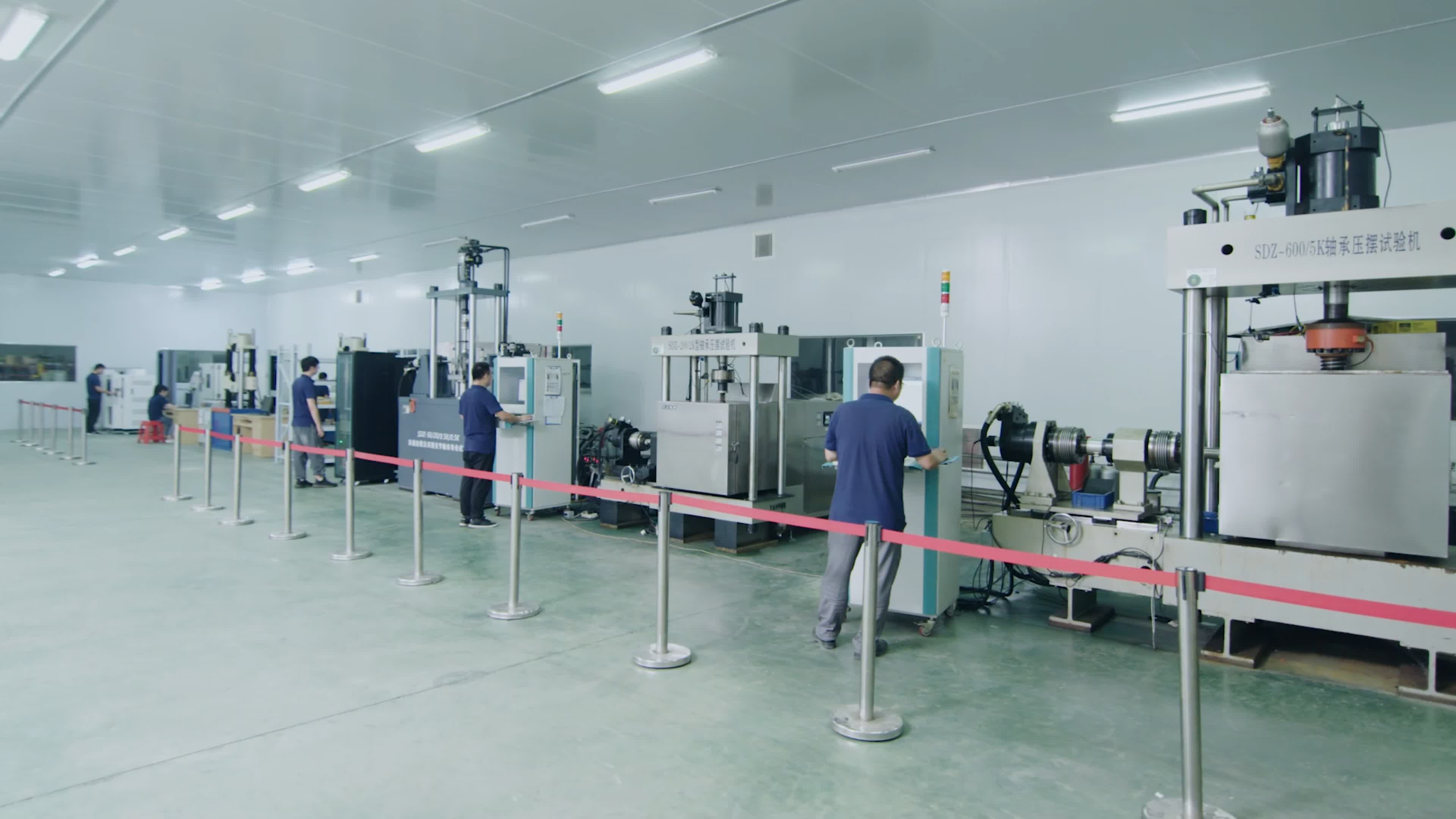
Validation step in the selection model: the reliability testing room used for fatigue life, noise and vibration, and salt spray checks.
Use Cases: Where the Parameters Change the Answer
Heavy truck engine bay, United Kingdom. A commercial vehicle OEM needed a linkage connecting a pneumatic actuator to a lever for use within the exhaust system, external to the exhaust gases, in a harsh engine-bay environment. The specification was met with stainless steel, maintenance-free rod ends from the SCHS series — a three-piece design with a SUS304 turned body, a 440 stainless steel ball and a PTFE composite race. The requirement was 5 million movements across -40 °C to 300 °C while withstanding typical road environment conditions. Here, the maintenance-free PTFE composite liner and the stainless body were the deciding parameters, not the bore size.
Fitness equipment, Netherlands. A five-year programme covering 500,000 units of rod end linkages required 20 million cycles, a lightweight construction and electrical conductivity across the entire assembly. The design replaced stainless steel with high strength aluminium alloy and reduced weight by 30%. A custom design and reliability verification process was used, and an unstable electromagnetic interference issue was resolved. The lesson for buyers is that the linkage assembly — not the individual bearing — is often the correct unit of customisation.
Automotive EGR system, Germany. An automotive OEM used 180,000 one-piece rod end linkages in an EGR application, selected for high-temperature exposure, with durability and strength carried by the one-piece design. The same logic appears in equipment that has to be sealed and maintenance-free rather than greased.
Spherical plain bearings and rod ends from these families are applied in railway engineering, photovoltaic industry, construction machinery, automotive suspension and steering, mining and aggregate processing, robotics technology, power generation and bridge building, as well as textile machinery, heavy duty truck, shock absorber and drag link, car wash and off-road recreational equipment.
Comparison Table: Spherical Plain Bearing Families Side by Side
| Series | Type / load direction | Sliding contact pair | Lubrication | Seals | Shaft dia range |
|---|---|---|---|---|---|
| GE..E(S) | Radial | Steel / steel, MoS2 treated | Re-greasable (ES); non-relubricable (E) | 2RS version, both sides | 4–300 mm |
| GEG..E(S) | Radial, heavy-duty | Steel / steel, MoS2 treated | Re-greasable (ES); non-relubricable (E) | 2RS version, both sides | 4–300 mm |
| GE..C / GEG..C | Radial | Steel / PTFE composite | Maintenance-free | — | 4–30 mm |
| GE..PW / SGE..PW | Radial (SGE stainless) | Steel / PTFE composite; stainless / PTFE composite | Maintenance-free | — | 5–30 mm |
| GE..ET-2RS | Radial | Steel / PTFE fabric | Maintenance-free | Two seals, both sides | 15–300 mm |
| GEG..ET-2RS | Radial, heavy-duty | Steel / PTFE fabric | Maintenance-free | Two seals, both sides | 15–280 mm |
| SGE..C | Radial, stainless | Stainless / PTFE composite | Maintenance-free | — | 4–30 mm |
| SGE..ET-2RS | Radial, stainless | Stainless / PTFE fabric | Maintenance-free | Two seals, both sides | 15–60 mm |
| GEZ..ES | Radial, inch | Steel / steel, MoS2 treated | Re-greasable | 2RS version, both sides | 12.7–88.9 mm (0.5–3.5 in) |
| GEEW..ES | Radial, wide inner ring | Steel / steel, MoS2 treated | Re-greasable | — | 12–320 mm |
| GEBK..S | Radial | Steel / brass | Re-greasable | — | 5–30 mm |
| GAC..S / GACZ..S | Angular contact | Steel / steel, MoS2 treated | Maintenance-free (S); re-greasable (GACZ..S) | — | 25–200 mm / 12.7–82.55 mm |
| GAC..T | Angular contact | Steel / PTFE fabric | Self-lubricated fabric liner | — | 25–200 mm |
| GX..S / GX..T | Thrust | Steel / steel (S); steel / PTFE fabric (T) | Re-greasable (S); maintenance-free (T) | — | 10–200 mm |
| COM / COM..T / SCOM / SCOM..T | Radial, inch (SCOM stainless) | Steel / steel; steel / PTFE composite | Re-greasable; maintenance-free (T) | — | 4.825–25.4 mm (0.19–1 in) |
| WSSB / NSSB / YSSB (+V) | Radial, inch, stainless | Stainless / PTFE (Teflon) fabric | Maintenance-free | — | 0.19–1 in (YSSB 0.25–0.75 in) |
| MIB.. / AIB.. / SIB.. (+T) | Radial, inch | 52100 ball with low carbon, alloy or stainless race | Relubricable; maintenance-free (T, PTFE fabric liner) | — | 0.19–1 in |
Rod ends follow the same spherical plain bearing logic, because several families mount a spherical plain bearing inside the rod end body:
| Rod end family | Mounted bearing / design | Lubrication | Thread | Shaft dia range |
|---|---|---|---|---|
| SI..E(S) / SA..E(S) | Mounted with GE..E or GE..ES | Re-greasable (ES); non-regreasable (E) | Female (SI) / male (SA) | 5–80 mm |
| SI..C / SA..C | Mounted with GE..C | Maintenance-free | Female / male | 5–30 mm |
| SI..ET-2RS / SA..ET-2RS | Mounted with GE..ET-2RS | Maintenance-free | Female / male | 15–80 mm |
| PHS / POS | Three-piece, steel / brass | Re-greasable | Female / male | 3–30 mm |
| CHS / COS | Three-piece, steel / PTFE composite | Maintenance-free | Female / male | 3–30 mm |
| SCHS / SCOS | Stainless SUS304 body, 440 ball, PTFE composite race | Maintenance-free | Female / male | 5–30 mm |
| NPHS / NPOS / NCHS / NCOS | Loader slot, alloy steel body, nylon race with PTFE additive | Maintenance-free, heavy-duty load application | Female / male | 5–30 mm / 6–30 mm |
FAQ
Q1. Which compliance documents cover LDK spherical plain bearings and rod ends?
Third-party verification exists at series level rather than at catalogue level. An SGS RoHS Compliance Verification Report, XMNEC25002178301_1, was issued by SGS SCTC Standards Technical Services Co., Ltd Xiamen Branch on 22 September 2025 with an expiry date of 22 September 2035, and covers GEG35ES-2RS together with the GE..E and GE..ES(-2RS), GEZ..E and GEZ..ES(-2RS), GEG..E and GEG..ES(-2RS), GEEW..ES(-2RS), GEEM..ES-2RS, GAC..S, GACZ..S, GX..S, GEF..ES, GE..XS/K, GEWZ..ES(-2RS), GEGZ..ES(-2RS) and GEK..XS-2GS scope, against EU RoHS Directive (EU) 2015/863 amending 2011/65/EU. A second SGS RoHS Verification Report, XMNEC25002178901_3, was issued on 16 October 2025 and is valid to 16 October 2035, covering rod end and ball joint scope including SI…E/ES, SA…E/ES, SI…C, SA…C, PHS, POS, CHS, COS, PHS..EC, POS..EC, PHSB, POSB, CF, CM, CF..T, CM..T, CF..TY, CM..TY, JF, JM, GE…C, GEBK…S, GE…PW, COM and COM…T. Quality and management system certificates include IATF 16949 (issued 26 January 2024, valid to 25 January 2027), ISO 9001, ISO 14001:2015 (valid to 6 November 2028) and ISO 45001:2018 (valid to 6 November 2028), covering production of ball bearing units, bearing housings and spherical plain bearings. RoHS/REACH/FDA compliance capability is stated within the OEM/ODM programme, and a US offshore processing equipment project delivered 70,000 stainless steel bearing units meeting RoHS/REACH compliance together with 500 hours of rust-free performance. Traceability is maintained through self-inspection plus second-party and third-party audits, and digital inspection records support skip-to-line audits.

SGS RoHS Compliance Verification Report referenced for GEG35ES-2RS and the wider GE/GEG/GEZ/GEEW/GAC/GX scope.
Q2. Can maintenance-free and re-greasable designs be supplied within one programme, including custom materials?
Yes, and the two regimes often sit in the same BOM. Maintenance-free options include GE..C and GEG..C, GE..PW and SGE..PW, GE..ET-2RS and GEG..ET-2RS, SGE..C and SGE..ET-2RS, GX..T, COM..T, SCOM..T, WSSB, NSSB, YSSB and the T versions of MIB/AIB/SIB. Re-greasable options include GE..ES, GEG..ES, GEZ..ES, GEEW..ES, GEBK..S, GACZ..S, GX..S, COM and SCOM. The rod end range mirrors this: SI..E(S) and SA..E(S) mount GE..E or GE..ES bearings and are re-greasable in the ES version, while SI..C and SA..C mount GE..C and SI..ET-2RS and SA..ET-2RS mount GE..ET-2RS as maintenance-free assemblies. In-house production of both bearings and housings supports over 100 combinations of materials and housing types, with OEM and ODM production, DFM expertise, 2D and 3D prototyping, durability, safety and performance testing, logo customisation, and NDA and IP protection.
Q3. What drives the commercial terms of a spherical plain bearing programme?
Four variables dominate: material mix (stainless 304 and 440 versus carbon and GCr15 steel), liner type (steel/brass, PTFE composite, PTFE fabric), sealing and retention features such as 2RS or wide inner rings, and the size and volume split. Standard OEM production programmes are quoted at a minimum order quantity of 5,000 units with a 30 to 90 day lead time, while flexible scheduling across more than 3,000 SKUs allows buyers to blend high-volume commodities and low-volume custom items into unified mixed container shipments; for strategic accounts, specialised long-tail items can be supported down to a minimum of 1 piece. Shipping can follow FOB, CIF, DDP or DDU terms, and for major OEM accounts a vendor-managed inventory safety stock can be arranged with a 24 to 48 hour regional emergency response. Payment structures such as usance L/C or O/A 30 to 60 days are reviewed case by case against credit assessment; the practical next step is a quote against a defined specification.
Q4. How is a selection validated before mass production?
Validation starts with 2D and 3D prototyping and moves into durability, safety and performance testing, supported in-house by fatigue life, tensile strength, noise and vibration, and salt spray testing. Two documented examples show what that means in practice: a fitness equipment programme of 500,000 rod end linkages verified 20 million cycles and a 30% weight reduction achieved with high strength aluminium alloy replacing stainless steel, and a heavy truck linkage programme verified 5 million movements across -40 °C to 300 °C in an engine bay environment. Samples are the normal route to confirming the sliding contact pair, sealing, operating angle and retention before a production order is released.
Q5. What lead time and supply continuity should a buyer plan for?
Standard lead time runs 30 to 90 days, supported by an annual production capacity of 15,000,000 units and a monthly capacity of 300,000 units within the OEM/ODM programme, with on-time delivery performance of at least 95%. For OEM accounts, vendor-managed inventory buffers can reduce line-down risk, and a 24 to 48 hour regional emergency response can cover sudden production spikes. To move from parameter shortlist to validated part, send the load direction, operating angle, environment and target bore to the engineering team, request a sample for validation, and download the product brochure at LDK bearing brochure (PDF).
Conclusion: Turn the Parameters into a Validated Specification
Selecting a spherical plain bearing is a sequence, not a single decision. Load direction selects the family — radial, angular contact or thrust. Load spectrum selects the duty class, with GEG..E(S), GEG..C and GEG..ET-2RS as the heavy-duty counterparts to their standard versions. Movement and maintenance access select the sliding pair and the lubrication regime, which is where re-greasable steel/steel designs such as GE..ES and GEZ..ES separate from maintenance-free PTFE composite and PTFE fabric designs such as GE..PW, GE..ET-2RS and SGE..PW. Environment selects the material, sealing selects the 2RS or open configuration, and the envelope plus retention decides whether the assembly should be a standalone bearing or a mounted rod end.
Documented delivery data shows how those parameters hold up outside the catalogue: stainless, maintenance-free SCHS rod ends validated to 5 million movements from -40 °C to 300 °C in a UK heavy truck engine bay; 500,000 rod end linkage units verified to 20 million cycles with a 30% weight reduction for a Netherlands fitness equipment programme; and 180,000 one-piece rod end linkages supplied for a German automotive EGR application. Each case was decided by material, lubrication regime and assembly design — not by bore size alone.
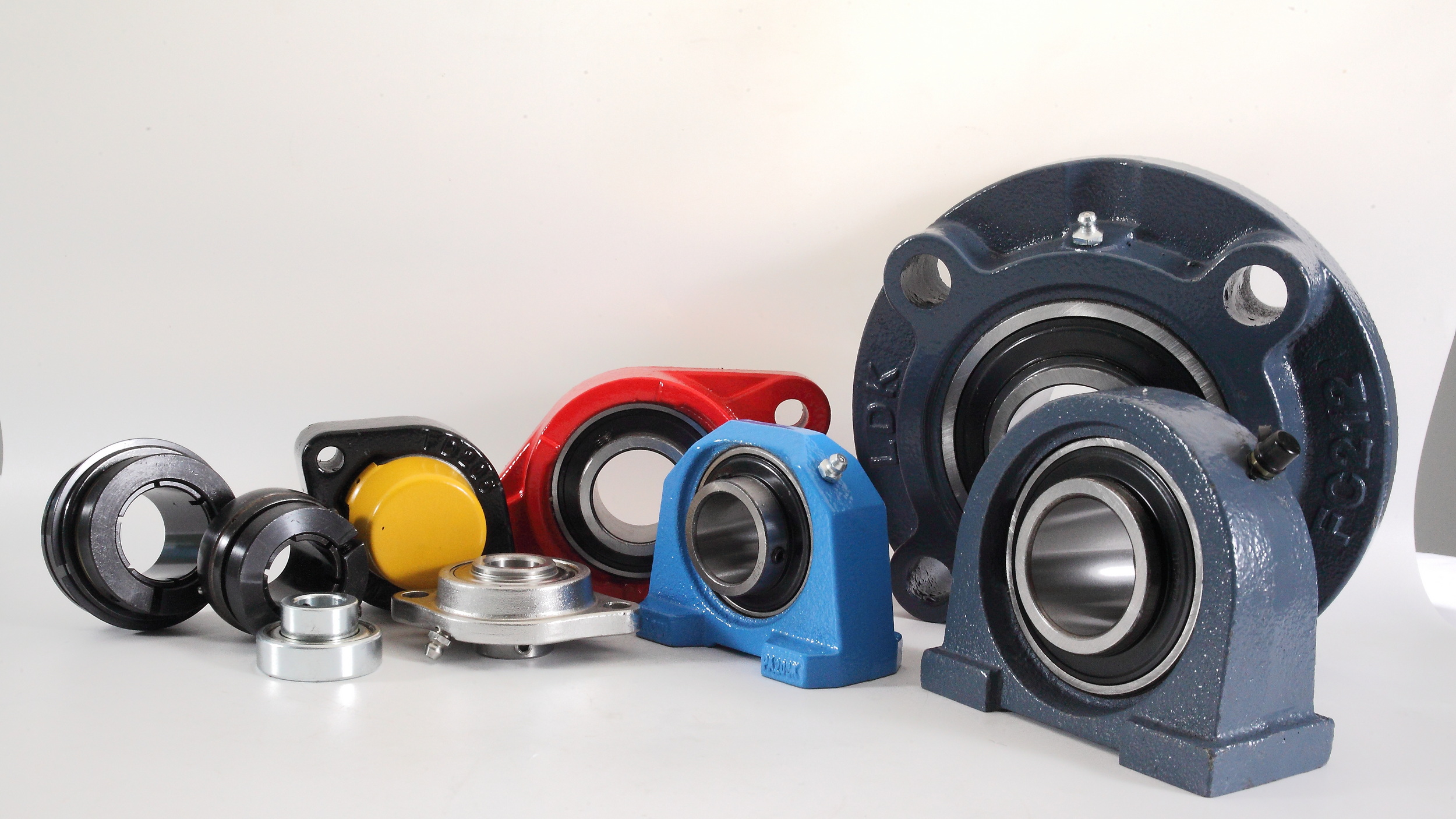
From parameters to production: OEM production capability covering rod ends and spherical plain bearings.
Next step: send your load direction, operating angle, environment and target bore to LDK for a parameter-matched shortlist, a validation sample, or a quotation. Product documentation is available in the LDK bearing brochure; the company website is www.ldk-bearings.com and technical enquiries can be sent to kzhang@ldk-bearings.com.
LDK (Deyuan Smart Technology (Fujian) Co., Ltd), established in 1986, manufactures pillow block bearings, rod end bearings and spherical plain bearings, exports to global markets, and supports OEM and ODM production with technical remote support.
Have Questions or Need More Details?
Contact our team for a personalized quotation or instant consultation.
Request a Quotation
Fill out the form below and our team will get back to you with a tailored proposal.
WhatsApp Direct Chat
Prefer to chat in real-time? Message us on WhatsApp for instant assistance & quick answers.
- Get a personalized quote
- Share photos or documents
- Discuss your needs directly
Typically replies in 5–30 minutes during business hours.