How to Evaluate Rod End & Spherical Plain Bearing Supplier Quality
How to Evaluate Rod End & Spherical Plain Bearing Supplier Quality: A Procurement Guide
Purchasing rod ends and spherical plain bearings is not a commodity transaction. When a single bearing failure can halt a production line, ground a vehicle, or compromise a solar tracking system, the supplier's quality becomes your most critical risk factor. This guide provides a structured framework for procurement professionals to assess whether a bearing supplier meets the rigorous demands of industrial applications.
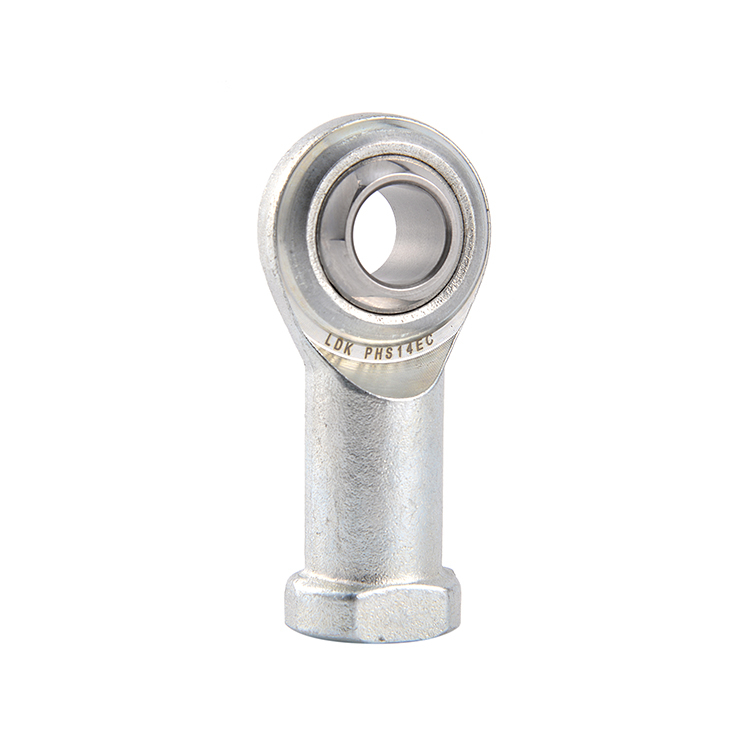
LDK's PHS..EC self-lubricating rod end bearings are designed for maintenance‑free operation in demanding environments.
The Hidden Cost of Substandard Bearings
Procurement managers often focus on unit price and delivery lead time, overlooking the true cost of poor quality. In the rod end and spherical plain bearing market, common issues include:
- Material substitution: Use of recycled or non‑conforming steel that fails under load.
- Inconsistent hardness: Balls not heat‑treated to the specified HRC range, causing rapid wear.
- Inadequate seals: Contamination ingress leading to premature seizure in dusty or wet environments.
- False certifications: Suppliers claiming IATF 16949 or RoHS compliance without actual system implementation.
These defects translate into unscheduled downtime, warranty claims, and even safety incidents. The question is: how do you separate a genuine quality partner from the rest?
Industry Context: Why Quality Differentiation Matters
Rod ends and spherical plain bearings are used in mission‑critical applications across agriculture, construction, automotive, solar energy, and industrial automation. For example:
- In heavy trucks, a single failed drag link bearing can cause steering failure.
- In solar trackers, bearings must withstand 25 years of outdoor exposure with zero maintenance.
- In food processing, lubrication leakage can contaminate products, violating FDA/HACCP requirements.
Suppliers like LDK (De Yuan Smart Technology (Fujian) Co., Ltd), established in 1986, have invested in full‑spectrum capabilities to address these challenges. Understanding what to look for in a supplier is the first step toward risk mitigation.
8 Critical Factors to Assess Supplier Quality
1. Certification & Compliance Infrastructure
Genuine quality management systems are verified by third‑party auditors. Look for:
| Certification | What It Guarantees | LDK Example |
|---|---|---|
| IATF 16949:2016 | Automotive‑grade quality system with defect prevention | Certified by BV, valid 2024–2027 |
| ISO 14001:2015 | Environmental management, conflict mineral compliance | Certified by CQM |
| ISO 45001:2018 | Occupational health and safety | Certified by CQM |
| RoHS & REACH | Restricted substance compliance for EU market | SGS verified reports (e.g., XMNEC25002178301) |
Always verify the certificate number with the issuing body. For example, LDK's IATF 16949 certificate number is traceable through BV.
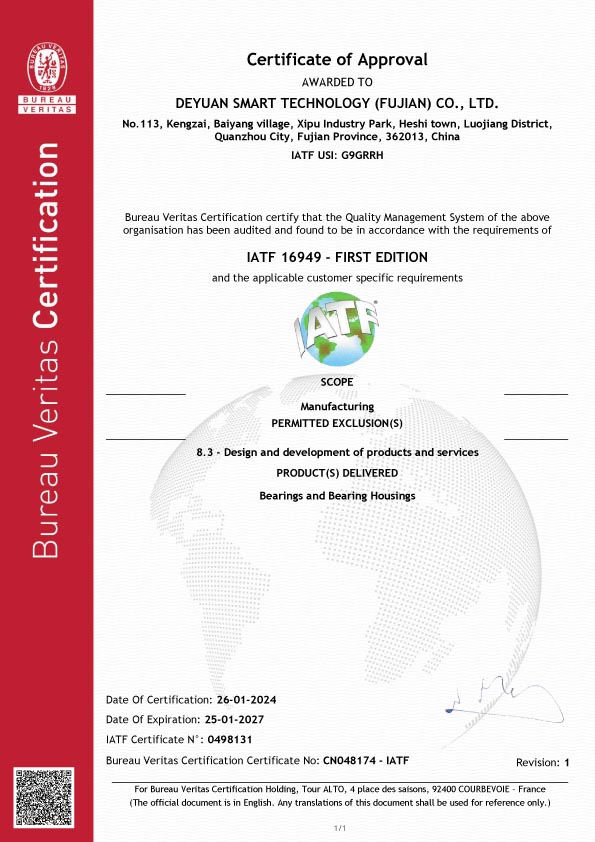
LDK holds IATF 16949:2016 certification, ensuring automotive‑grade quality processes.
2. Raw Material Sourcing & Traceability
High‑quality bearings begin with certified steel. Ask for:
- Mill test certificates (MTC) for each batch of bearing steel.
- Material analysis reports showing chemistry and cleanliness (e.g., vacuum‑degassed GCr15).
- Evidence of incoming inspection (chemical lab, hardness testing).
LDK operates a physical and chemical material analysis laboratory that inspects all incoming raw materials, sourcing only from China's leading specialty steel mills with IATF‑approved procedures.
3. In‑House Manufacturing vs. Outsourced Assembly
The industry average for outsourced processes in bearing production is over 70%, which introduces variability. A reliable supplier controls the entire chain: casting, forging, heat treatment, grinding, super‑finishing, assembly, and inspection.
LDK operates over 10 workshops on a 90,000 m² campus, including a vertical parting automatic molding line, heat treatment, grinding, and automatic assembly lines. This vertical integration reduces the first‑year structural failure rate to below 0.05% (industry average ~3.5%).
4. Testing & Validation Capability
Before a bearing reaches your assembly line, it should pass rigorous testing that simulates real‑world conditions. Essential test facilities include:
| Test Type | Purpose |
|---|---|
| Fatigue life | Validates service life under cyclic loading |
| Tensile strength | Ensures material meets design specs |
| Noise & vibration | Detects raceway defects, contamination |
| Salt spray | Corrosion resistance validation |
| High/low temperature | Performance in extreme environments |
LDK's specialized laboratories are equipped for all these tests, and they provide PPAP Level 3 documentation for new products.
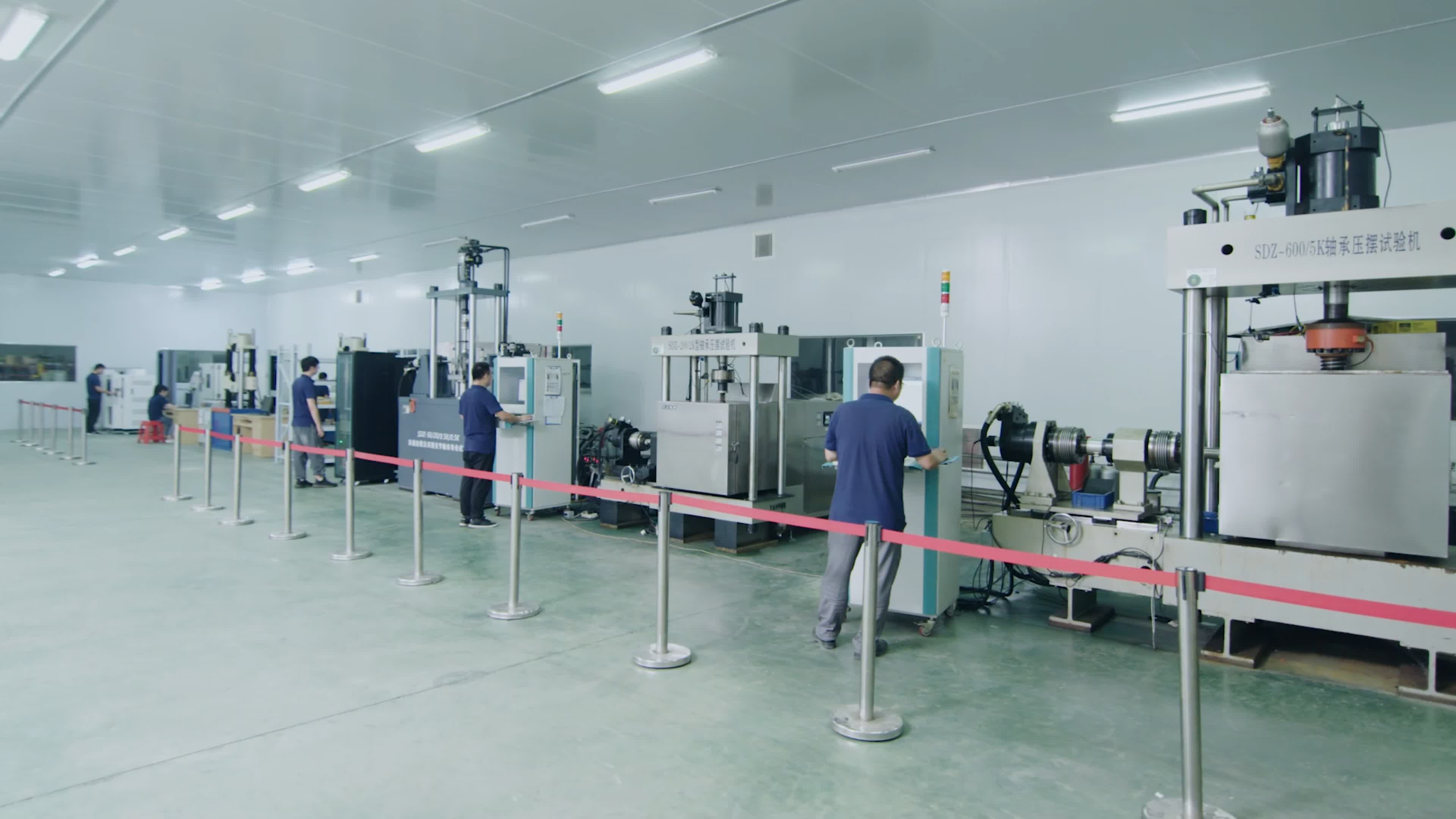
LDK's reliability testing room performs fatigue, tensile, and environmental tests to validate product performance.
5. Product Range & Customization Flexibility
A supplier that offers over 3,000 active SKUs across metric and inch sizes, with multiple material combinations (stainless steel, chromoly, PTFE‑lined, etc.), demonstrates deep engineering capability. For rod ends and spherical plain bearings, key parameters to look for include:
- Shaft diameters from 3 mm to 300 mm.
- Sliding contact surface options: Steel‑on‑steel (MoS₂ treated), Steel‑PTFE composite, Steel‑PTFE fabric, Steel‑Brass.
- Thread configurations: right‑hand, left‑hand, metric, inch, with various pitch accuracy.
- Special coatings: chrome plating, phosphate, zinc plating, black oxide.
LDK's catalog includes inch rod ends (JFX..T, JMX..T, CF..TY, etc.), metric rod ends (PHS, POS, CHS, COS, SI..ES, SA..ES), hydraulic rod ends (SK..ES, SF..ES, SIR..ES, SIQ..ES), and spherical plain bearings (GE..ES, GEG..ES, GAC..S, GX..S, COM..T).
6. Application Experience & Case References
Proven track records in your industry are invaluable. Request case studies that match your operating environment. For example:
- Heavy truck OEM (UK): LDK supplied SCHS rod ends for a pneumatic actuator in engine bays. The product survived 5 million cycles across -40°C to 300°C, with zero failures.
- Food processing OEM (UK): LDK's plastic bearing units with solid‑lube eliminated grease contamination, reducing equipment ownership cost by 30% while achieving FDA compliance.
- Offshore processing equipment (US): A patented coating provided 500 hours of salt spray resistance, outperforming stainless steel at lower cost.
- Cold storage (NZ): Customized bearing inserts with special grease operated reliably at -50°C.
7. Quality Control & Traceability Systems
Beyond final inspection, a robust QC system includes:
- Incoming quality control (IQC) with material certification verification.
- In‑process quality control (IPQC) with statistical process control (SPC).
- Outgoing quality control (OQC) with dimensional, hardness, and appearance checks.
- Full traceability via barcode/QR code linking each batch to production date, heat‑treatment record, and test results.
LDK implements IATF 16949‑compliant traceability and can provide PPAP Level 3 documentation upon request.
8. Supply Chain & Commercial Terms
Quality also means reliability of supply. Evaluate:
- MOQ flexibility: Can they accommodate low‑volume prototypes as well as high‑volume production? LDK supports MOQ as low as 1 piece for long‑tail items, with mixed container shipments.
- Lead time: Typical lead time 30–90 days, with rush options.
- Payment terms: Usance L/C or O/A 30–60 days for qualified accounts (via SINOSURE credit insurance).
- Delivery incoterms: FOB, CIF, DDP, DDU, and VMI support.
Step‑by‑Step Supplier Evaluation Checklist
- Request certificates – IATF 16949, ISO 14001, ISO 45001, RoHS report. Verify authenticity.
- Audit manufacturing capabilities – Ask for a virtual or on‑site tour of foundry, heat treatment, grinding, and assembly.
- Review material certifications – Ask for MTCs for the specific steel grades used in your product.
- Evaluate testing labs – Confirm they can perform fatigue, salt spray, and noise testing in‑house.
- Request application case studies – Look for experience in your industry (agriculture, automotive, solar, etc.).
- Check product range – Does the supplier offer the exact type of rod end or spherical plain bearing you need (metric/inch, maintenance‑free or re‑greasable, steel‑on‑steel or PTFE)?
- Assess lead time and MOQ – Ensure they can meet your demand without minimum order constraints.
- Ask about traceability – Can they provide batch numbers and production records for every shipment?
Case Study: LDK's Hydraulic Rod Ends for Heavy Trucks
A leading heavy truck OEM in the UK needed rod ends for a pneumatic actuator in engine bays. The environment was extreme: -40°C to +300°C, road salt, vibration. After testing, LDK's SCHS stainless steel rod ends were selected. The product achieved 5 million cycles without failure and passed 1000‑hour salt spray testing. The customer reduced warranty claims by 70% compared to the previous supplier.
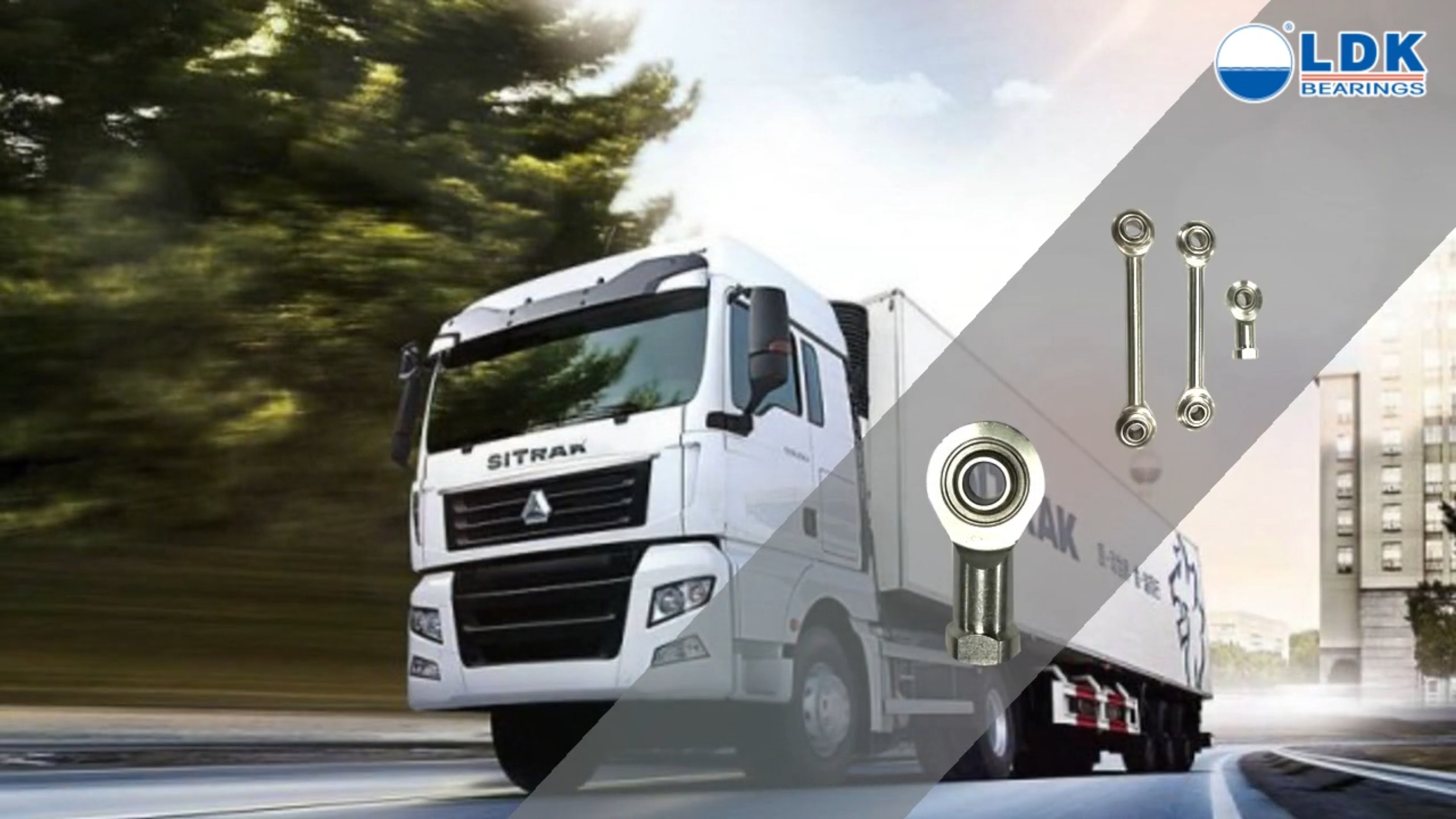
LDK rod ends and linkages are engineered for the harsh conditions of heavy truck applications.
Frequently Asked Questions
Q1: How can I verify that a supplier's IATF 16949 certificate is valid?
Check the certificate number with the certification body (e.g., BV, SGS, CQM). Ensure the scope covers your product type. LDK's certificate number is IATF 16949 – FIRST EDITION, issued by BV.
Q2: What is the difference between steel‑on‑steel and PTFE‑lined spherical plain bearings?
Steel‑on‑steel (e.g., GE..ES series) requires periodic regreasing and handles high dynamic loads. PTFE‑lined (e.g., GE..ET‑2RS) is maintenance‑free and suitable for low‑speed oscillating applications where relubrication is impossible.
Q3: Can LDK provide custom rod ends with left‑hand thread?
Yes. All LDK rod end series (metric and inch) can be manufactured with left‑hand thread and different pitch or accuracy upon request.
Q4: What is the typical lead time for a large order of rod ends?
Standard lead time is 30–90 days depending on quantity and customization. Rush orders can be expedited.
Q5: How does LDK ensure corrosion resistance for outdoor applications like solar trackers?
LDK offers stainless steel versions (e.g., SCHS, SCOS, SPOS..EC) with turned surface SUS304 bodies and 440 stainless steel balls. They also provide chrome plating and phosphate coating as standard options. Products are tested via salt spray to confirm performance.
Conclusion
Evaluating a rod end and spherical plain bearing supplier requires looking beyond the price list. By focusing on certification, material traceability, in‑house manufacturing, testing capability, application experience, and supply chain reliability, you can identify a partner that delivers consistent quality. LDK, with over three decades of experience, IATF 16949 certification, 90,000 m² facilities, and a portfolio of 3,000+ SKUs, demonstrates the hallmarks of a trustworthy supplier.
Download the LDK corporate brochure for a complete overview of capabilities, product range, and quality certifications. For inquiries, contact kzhang@ldk-bearings.com or visit www.ldk-bearings.com.
LDK – DE YUAN SMART TECHNOLOGY (FUJIAN) CO., LTD
Xi Pu Industry Park, He Shi, Luo Jiang, Quanzhou City, Fujian Province, P.R. China (Zip: 362013)
Tel: +86 592-5807618
Email: kzhang@ldk-bearings.com
Web: www.ldk-bearings.com
Have Questions or Need More Details?
Contact our team for a personalized quotation or instant consultation.
Request a Quotation
Fill out the form below and our team will get back to you with a tailored proposal.
WhatsApp Direct Chat
Prefer to chat in real-time? Message us on WhatsApp for instant assistance & quick answers.
- Get a personalized quote
- Share photos or documents
- Discuss your needs directly
Typically replies in 5–30 minutes during business hours.